White or Black T-shirt for Printing: Which Looks Better
We compare how a white or black T-shirt affects print colours, costs and wash durability, with guide prices and recommendations by printing technique.
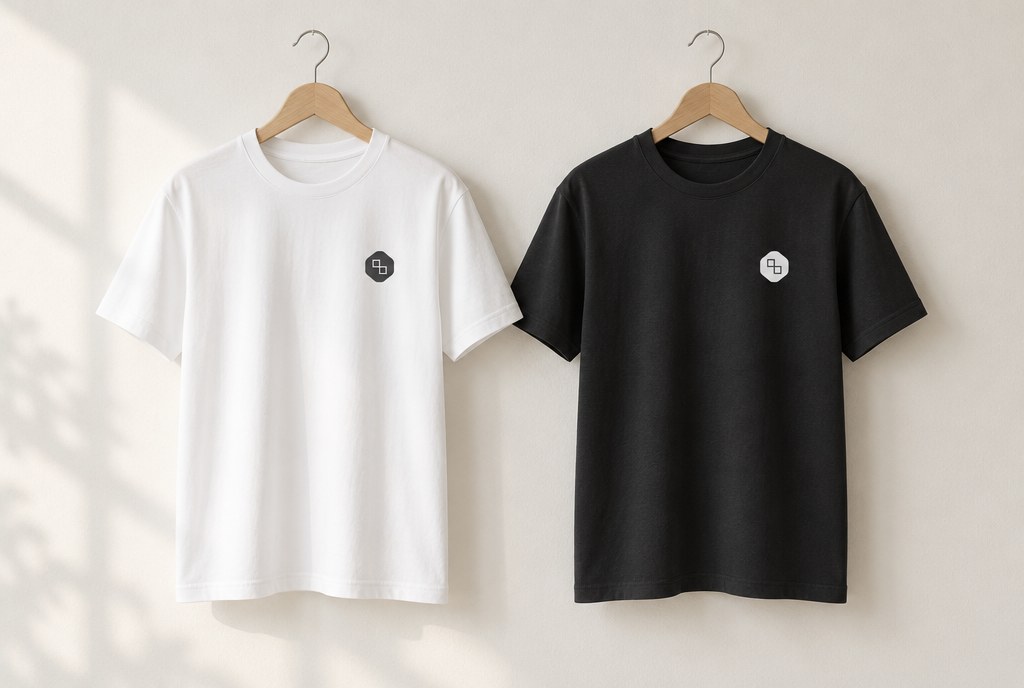
White or black T-shirt – the choice affects not only the look but also the printing technique and price: on a white T-shirt the design is printed without a white base layer, so in screen printing it's usually 0.30–0.80 EUR/pc cheaper, whereas on a black T-shirt every colour needs an underbase, which adds one extra printing pass. Visually, a black T-shirt gives greater contrast to bright and white colours, while a white T-shirt reproduces fine lines, halftones and photographs more accurately. In practice, we recommend choosing colour based on the design: if your logo is dark or multicoloured with fine details – go for a white T-shirt; if your logo is white, yellow or neon – go for black.
How T-shirt colour changes the print result
On white fabric, ink or paint sits on a light base, so colours come out close to what you see on screen and in a CMYK artwork file. Dark tones, grey gradients and thin 0.3–0.5 mm lines can be printed without loss.
On black fabric, any colour without a white underbase would turn translucent and dirty-dark. That's why a white base is applied beneath the design – in screen printing as a separate screen pass, while in DTF transfer it's built into the film process. The result is vibrant, but printing on a black T-shirt always feels slightly "thicker" to the touch, and halftones (e.g. 5–15% raster) may clog or look coarse.
When a black T-shirt works better
- A single-colour white or light logo – maximum contrast, looks sharp for an event or team even in the evening and in photos.
- Neon and saturated colours (yellow, orange, light blue) look more expressive on a black background.
- Practical settings: kitchen, bar, construction, concert staff – stains are less visible.
When a white T-shirt works better
- Photographs, gradients, watercolour effects, multicolour illustrations.
- Fine text (under 6 pt), thin outlines, QR codes – nothing "blurs" on a white base.
- Sublimation: full-colour sublimation is technically only possible on white or very light polyester.
- Summer events, school and children's projects, a light overall visual style.
Comparison table
| Criterion | White T-shirt | Black T-shirt |
|---|---|---|
| Colour reproduction | Close to artwork, precise CMYK tones | Vibrant, but slightly "denser", dark tones lose nuance |
| White underbase | Not needed | Mandatory (extra screen pass) |
| Fine detail | Very good | Line thickness should be increased to at least 0.5 mm |
| Sublimation | Possible | Not possible |
| Embroidery | Good, but light thread "disappears" | Very good, contrasting threads |
| Visibility of stains | High | Low (but lint and salt stains are visible) |
| Durability after washing | Fabric slightly yellows | Fabric may fade to greyish after 20–30 washes |
| Guide T-shirt price | from 4 EUR | from 4.50 EUR |
Prices are indicative, excl. VAT; the final price depends on the model, fabric weight, quantity and printing method.
Price difference by technique
Screen printing becomes cost-effective from 30–50 pcs, and the number of colours directly determines the price. On a black T-shirt, the white underbase is effectively one extra colour, so one colour on black costs roughly the same as two colours on white. The setup fee (screen preparation) is charged per colour, including the underbase.
| Printing technique | White T-shirt (approx.) | Black T-shirt (approx.) |
|---|---|---|
| Screen printing, 1 colour, 100 pcs | from 1.20 EUR/pc | from 1.70 EUR/pc |
| Screen printing, 3 colours, 100 pcs | from 2.40 EUR/pc | from 2.90 EUR/pc |
| DTF transfer A5, 1–10 pcs | from 6 EUR/pc | from 6 EUR/pc |
| DTF transfer A4, 50 pcs | from 4 EUR/pc | from 4 EUR/pc |
| Embroidery up to 90×90 mm, 20 pcs | from 5 EUR/pc | from 5 EUR/pc |
With DTF transfer, T-shirt colour doesn't affect the price – the white layer is included in the process. That's why for small quantities (1–30 pcs), a black T-shirt with DTF doesn't cost more than white, and it's the most common choice for company orders of 5–20 shirts. For more on techniques and fabrics, see our garment printing section.
The importance of fabric and model
A black T-shirt requires a denser fabric: at 140–150 g/m², the fabric is translucent and the white base may absorb unevenly. We recommend 180–200 g/m² cotton – the result is smoother and the print more durable. For white T-shirts, 150–160 g/m² is usually enough.
Polyester content also matters. On black and navy polyester or blend fabrics, dye migration can occur – after heat pressing, the white print may turn grey or pinkish within a few weeks. In such cases we use a blocking underbase or recommend switching models. For T-shirts, hoodies and sweatshirts from our T-shirts and hoodies sections, we always let you know which model in a given colour prints more reliably.
Standard print placements and sizes
Regardless of colour, we work with the following sizes:
- Left chest: 110×90 mm
- Front or back: up to 280×210 mm
- Sleeve: 80×60 mm
- Embroidery: up to 90×90 mm
On a black T-shirt, we recommend choosing a slightly larger logo – contrast makes the design look "smaller" than on a white background. Conversely, on a white T-shirt, a large dark area can look heavy, so an outline-based design often works better.
How to prepare the file
You'll need vector graphics (.ai, .eps, .pdf, .svg), CMYK, 300 dpi for raster images. For a black T-shirt, specify separately which parts of the design should remain "transparent" – sometimes a plain black background looks better than a printed black area. If the logo is dark and the T-shirt is black, we prepare an alternative version in white or in one additional colour, and send the artwork for approval by e-mail before production. Real examples on light and dark fabrics can be seen in our work.
Timelines: garment printing with our in-stock models typically takes 6–10 business days (production 4–7 business days + delivery 2–3 days); urgent jobs by arrangement.
Frequently asked questions
Does printing on a black T-shirt cost more?
In screen printing, yes – the white underbase is an extra colour pass, which at 100 pcs adds roughly 0.30–0.80 EUR/pc, plus a setup fee for the additional screen. With DTF transfer, the price is the same for both white and black T-shirts.
Can you print a photograph on a black T-shirt?
Yes, with DTF transfer, and the result is vibrant. However, light skin tones and fine gradients look more contrasty on a black background than in the original; if the photograph is the main element, a white or light grey T-shirt will give a more accurate result.
Which T-shirt holds its appearance better after washing?
Black fabric tends to fade to greyish after 20–30 washes at 40°C, while white fabric tends to yellow. In both cases, the print lasts better when washed at 30–40°C, inside out, without a tumble dryer.
Will a white logo on a black T-shirt really look white?
Yes, if you use a dense fabric and the right underbase. On thin black polyester, dye migration is possible, so for such models we use a blocking underbase or recommend a denser cotton T-shirt.
Which colour is better suited for embroidery?
Embroidery works equally well on both, but a black background gives a stronger contrast. On a white T-shirt, avoid very light threads – the logo blends in with the fabric.
How many pieces can I order?
We also work with a single piece (DTF or sublimation). Screen printing becomes cost-effective from 30–50 pcs, and at larger quantities the price per piece drops significantly.
Send us your logo and preferred model at info@attaprint.lv, call or write on WhatsApp +371 25776699 – within one business day we'll prepare a quote with prices for both colour versions and a recommendation on which will look best for your design.
FAQ
Does printing on a black T-shirt cost more?
In screen printing, yes – the white underbase is an extra colour pass, which at 100 pcs adds roughly 0.30–0.80 EUR/pc, plus a setup fee for the additional screen. With DTF transfer, the price is the same for both white and black T-shirts.
Can you print a photograph on a black T-shirt?
Yes, with DTF transfer, and the result is vibrant. However, light skin tones and fine gradients look more contrasty on a black background than in the original; if the photograph is the main element, a white or light grey T-shirt will give a more accurate result.
Which T-shirt holds its appearance better after washing?
Black fabric tends to fade to greyish after 20–30 washes at 40°C, while white fabric tends to yellow. In both cases, the print lasts better when washed at 30–40°C, inside out, without a tumble dryer.
Will a white logo on a black T-shirt really look white?
Yes, if you use a dense fabric and the right underbase. On thin black polyester, dye migration is possible, so for such models we use a blocking underbase or recommend a denser cotton T-shirt.
Which colour is better suited for embroidery?
Embroidery works equally well on both, but a black background gives a stronger contrast. On a white T-shirt, avoid very light threads – the logo blends in with the fabric.
How many pieces can I order?
We also work with a single piece (DTF or sublimation). Screen printing becomes cost-effective from 30–50 pcs, and at larger quantities the price per piece drops significantly.