High-Visibility Safety Vests with Logo Printing: Classes, Colours and Logo Placement
A guide to safety vests with logo printing: EN ISO 20471 classes, fluorescent colours, logo sizes and placement, printing methods, prices from EUR 2.90/pc.
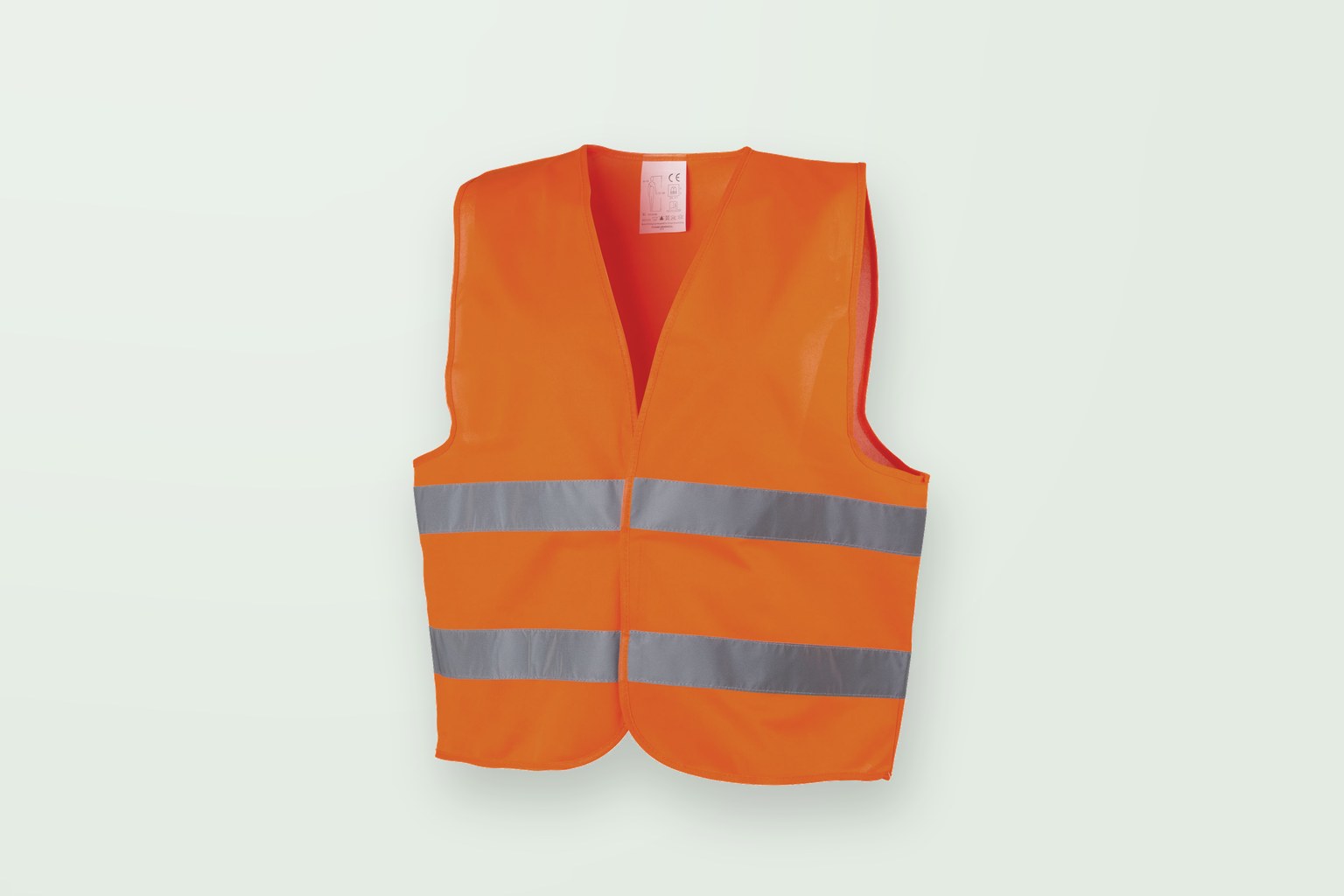
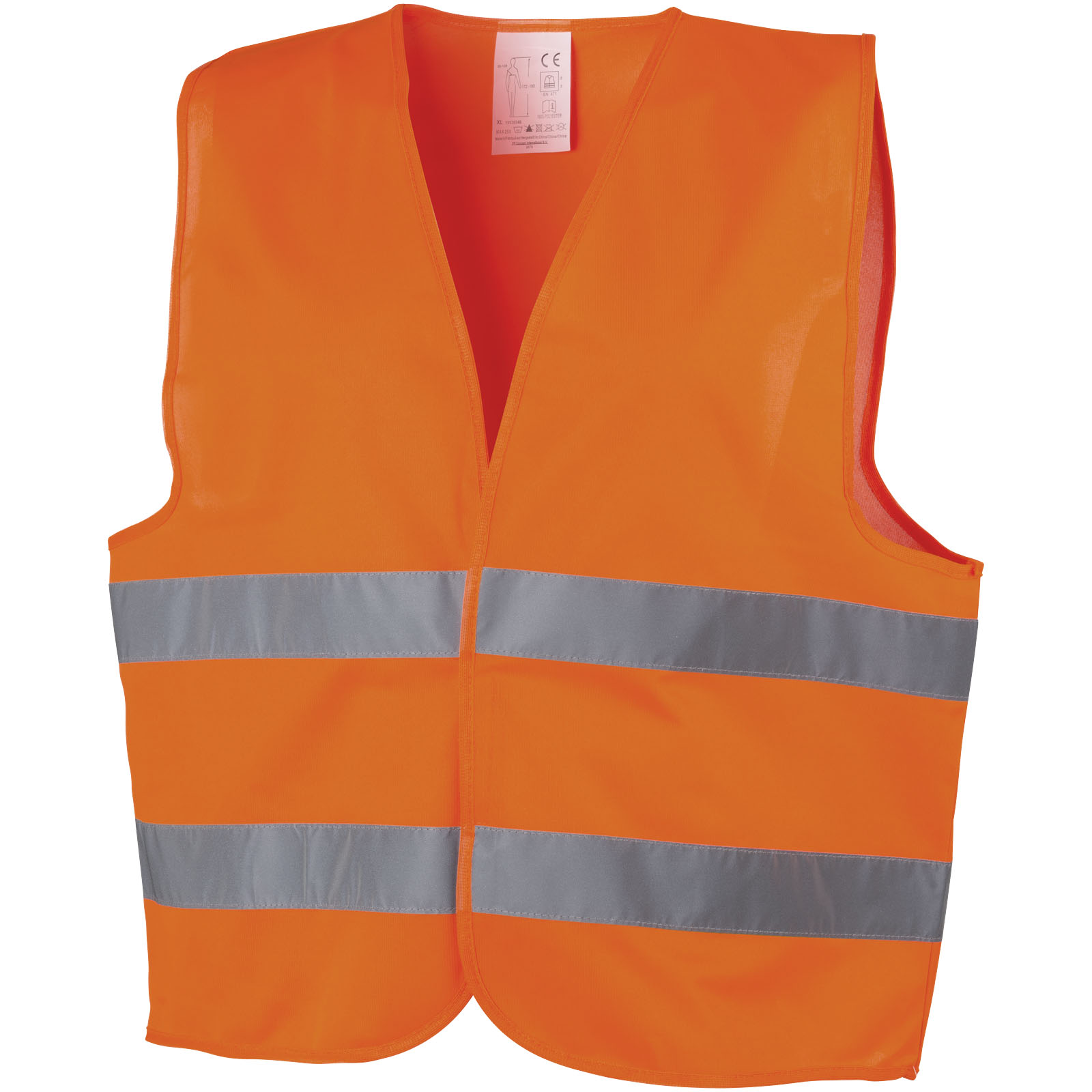
Safety vests with logo printing are one of the cheapest ways to meet workplace safety requirements and display your company name at the same time: in our catalogue, a standard vest starts from EUR 2.90/pc at 100 pieces, while printing setup (screen/file preparation) is charged once per colour. The key rule to know as a buyer: the printing must not cover the reflective tape and must not excessively reduce the area of fluorescent material — that's why a logo on a vest is usually 100–200 mm wide and placed between or above the tapes. Prices are excl. VAT and are indicative.
Classes under EN ISO 20471
High-visibility clothing in Latvia follows the EN ISO 20471 standard. The class is determined by the area of fluorescent (background) material and reflective material on the smallest size of a single garment.
| Class | Fluorescent material | Reflective material | Typical use |
|---|---|---|---|
| Class 1 | ~0.14 m² | ~0.10 m² | Warehouses, areas without traffic, event staff |
| Class 2 | ~0.50 m² | ~0.13 m² | Standard vests: construction sites, service staff, logistics |
| Class 3 | ~0.80 m² | ~0.20 m² | Roadworks, high speed, poor visibility (usually a jacket or vest with sleeves) |
Most classic "yellow" vests are Class 2. If the work takes place on public roads or at night, Class 3 garments are required — this usually can't be achieved with a single sleeveless vest.
Colours: why only yellow, orange or red
The standard allows three fluorescent base colours: fluorescent yellow, fluorescent orange-red and fluorescent red. Blue, black or green vests can be used as identification vests (e.g. for event organisers), but they are not high-visibility clothing in the standard's sense.
In practice, the choice is simple:
- Yellow — better visibility in daylight and green surroundings, more commonly used in construction and logistics.
- Orange — traditional for roadworks, stands out better against green and yellow backgrounds.
- Coloured (non-HV) vests — for events, teams, volunteers, where legal requirements don't apply.
How printing affects compliance
The manufacturer's certification applies to the vest as produced. Once a logo is added, the product is modified, so a few principles should be followed to maintain visibility:
- Never print on the reflective tape. Screen printing, heat transfer and DTF film settle on the tape and make it non-reflective. We will technically decline such artwork.
- Don't cover more fluorescent material than necessary. One logo on the chest and one larger one on the back of a Class 2 vest usually leaves enough margin; a large, dense area covering the full width of the back can reduce the fluorescent area below the class threshold.
- Use contrasting, dark colours. Black, dark blue or dark green on yellow or orange reads well and doesn't blend with the fluorescent tone.
- Don't print near the reflective strip. Keep at least 10–15 mm from the edge of the tape so the print doesn't curl at the edge.
- Keep in mind: the vest is a personal protective equipment item.
If the vest is personal protective equipment with formal requirements, we recommend approving the artwork with your company's health and safety officer before a large print run — we prepare the artwork with precise dimensions and clearances so it can be reviewed.
Logo placement and sizes on the vest
A vest is a small area divided by tapes, so printing zones are smaller than on a T-shirt.
| Location | Recommended size | Notes |
|---|---|---|
| Chest, left side | 110 × 90 mm | Standard logo position, above the lower tape |
| Back, upper area | 200 × 100 mm | Between the shoulder and the first tape; name + phone |
| Back, area between tapes | 250 × 80 mm | Single line of text, legible from a distance |
| Pocket/side area | 80 × 60 mm | Only for vests with pockets |
| Embroidery | up to 90 × 90 mm | Only for vests with suitable, dense fabric |
The minimum letter height legible from 10 m is approximately 40 mm — so on the back it's better to have one name in a large size rather than name, phone, email and website in small print.
Screen printing, DTF or embroidery
- Screen printing — cost-effective from 50–100 pcs, 1–2 colours, low unit cost, good wash durability.
- DTF transfer — suitable for small runs (from 1 pc) and multi-colour logos; the transfer is a film, so we keep the area compact.
- Embroidery — looks solid, but isn't always suitable for the thin polyester fabric of a vest; on some vests we can do it in a fixed location.
More on the technologies — garment printing section.
Examples from our catalogue
A few examples from our catalogue:
- RFX™ See-me XL safety vest for professional use – classic professional vest, 2 colours, screen printing, DTF transfer or embroidery in a fixed location, from EUR 3.15/pc at 1 pc and from EUR 3.03/pc at 100 pcs.
- RFX™ Watch-out XL safety vest in a pouch – vest with a storage pouch for a car or toolbag, 2 colours, from EUR 3.02/pc at 1 pc and from EUR 2.90/pc at 100 pcs.
- RFX™ Desiree reflective safety vest with straps – strap-type vest for cyclists and delivery staff, 1 colour, screen printing or heat transfer, from EUR 17.64/pc at 1 pc and from EUR 16.47/pc at 100 pcs.
- RFX™ Marie XS safety vest with hook-and-loop fastening for children 7–12 years – for schools and camps, 1 colour, from EUR 3.95/pc at 1 pc and from EUR 3.80/pc at 100 pcs.
- RFX™ Odile XXS safety vest for children 3–6 years – for kindergartens, with hook-and-loop fastening, from EUR 4.22/pc at 1 pc and from EUR 4.05/pc at 100 pcs.
- RFX™ Mats 38 cm reflective TPU safety band – complement to vests, pad printing, from EUR 2.79/pc at 1 pc and from EUR 2.69/pc at 100 pcs.
- RFX™ Johan 38 cm reflective PVC safety band – cheaper band for large runs, from EUR 1.70/pc at 1 pc and from EUR 1.64/pc at 100 pcs.
Timelines and how ordering works
Add items to a request on our website, or email us the quantity, colour and logo file. Within one business day we send a quote online and as a PDF with product images, prices, print location, setup fee and lead time for each item; on request we prepare a 3D preview with your logo. Vests with printing are usually ready in 6–10 business days (production 4–7 business days depending on quantity + delivery 2–3 days); urgent jobs by arrangement.
We need files in vector format (.ai, .eps, .pdf, .svg), CMYK; raster images at 300 dpi. The artwork is approved by email before production.
FAQ
Does printing void the vest's compliance with EN ISO 20471?
The manufacturer's certification applies to the unprinted product. A small chest logo and a moderate area on the back don't critically reduce visibility, but large, dense printing or printing on the reflective tape affects compliance. We never print on the reflective tape and indicate the printed area dimensions on the artwork so your health and safety officer can assess them.
How large can a logo be on the back of a vest?
The practical guideline is up to 250 × 100 mm between the reflective tapes or 200 × 100 mm at the top of the back. Larger areas are technically possible, but then you need to assess how much fluorescent material remains uncovered.
Which printing method is more cost-effective — screen printing or DTF transfer?
Up to roughly 30–50 pieces or for multi-colour logos, DTF transfer is more cost-effective. From 50–100 pieces with 1–2 colours, screen printing is cheaper, as the setup is charged once and the price per piece drops.
Can I order just one or two vests with a logo?
Yes, we also work with 1 piece. In that case, the printing setup fee makes up most of the cost, so the price per piece is significantly higher than at 50 or 100 pieces.
What colour should the logo be on a yellow or orange vest?
Black, dark blue or dark green read best. White and light grey printing lose contrast on fluorescent yellow, while red on an orange vest is practically illegible.
How long do I need to wait for vests with printing?
Usually 6–10 business days: production 4–7 business days depending on quantity and printing method, plus delivery 2–3 days. Urgent jobs are possible by arrangement.