Eco-friendly Promotional Products: What RCS, GRS, FSC, and OEKO-TEX Mean
An explanation and glossary of RCS, GRS, FSC, and OEKO-TEX certifications in promotional products: what each one confirms, how to verify it, and what logo printing costs.
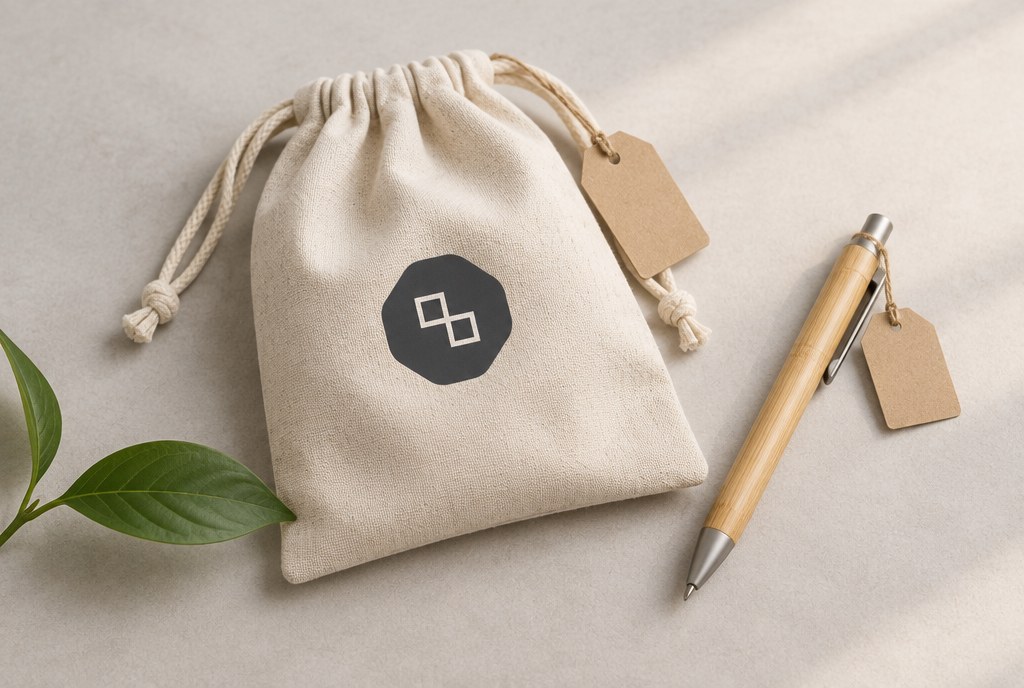
In practice, eco-friendly promotional products mean an item with a verifiable certificate, not just the word "eco" printed on the packaging. The four most common labels in our catalogue are RCS (traceability of recycled material, from 5% content), GRS (recycled material plus environmental and social requirements at the production site, at least 50% for labelling), FSC (responsibly managed forests for paper and wood), and OEKO-TEX STANDARD 100 (textiles tested for harmful substances). The standard lead time for such products with printing is 5–10 business days, with indicative prices starting from around EUR 0.60 per pen and EUR 2.50 per recycled cotton bag (excl. VAT, depending on quantity).
Why a certificate, not just the word "eco"
Words like "natural", "green", or "eco-friendly" aren't legally defined — they can be printed on any product. A certificate, on the other hand, means an independent third party has verified the supply chain and issued a document with a number that can be requested.
Public sector, school, and larger company procurements increasingly ask for a specific certificate code or declaration. If you'll need this, mention it at the time of your request — preparing documentation for certain items takes a few extra days.
RCS — Recycled Claim Standard
RCS traces the path of recycled material from raw input to finished product. An item can qualify for RCS if it contains at least 5% recycled material, while the "RCS 100" label requires 95–100%.
It's important to understand what RCS doesn't verify: it sets no requirements for chemical use, water consumption, or working conditions at the factory. It's purely a traceability standard. Most commonly seen on RPET textile bags, jackets, and accessories.
GRS — Global Recycled Standard
GRS is a stricter version of RCS. In addition to tracing recycled content, it includes requirements for chemical use, wastewater, workplace safety, and social conditions at the production site. A product must contain at least 20% recycled material, but to carry the GRS label on the product itself, at least 50% is required.
In practice, you'll most often see GRS on RPET bottles and thermal mug sleeves, backpacks, T-shirts, and sweatshirts made from a recycled cotton-polyester blend.
FSC — forest and paper
FSC (Forest Stewardship Council) applies to wood and paper. It confirms that the raw material comes from a responsibly managed forest or recycled fibres. In promotional products, FSC is usually seen on notebooks, calendars, wooden and bamboo pens, wooden keyrings, and cardboard packaging.
FSC certification also applies to many printing papers, so we can use it not only for merchandise but also for leaflets, catalogues, and business cards. If your project requires FSC paper, specify this in your order — some paper grades need to be ordered separately, which extends the lead time by 2–3 business days.
OEKO-TEX STANDARD 100
This is a textile safety standard: a fabric sample is tested for over 1,000 harmful substances — azo dyes, formaldehyde, heavy metals, pesticides. It says nothing about recycled content or carbon footprint, but it's important if shirts, towels, or bags are going to children or will be in prolonged contact with skin.
For school and sports club orders, OEKO-TEX combined with water-based screen printing inks is a sensible pairing.
Glossary: comparing the four standards
| Standard | What it confirms | Minimum content | Typical products |
|---|---|---|---|
| RCS | Traceability of recycled material | 5% (95%+ for labelling) | RPET bags, accessories |
| GRS | Recycled content + chemicals, environment, working conditions | 20% (50% for labelling) | Bottles, backpacks, T-shirts, sweatshirts |
| FSC | Responsible forest management | Depends on label type | Notebooks, wooden pens, paper, packaging |
| OEKO-TEX STANDARD 100 | Textiles free of harmful substances | No content requirement | T-shirts, towels, cotton bags, caps |
What to choose from our catalogue
Our promotional products catalogue includes the following certified product groups:
- RPET water bottles 500–750 ml, body made from recycled plastic material — bottles.
- Stainless steel thermal mugs and flasks 350–1000 ml with a partially recycled steel body; logo printing via laser engraving or single-colour print.
- Cotton and jute bags 140–320 g/m², OEKO-TEX or GRS recycled cotton — tote bags.
- A5 and A6 notebooks with FSC paper and a recycled cardboard cover.
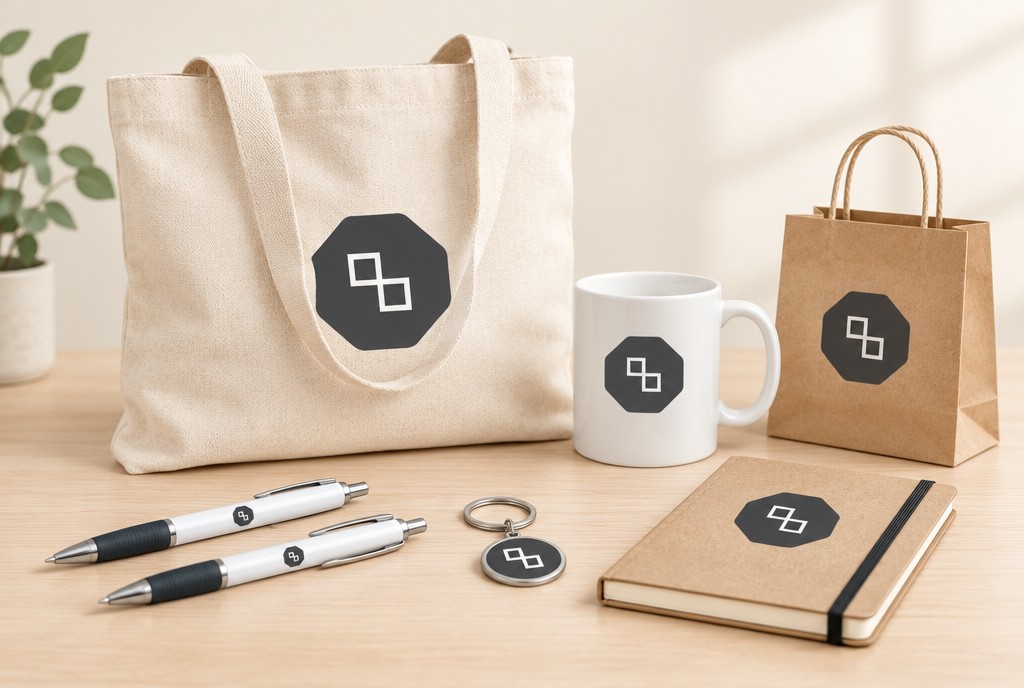
- Pens made from bamboo, recycled paper, or recycled plastic; printed in 1–2 colours or engraved.
- T-shirts and sweatshirts made from organic or recycled cotton, 160–300 g/m²; DTF, screen printing, or embroidery.
- Towels and caps made from OEKO-TEX cotton with embroidery.
- Umbrellas and tech gifts with RPET fabric or recycled plastic housing.
Printing: what affects the "green" result
A certified product with poor printing loses its point. Water-based screen printing inks or DTF suit recycled textiles; for wood and metal items, laser engraving requires no ink at all. UV printing or screen printing works well on RPET bottles.
A second practical step: reduce packaging. Often 200 mugs can be delivered in bulk packaging rather than individually boxed.
Indicative prices and lead times
| Product | Quantity | Indicative price per pc (excl. VAT) | Lead time |
|---|---|---|---|
| Bamboo/recycled paper pen, 1 colour | 250 | from EUR 0.60 | 5–8 business days |
| Recycled cotton bag 180 g/m², 1 colour | 100 | from EUR 2.50 | 7–10 business days |
| RPET bottle 600 ml, 1 colour | 100 | from EUR 4.00 | 7–10 business days |
| FSC notebook A5 | 100 | from EUR 2.00 | 5–8 business days |
| Thermal flask 500 ml, engraved | 50 | from EUR 12.00 | 7–10 business days |
| Organic cotton T-shirt, DTF A4 | 50 | from EUR 9.50 | 5–7 business days |
Prices are indicative; the exact amount depends on quantity, number of print colours, and print locations. At larger quantities, the price drops noticeably — for example, the difference between 250 and 1000 pens is typically 25–35%.
Frequently asked questions
Are certified products always more expensive?
Usually yes, but the difference isn't large: 10–25% for textiles, 5–15% for paper products. For some RPET products, the price is already comparable to standard versions, as production volumes have grown.
How can I verify that a certificate is genuine?
Every GRS, RCS, and FSC certificate has a licence number that can be checked in the relevant public database. We can include this number in the quote or delivery note if you need it for procurement documentation.
Can I order just one piece as a sample?
Yes, we also work with single-piece orders. For a printed sample, allow 5–7 business days and expect a higher unit price, as setup costs are spread over just one item.
What files are needed for logo printing?
Vector graphics in .ai, .eps, or .pdf format, with colours specified in CMYK or Pantone codes. If you only have a JPG, we can redraw the logo in vector format for an additional fee.
Can you print on certified products the client brings themselves?
Yes, provided the material suits the chosen printing technology. Before running the full batch, we prepare a test print on a single piece, as recycled fabrics absorb ink differently than new fibres.
If you know the quantity and budget, send your logo and an approximate deadline to info@attaprint.lv, call +371 25776699, or message us on WhatsApp — project manager Madara will respond with catalogue items and certification details. We prepare quotes within one business day.
FAQ
Are certified products always more expensive?
Usually yes, but the difference isn't large: 10–25% for textiles, 5–15% for paper products. For some RPET products, the price is already comparable to standard versions, as production volumes have grown.
How can I verify that a certificate is genuine?
Every GRS, RCS, and FSC certificate has a licence number that can be checked in the relevant public database. We can include this number in the quote or delivery note if you need it for procurement documentation.
Can I order just one piece as a sample?
Yes, we also work with single-piece orders. For a printed sample, allow 3–5 business days and expect a higher unit price, as setup costs are spread over just one item.
What files are needed for logo printing?
Vector graphics in .ai, .eps, or .pdf format, with colours specified in CMYK or Pantone codes. If you only have a JPG, we can redraw the logo in vector format for an additional fee.
Can you print on certified products the client brings themselves?
Yes, provided the material suits the chosen printing technology. Before the full batch, we run a test print on a single piece, as recycled fabrics absorb ink differently than new fibres.