Sticker Materials: Paper, PP Film, Vinyl, Transparent
A practical guide to choosing a sticker material based on surface and environment: paper, PP film, vinyl, transparent and metallic, with a price comparison.
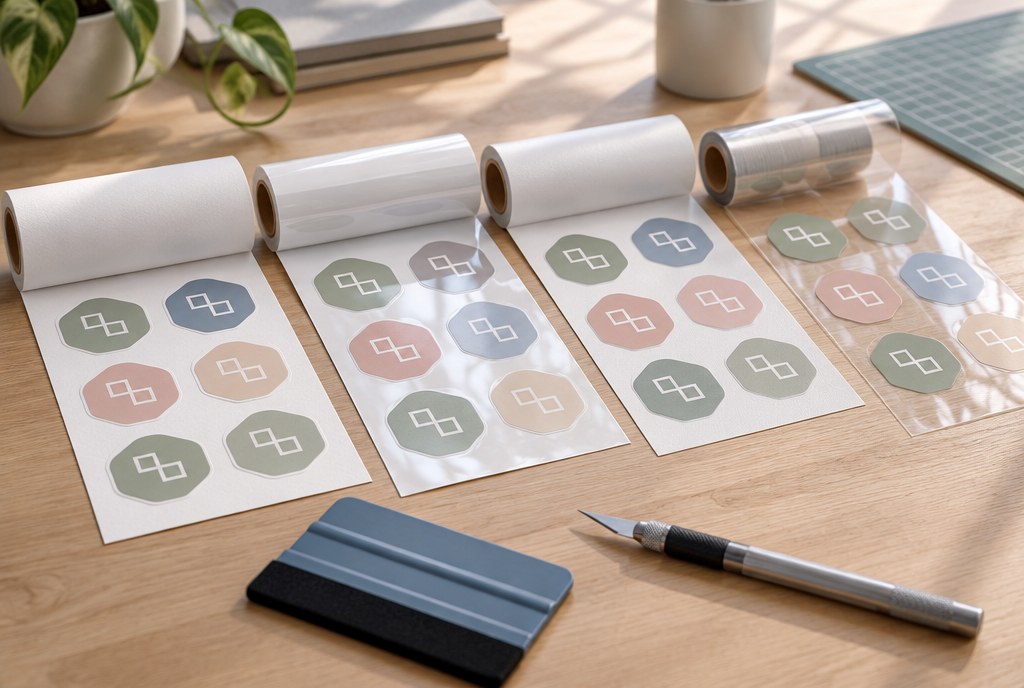
Sticker materials fall into four main groups in practice: paper (the cheapest, for dry environments), PP film (moisture-resistant, for everyday product labels), vinyl (durable against outdoor conditions and mechanical wear) and transparent or metallic film (design solutions for glass and smooth surfaces). The price difference between paper and vinyl at the same print run is usually 1.8–2.5 times, so it's worth starting your material choice with one question: where will the sticker be applied, and how long does it need to last? Set-up costs and contour cutting are charged separately, and from a quantity of 500 pcs, the material's effect on the unit price drops sharply.
How to choose: three questions before ordering
Before choosing a material, answer three things. First — the surface: cardboard, a PET bottle, glass, metal, wood, textile packaging or an uneven film. Second — the environment: a dry warehouse, a fridge, contact with water, grease, alcohol, or outdoor conditions. Third — the service life: a few days for an event, or a year on a product.
A paper sticker on a glass jar kept in the fridge turns wavy and dirty within a week. The same label on PP film still looks the same as on day one. On the other hand, vinyl on a cardboard box is an overspend — paper performs identically there for half the price.
Material comparison
| Material | Best for | Moisture / outdoor use | Price factor (paper = 1.0) |
|---|---|---|---|
| Paper (matte, gloss) | Cardboard packaging, envelopes, ingredient and barcode labels, internal marking | Not moisture-resistant | 1.0 |
| PP film (white, matte/gloss) | Product labels, cosmetics, food, bottles, jars | Resistant to water and condensation | 1.3–1.6 |
| Vinyl | Outdoor signs, vehicles, equipment, floor and tool marking | Outdoor use 2–5 years | 1.8–2.5 |
| Transparent film | Glass, touch-sensitive design, "no-label" effect | Moisture-resistant | 1.4–1.8 |
| Metallic (silver, gold) | Premium labels, serial numbers, warranty stickers | Moisture-resistant | 1.7–2.2 |
The factors are indicative and calculated for the same format and quantity, excl. VAT. The exact price depends on size, quantity, colour coverage, format (sheets or rolls) and the complexity of contour cutting.
Paper
Paper stickers are a logical choice when the sticker stays in a dry environment: logistics marking, ingredient and translation labels on cardboard boxes, price tags, seal stickers for bags and gift wrapping. Matte paper takes pen writing well — important if staff need to note a batch number or date directly on the sticker.
PP film
PP film is the most commonly used material for product labels. It's waterproof, withstands condensation and light rubbing, and keeps its shape on round bottles and jars. For food and cosmetics manufacturers, it's the standard, because the label survives transport, the shop shelf and the consumer's kitchen.
Vinyl
Vinyl is thicker and more flexible, so it also sticks to slightly uneven surfaces and withstands UV exposure. We use it for door stickers, production equipment marking, car stickers and anything that stays outdoors. If the sticker will be in the sun for longer than a year, we recommend laminated vinyl.
Transparent and metallic
Transparent film creates the effect that only the print appears on the glass, with no background. Keep in mind that white ink in digital printing on transparent film isn't available in every case — a light design on a dark background can look dull, so for dark products we more often suggest white PP with a transparent edge, or printing with a white base layer. Metallic film works well for small premium labels and warranty stickers.
Sheets or roll, and contour cutting
Sheets (A4 or larger) are convenient for small and medium runs when stickers are applied by hand. Rolls are needed if you use a label applicator or apply large volumes on a conveyor — in that case you need to specify the roll core diameter and sticker sequence.
Contour cutting lets you cut any shape, not just a rectangle. A complex shape takes longer to cut, so it noticeably affects the price on small runs; at 1000 pcs the difference is already down to cents. For more on formats and production, see our stickers section, and for larger formats — large-format printing.
Files and timelines
Send your artwork as vector graphics (.ai, .eps, .pdf, .svg) in CMYK colour space; raster images at 300 dpi. For contour cutting, include a separate cutting line. If you don't have a design, we can prepare one based on your text and logo.
Sticker printing at our facility on Kandavas iela 29A, Riga, takes 1–3 business days depending on quantity and finishing; urgent jobs by arrangement. If stickers are ordered together with promotional products, the overall lead time is usually 6–10 business days.
Frequently asked questions
Which material is suitable for food product labels?
In practically all cases, PP film, as it withstands condensation, cold and light moisture. Paper is only suitable for dry cardboard packaging, such as tea or biscuit boxes.
Will the stickers withstand outdoor conditions?
Vinyl stickers last approximately 2–5 years outdoors, longer with lamination. Paper and PP stickers aren't designed for outdoor use: paper deteriorates within days, and PP fades under UV exposure.
How much does the material affect the price?
At the same print run, PP film is roughly 1.3–1.6 times more expensive than paper, and vinyl 1.8–2.5 times. At quantities from 500–1000 pcs, the unit price drops, and the difference between materials in actual money becomes smaller.
Can white be printed on transparent film?
Not always, and not at every size — it depends on the printing technology. If white elements on a dark surface are important to your design, we recommend printing on white film or using a solution with a white base layer; we specify this clearly in the quote.
Can I order a small quantity, for example 50 stickers?
Yes, we also work with small quantities, even from 1 pc. For small runs, the unit price is mainly determined by set-up and cutting costs rather than the material.
How do I know whether I need sheets or rolls?
If you're applying stickers by hand — sheets. If you use a label applicator or the volume is in the thousands — rolls; in that case you need to specify the core diameter and sticker layout on the roll.
Send us the sticker size, approximate quantity, and details about the surface at info@attaprint.lv, call +371 25776699, or message us on WhatsApp at the same number — contacts here. We prepare a quote with material options, price and lead time within one business day.
FAQ
Which material is suitable for food product labels?
In practically all cases, PP film, as it withstands condensation, cold and light moisture. Paper is only suitable for dry cardboard packaging, such as tea or biscuit boxes.
Will the stickers withstand outdoor conditions?
Vinyl stickers last approximately 2–5 years outdoors, longer with lamination. Paper and PP stickers aren't designed for outdoor use: paper deteriorates within days, and PP fades under UV exposure.
How much does the material affect the price?
At the same print run, PP film is roughly 1.3–1.6 times more expensive than paper, and vinyl 1.8–2.5 times. At quantities from 500–1000 pcs, the unit price drops and the difference between materials in actual money becomes smaller. Prices are indicative, excl. VAT.
Can white be printed on transparent film?
Not always, and not at every size — it depends on the printing technology. If white elements on a dark surface are important to your design, we recommend white film or a solution with a white base layer; we specify this clearly in the quote.
Can I order a small quantity, for example 50 stickers?
Yes, we also work with small quantities, even from 1 pc. For small runs, the unit price is mainly determined by set-up and cutting costs rather than the material.
How do I know whether I need sheets or rolls?
If you're applying stickers by hand — sheets. If you use a label applicator or the volume is in the thousands — rolls; in that case you need to specify the core diameter and sticker layout on the roll.