Construction Company Workwear with Logo, Equipment Stickers and Banners
An industry guide for construction companies: how to print logos on workwear, label equipment with stickers and decorate your site with banners. Approximate prices and turnaround times.
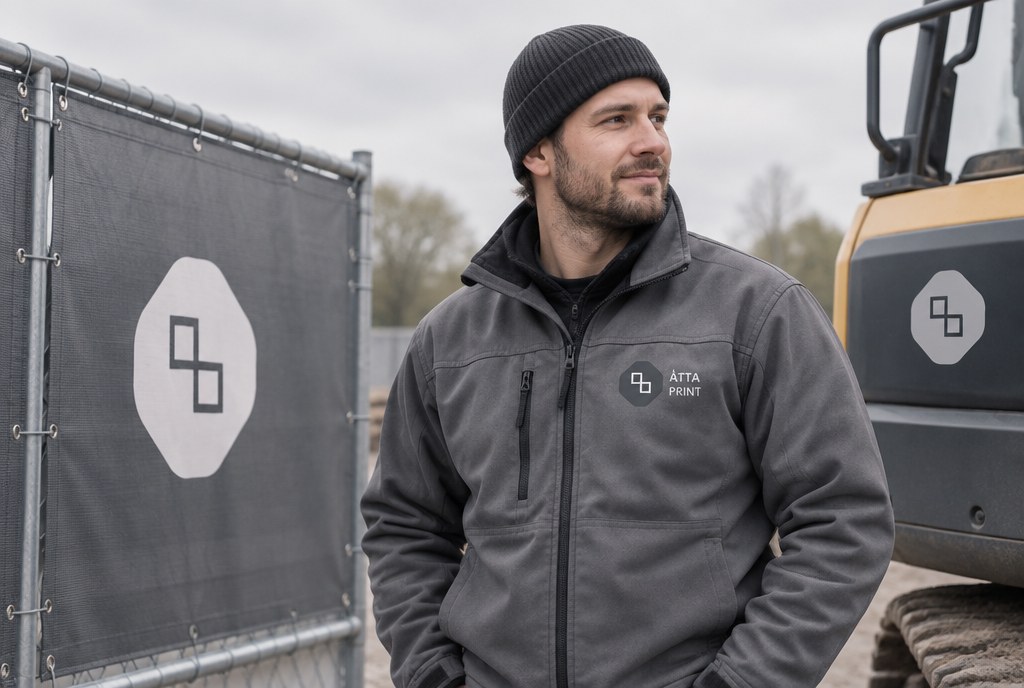
Workwear with a logo, equipment stickers and a site banner are the three things that, in practice, mark the start of brand recognition for any construction company — and together they cost less than people usually assume. As a guideline: a T-shirt with a DTF logo from EUR 9 per piece, a softshell jacket with embroidery from EUR 38, a laminated sticker for equipment from EUR 3, and a PVC fence banner at roughly EUR 14–15 per square metre (prices excl. VAT, depending on quantity and the number of print areas). Standard production time is 2–10 business days after artwork approval; urgent jobs by arrangement.
Minimum promotional set for a construction company
If a company is just starting to build a consistent visual identity, four items are usually enough in practice. They cover the site, meetings with clients, and the crew's everyday work:
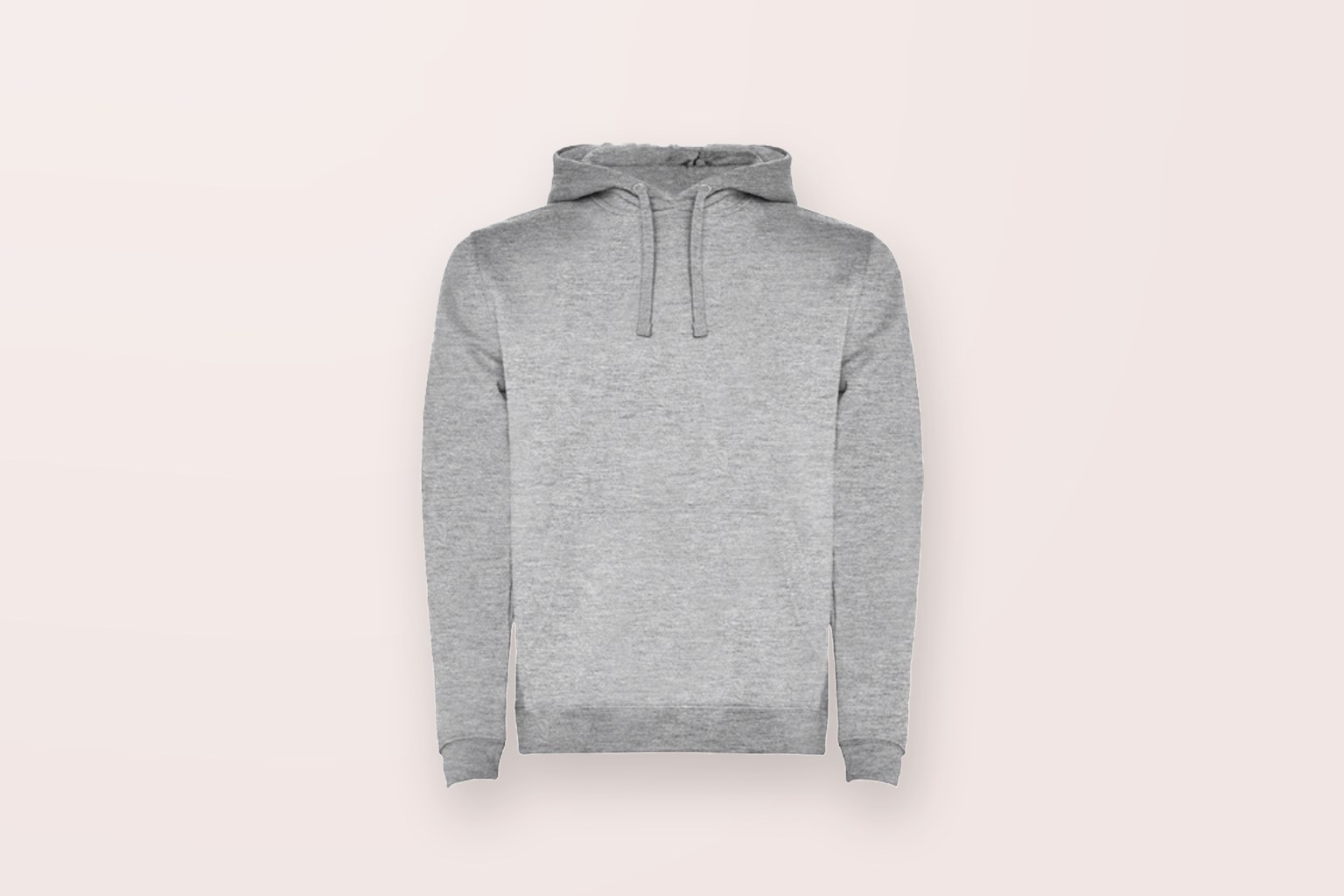
- Workwear with a logo — hi-vis vests, T-shirts, hoodies or softshell jackets for the crew and site manager.
- Stickers for vehicles and equipment — logo and phone number on vans, trailers, generators, tool boxes.
- Banner on the construction fence — 2x1 m or 3x1 m with logo, type of activity and contact details.
- Roll-up banner stand and business cards — for procurement meetings, site handovers and negotiations.
The overall starting budget for a 20-person crew usually falls within EUR 700–1500, depending on the quality class of the clothing.
Workwear with a logo: which technology to choose
In construction, clothing is washed often and intensively, so choosing the right printing method matters more than, say, for event T-shirts.
Embroidery
The most durable solution for thicker fabrics — softshell jackets, winter jackets, hoodies, caps, polo shirts. A logo up to 8 cm wide on the left chest is the standard choice, costing roughly EUR 4–6 per location depending on the number of stitches. Embroidery withstands hundreds of washes and doesn't get damaged by rough fabric surfaces. For more on options, see the clothing printing page.
Screen printing
The most cost-effective option starting from 30–50 units of the same design. Well suited to large back prints — company name and website at 25–30 cm width. At 100 T-shirts, screen printing cost for one colour in one location drops below EUR 2 per piece.
DTF
The best option for small orders and multi-colour logos — we work even with a single piece. DTF suits T-shirts, hoodies and hi-vis vests, and withstands washing at 40–60 °C. If you need 5 shirts for new employees, DTF is the logical choice; for 150, screen printing wins.
About hi-vis clothing
When printing on EN ISO 20471 hi-vis clothing, the print area must be planned so it doesn't reduce the area of the background material or reflective tape — in practice, we place the logo on the chest above the pocket and on the back between the tapes. If the vest needs to retain its certification, we discuss sizing and placement before the order.
Stickers for vehicles, equipment and tools
Stickers are the cheapest advertising per square metre, and they work for a construction company every single day. We use matte or gloss self-adhesive vinyl with lamination that withstands UV exposure, high-pressure washing and temperature fluctuations. For outdoor surfaces we recommend laminated film — without lamination, colours visibly fade in Latvian conditions after 1.5–2 years, while with lamination they last 4–5 years.
Most common orders:
- a contour-cut logo on a van door, 40–60 cm wide;
- a phone number and website on the rear door, letter height 8–10 cm so it's readable from 20 m;
- small 5x3 cm stickers for tool inventory and numbering;
- stickers for generators, containers, scaffolding elements and trailers.
Contour cutting allows the logo to be cut to shape, without a rectangular background. See sticker types and materials on the stickers page.
Banners for the site: fence, scaffolding, roll-up
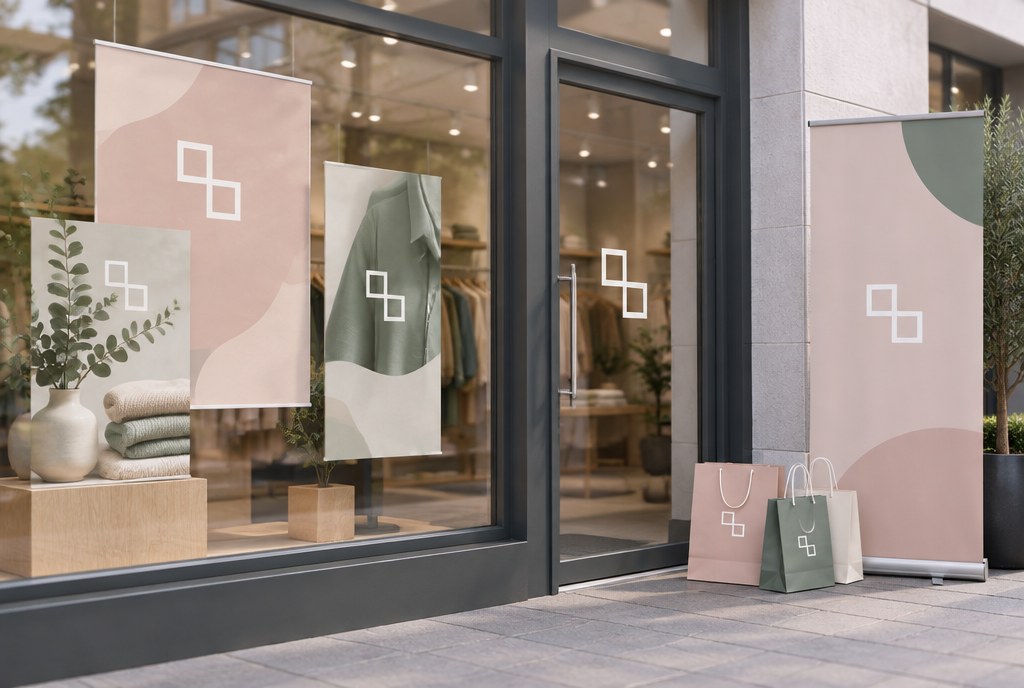
A construction fence banner is a must-have if the site is located near a busy street. The standard material is 440–510 g/m² PVC with metal eyelets every 50 cm; for wind-exposed locations, air vents or perforated mesh material are additionally recommended.
Common sizes: 2x1 m for small crew sites, 3x1 m or 4x1.5 m for larger sites, 6x3 m for multi-storey buildings on scaffolding. A simple layout works best — logo, one sentence about the type of activity, phone number and website. More text than that is no longer readable from 15 m away.
An 85x200 cm roll-up banner stand is used for procurement presentations, workplace safety training and industry exhibitions; the stand is reusable, with only the print cassette needing replacement. See formats and prices on the banners page.
Approximate prices and quantities
| Item | Printing | Approx., excl. VAT |
|---|---|---|
| T-shirt | DTF, 1 location, from 1 pc | from EUR 9/pc |
| T-shirt, 100 pcs | Screen printing, 1 colour, 1 location | from EUR 7/pc |
| Hoodie / sweatshirt | Embroidery on chest | from EUR 25/pc |
| Softshell jacket | Embroidery, 2 locations | from EUR 38/pc |
| Hi-vis vest | DTF or screen printing | from EUR 8/pc |
| Cap | Embroidery | from EUR 8/pc |
| Contour-cut sticker, A5 | Laminated vinyl, 50 pcs | from EUR 3/pc |
| Vehicle set (2 sides + rear) | Laminated vinyl | from EUR 120 |
| PVC banner 440 g, with eyelets | Full-colour print | approx. EUR 14–15/m² |
| Roll-up banner stand 85x200 cm | With cassette and bag | from EUR 85 |
| Business cards, 500 pcs | Double-sided print, 350 g | from EUR 35 |
Prices are indicative. The exact amount depends on quantity, number of print locations, number of colours and the specific clothing model from our catalogue. In larger quantities, the unit price drops significantly — between 20 and 200 shirts, the difference is typically 30–40%.
Files, turnaround times and workflow
The logo should preferably be submitted as vector graphics — .ai, .eps or .pdf, with colours in CMYK or specified Pantone values. If only a JPG or PNG from the website is available, it usually needs to be redrawn for embroidery and contour cutting; this is doable but requires 1–2 extra business days.
Typical workflow: request → quote within one business day → layout visualisation for approval → production. Turnaround times: stickers and business cards 2–5 business days, banners and posters 2–5 business days, clothing printing 5–10 business days after artwork approval, depending on technology and stock availability. See the full range of services on the printing services page.
Practical tip: order clothing with a 10–15% reserve in the most commonly used sizes (L, XL, XXL). Onboarding a new employee later with a single piece ends up costing more than ordering a slightly larger batch upfront.
Frequently asked questions
How long does a logo on workwear last?
Embroidery barely wears out at all — it outlasts the garment itself. DTF and screen printing, when washed correctly (40°C, no bleach, no ironing directly on the print), withstand 50–80 washes, which, given the intensity of construction work, means 1.5–2 seasons.
Can you print on our own clothing that we've already purchased?
Yes, we also print on clothing supplied by the client. In this case, we agree on the fabric composition and colour beforehand, as synthetic and membrane materials require a different printing mode. For certain materials, we ask for a single sample for testing.
What is the minimum order?
We work even with a single piece — for shirts, stickers and banners alike. For screen printing, an economically reasonable minimum is around 30 pieces per design; below that, DTF is more cost-effective.
How long do stickers last on outdoor equipment?
Laminated vinyl on a smooth, degreased surface lasts 4–5 years. On rough, rusting or textured powder-coated surfaces, the lifespan is shorter, so in such cases it's often more effective to use a small printed PVC plate instead.
Can you make banners with site information and the client's logo?
Yes, we regularly produce informational site banners with the details required by the building authority, along with the logos of the client, designer and construction supervisor. Just send us the text and logo files; we prepare and agree on the layout before printing.
When should an order be planned before the start of the season?
April and May see the highest volume of clothing orders, so it's advisable to order the crew set 2–3 weeks before the required date, to leave room for size top-ups.
Send your clothing list with sizes, logo file and site banner dimensions to info@attaprint.lv — we'll prepare a quote within one business day. Call or message us on WhatsApp at +371 25776699 if it's easier to discuss everything directly; project manager Madara will help you choose the right technology and materials.
FAQ
How long does a logo on workwear last?
Embroidery barely wears out at all and outlasts the garment itself. DTF and screen printing, when washed correctly (40°C, no bleach, no ironing directly on the print), withstand 50–80 washes, which, given the intensity of construction work, means 1.5–2 seasons.
Can you print on our own clothing that we've already purchased?
Yes, we also print on clothing supplied by the client. We agree on the fabric composition and colour beforehand, as synthetic and membrane materials require a different printing mode. For certain materials, we ask for a single sample for testing.
What is the minimum order?
We work even with a single piece — for shirts, stickers and banners alike. For screen printing, an economically reasonable minimum is around 30 pieces per design; below that, DTF is more cost-effective.
How long do stickers last on outdoor equipment?
Laminated vinyl on a smooth, degreased surface lasts 4–5 years. On rough, rusting or textured surfaces, the lifespan is shorter, so it's often more effective to use a small printed PVC plate instead.
Can you make banners with site information and the client's logo?
Yes, we regularly produce informational site banners with the details required by the building authority, along with the logos of the client, designer and construction supervisor. Just send us the text and logo files; we agree on the layout before printing.
When should an order be planned before the start of the season?
April and May see the highest volume of clothing orders, so it's advisable to order the crew set 2–3 weeks before the required date, to leave room for size top-ups.