Printed Flags: Sizes, Materials and Prices 2026
How much printed flags cost, which polyester materials are used, popular sizes, mounting options and realistic production times in Riga.
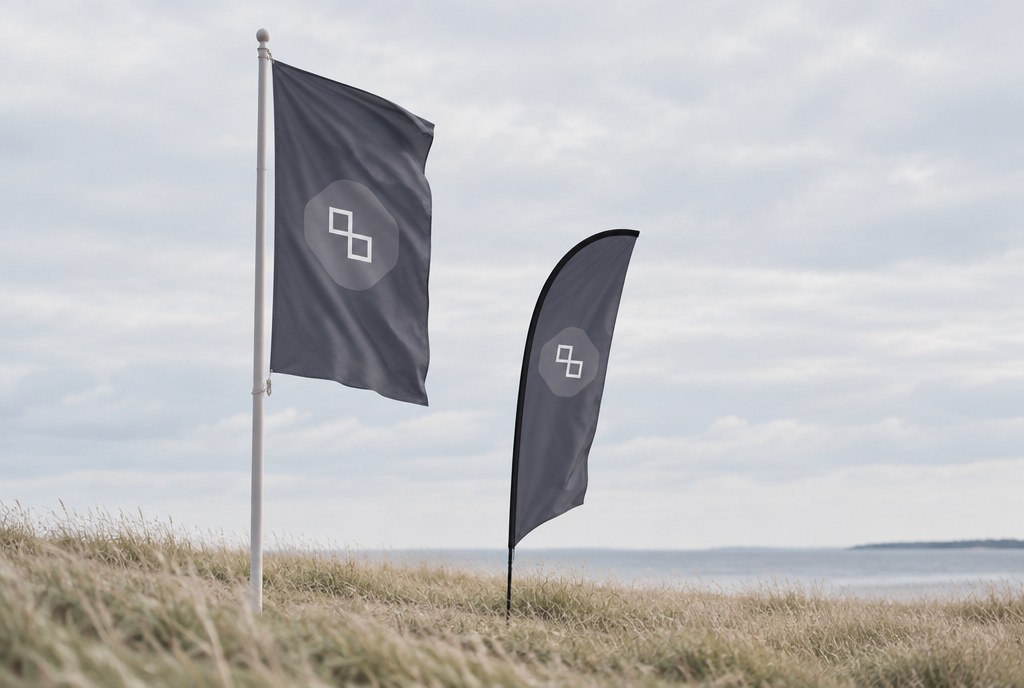
Printed flags on the Latvian market in 2026 cost from around 55 EUR for a standard 90x150 cm flagpole flag, from 80 EUR for 100x200 cm, and from 160 EUR for 150x300 cm (prices excl. VAT, single-sided sublimation printing on 110 g/m² polyester). A feather flag set complete with pole and base starts from around 175 EUR, while table flags start from 9 EUR per piece. Production time is usually 5–10 business days depending on size and quantity; urgent orders are arranged individually.
Approximate prices by size
The prices below are approximate, excl. VAT, for single-sided full-colour printing. The exact price depends on quantity, material weight, mounting type and whether double-sided printing is needed.
| Product | Size | Approximate price (excl. VAT) |
|---|---|---|
| Hand flag on a stick | 15x22 cm | from 3.50 EUR/pc (from 50 pcs) |
| Table flag with stand | 10x15 cm | from 9.00 EUR/pc |
| Flagpole flag | 90x150 cm | from 55.00 EUR |
| Flagpole flag | 100x200 cm | from 80.00 EUR |
| Flagpole flag | 150x300 cm | from 160.00 EUR |
| "Feather" flag with pole and base | 70x250 cm | from 185.00 EUR |
| "Teardrop" flag with pole and base | 70x200 cm | from 175.00 EUR |
| Façade flag with sleeve | 100x300 cm | from 125.00 EUR |
If you order 5 or more identical flags, the price per piece drops by around 10–20%, since artwork preparation and sewing setup happen in one go. We also work with single units — that's a normal order, for example for a club or a local council event.
Materials: which polyester suits which purpose
- Flag polyester 110 g/m² — the standard choice for flagpole and façade flags. Lightweight, moves well in the wind, and sublimation printing penetrates the fibre so the colour doesn't peel and the fabric stays soft.
- Denser polyester 115–130 g/m² — for flags that hang permanently on a building and need to withstand wind and rain throughout the season.
- Mesh polyester — for feather/teardrop flags and large-format flags in open areas; it lets some wind through, putting less strain on the pole.
- Blockout fabric — for double-sided flags, where an opaque middle layer is inserted between two printed layers so the sides don't show through each other.
Sublimation printing is washable at 30 degrees and barely loses colour in the sun over one season. For heavily used outdoor flags, the realistic lifespan is 1–3 seasons, depending on location and wind exposure.
Sizes and mounting
Flag proportions are chosen according to the pole and installation location. Vertical façade flags most often use 100x300 cm or 120x400 cm; horizontal ones use 90x150 cm and 100x200 cm.
Mounting options:
- sewn sleeve for a pole (3, 4 or 5 cm wide);
- reinforced edge with metal grommets every 50–60 cm;
- rope with carabiners for flagpole flags;
- plastic stick for hand flags;
- flexible pole with a cross or water-fillable base for feather/teardrop flags.
All edges are finished with a double seam, with extra reinforcement at the corners and sleeve — that's where flags tend to tear first.
Single-sided or double-sided printing
With single-sided printing, the design appears mirrored on the reverse side. If the logo contains text that needs to be readable from both sides, you'll need a double-sided version, which costs around 60–80% more, since two fabrics are printed and a middle layer is sewn in. In practice, sports clubs and events are fine with single-sided printing, while local councils and retail locations usually choose double-sided flags for entrances.
If the goal is a large advertising surface on a building or fence, a PVC banner is often cheaper and more durable — see comparison and prices in the banners and roll-up stands section.
Files and artwork preparation
Flags require vector graphics (.ai, .eps, .pdf) in CMYK colour space, with text converted to curves. We also accept large-format files at 1:10 scale. For raster images, the minimum resolution is 100–150 dpi at actual size — this looks clean from a distance.
It's important to leave 3–5 cm of extra space for the sleeve or edge seam, so the logo isn't lost under the mounting. We also prepare a digital proof for approval before printing; the artwork is free of charge. You can view the rest of our printed products and prices in the catalogue section.
Timeframes and quantities
The standard turnaround is 5–10 business days from artwork approval. Hand flags in large quantities (from 500 pcs) usually take 7–10 business days, a single flagpole flag — 5–7 business days. Feather/teardrop flag sets take 7–10 business days, depending on stand availability.
With larger quantities, the price drops in several tiers, just like with the rest of our products: for example, screen printing on T-shirts starts from 3.50 EUR/pc, but from 250 pcs it's already from 1.50 EUR/pc. The same principle applies to flags — the setup cost is spread across the whole print run.
An event package around flags
If the flags are intended for sports competitions or a supporters' zone, we often add other items from our catalogue to the same order: bright face-painting flags (5 colours, digitally printed, with a sticker or pad printing) and sunglasses (5 colours, digital printing or pad printing). For a wider selection of logo-printed items, see the promotional products section.
Frequently asked questions
How much does one printed flag cost?
A single 90x150 cm flagpole flag with single-sided full-colour printing costs from around 55 EUR excl. VAT, and a 100x200 cm one from 80 EUR. The price depends on size, material weight and mounting type; artwork preparation is free of charge.
Do you make a single flag?
Yes. Sublimation printing doesn't require costly setup, so a single piece is a realistic order. From 5 pieces, the unit price drops by around 10–20%.
What's the difference between a single-sided and double-sided flag?
On a single-sided flag, the image on the reverse is mirrored. A double-sided flag is made by sewing together two printed fabrics with an opaque middle layer, and costs 60–80% more.
How long does a flag last outdoors?
On average 1–3 seasons. In open, windy locations the edge wears out faster, so we recommend mesh fabric and a reinforced edge with grommets there.
How long does it take to make flags?
Usually 5–10 business days from artwork approval. If you need a shorter deadline, get in touch — urgent jobs are planned individually.
In what format should I send the logo?
Vector graphics (.ai, .eps, .pdf) in CMYK with text converted to curves. If you only have a raster file, it should be at least 100–150 dpi at the actual flag size.
Send us the size, quantity and logo file at info@attaprint.lv, call us or message us on WhatsApp at +371 25776699 — project manager Madara will prepare a quote within one business day. Contact details and our address at Kandavas iela 29A are available in the contacts section.
FAQ
How much does one printed flag cost?
A single 90x150 cm flagpole flag with single-sided full-colour printing costs from around 55 EUR excl. VAT, and a 100x200 cm one from 80 EUR. The price depends on size, material weight and mounting type; artwork preparation is free of charge.
Do you make a single flag?
Yes. Sublimation printing doesn't require costly setup, so a single piece is a realistic order. From 5 pieces, the unit price drops by around 10–20%.
What's the difference between a single-sided and double-sided flag?
On a single-sided flag, the image on the reverse is mirrored. A double-sided flag is made by sewing together two printed fabrics with an opaque middle layer, and costs 60–80% more.
How long does a flag last outdoors?
On average 1–3 seasons. In open, windy locations the edge wears out faster, so we recommend mesh fabric and a reinforced edge with metal grommets there.
How long does it take to make flags?
Usually 5–10 business days from artwork approval. If you need a shorter deadline, get in touch — urgent jobs are planned individually.
In what format should I send the logo?
Vector graphics (.ai, .eps, .pdf) in CMYK colour space with text converted to curves. If you only have a raster file, it should be at least 100–150 dpi at the actual flag size.