Printing on a Black T-Shirt: Why You Need a White Base
We explain why printing on a black T-shirt requires a white base layer, how it affects price and turnaround, and which technology to choose.
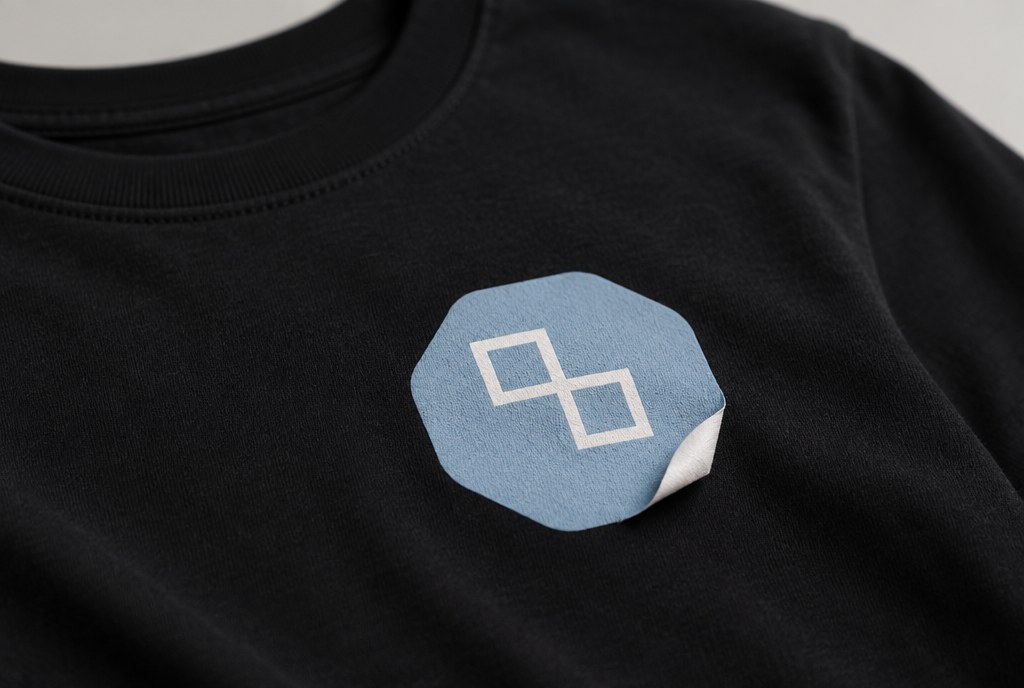
Printing on a black T-shirt almost always requires a white base — an underlying layer of white that the other colours are printed on top of. The reason is physical: print inks are semi-transparent, and without a white base, red or yellow ink on black fabric looks dark and muddy. In practice, a white base means one extra print layer, which in screen printing increases the price by roughly 0.30–0.80 EUR per piece, while in DTF printing it's already built into the process automatically.
Why colour "disappears" on dark fabric
Textile inks aren't opaque like car paint — they let some light through. On a white T-shirt, light reflects back from the fabric through the ink layer, making the colour look bright. On black fabric, light is absorbed, so red turns dark brown, light blue turns greyish, and yellow is barely visible at all.
A white base solves this problem: it creates an artificial "sheet of white paper" on the fabric. The colours printed on top behave just as they would on a light-coloured material, and the result matches the design on screen.
When you can skip the white base
- If the design is white only — then the white ink itself serves as both the base and the image (usually printed in two layers for opacity).
- If you deliberately want a "faded", vintage look — the ink is printed directly onto the fabric, giving a soft, semi-transparent finish.
- If you're using embroidery — thread is opaque, so no base is needed at all.
How the white base works across different technologies
Screen printing
In screen printing, the white base is a separate screen and a separate print pass. Between the base and the colour layers, the fabric is dried (flash-cured) so the colours don't mix. This means one extra colour in the technical calculation: a two-colour logo on a black T-shirt is costed as a three-colour job.
Screen printing becomes cost-effective from 30–50 pieces upward. The larger the print run, the less noticeable the screen set-up cost (roughly 12–20 EUR per colour).
DTF (Direct to Film)
In DTF printing, the white base is applied automatically by the printer — the colours are printed onto the film first, followed by the white layer and the adhesive powder. The customer doesn't need to think about the number of colours: a full-colour photo costs the same as a single-letter print of the same size. That's why DTF is a logical choice for orders of 1–50 pieces and designs with colour gradients.
Embroidery
Embroidery on dark textiles works without any base at all, because the thread fully covers the fabric. The only limitation is that fine lines under 1 mm and text under 4 mm in height don't embroider well, so logos sometimes need to be simplified.
Sublimation
Sublimation doesn't work on black or coloured polyester — the dye soaks into the fibre but can't cover a dark base, and there's no such thing as white sublimation ink. For dark textiles, we recommend screen printing, DTF, or embroidery instead.
Price and turnaround
Indicative prices excl. VAT for printing only (the T-shirt itself is not included):
| Technology | 1–10 pcs | 30 pcs | 100 pcs | White base |
|---|---|---|---|---|
| DTF, A5 size | from 6 EUR | ~4 EUR | ~2.80 EUR | included in price |
| DTF, A4 size | from 9 EUR | ~6 EUR | ~4.50 EUR | included in price |
| Screen printing, 1 colour | not cost-effective | ~3.50 EUR | ~1.80 EUR | +0.30–0.80 EUR/pc |
| Screen printing, 3 colours | not cost-effective | ~6 EUR | ~3.20 EUR | counted as an extra colour |
| Embroidery up to 8,000 stitches | from 6 EUR | ~6 EUR | ~4.50 EUR | not needed |
Prices are indicative; the exact calculation depends on quantity, print area size, number of colours, and number of print locations (front + back + sleeve are calculated separately).
Turnaround: DTF orders typically take 5–7 business days, screen printing 5–8 business days (including screen preparation), and embroidery 5–10 business days depending on design digitising. Rush jobs can be arranged by agreement.
How to prepare a file for dark textiles
- Vector graphics: .ai, .eps or .pdf with text converted to outlines. For raster images, minimum 300 dpi at actual print size.
- Transparent background. If the design has a white rectangular background, it will print as a white rectangle on the black T-shirt.
- Black lines in a design won't be visible on a black T-shirt — for dark garments, outlines should be replaced with a light tone or left unprinted (fabric showing through).
- Specify Pantone or CMYK values. On dark fabric, the tone will always appear slightly more muted than on paper — a 5–10% difference is normal.
- Fine details under 0.5 mm fill in with screen printing; DTF can handle details down to about 0.3 mm.
You can find more about our garment printing options and T-shirt range on our website.
Fabric composition and dye migration
Some dark polyester and cotton-polyester blends are prone to dye migration: the fabric's dye moves into the print layer under heat, and a white print can turn pink or greyish after a few days. The solution is a blocking white base (low-bleed white) or a lower curing temperature.
Practical tip: if you're ordering a large batch on a specific dark T-shirt model or sweatshirt, we make one sample before producing the full run. This takes 1–2 business days and helps you avoid ending up with 100 unusable pieces.
Frequently asked questions
Does the white base make the print thick and stiff?
In screen printing, yes — the layer is noticeable, with two ink layers together being roughly 0.1–0.2 mm thick. A softer result comes from a thin base with a finer mesh, or from DTF, where the layer is flexible and handles folding well.
How much extra does the white base cost?
In screen printing it's counted as one extra colour: set-up costs roughly 12–20 EUR per screen, plus roughly 0.30–0.80 EUR per piece depending on quantity. There's no extra charge with DTF or embroidery.
Can a black T-shirt be printed without a white base?
Yes, if the design is in a light, saturated tone and you're happy with a softer, semi-transparent look. This is a deliberate stylistic choice rather than a mistake, but you won't get vibrant colours this way.
How well does print on a black T-shirt withstand washing?
Properly cured screen printing withstands 40–50 wash cycles at 30–40°C, while DTF withstands roughly 30–40 cycles. We recommend washing the T-shirt inside out, without bleach, and not ironing directly over the print.
How quickly can 20 black T-shirts with a logo be produced?
With DTF technology, typically 5–7 business days from artwork approval, provided the T-shirts are in stock. For urgent cases, we can agree on a shorter turnaround.
If you have a specific design and fabric colour in mind, send the file to info@attaprint.lv, call +371 25776699, or message us on WhatsApp — project manager Madara will let you know whether a white base is needed and which technology will be most cost-effective. We prepare quotes within one business day; contact details are also available on our Contact page.
FAQ
Does the white base make the print thick and stiff?
In screen printing, yes — the layer is noticeable, with two ink layers together being roughly 0.1–0.2 mm thick. A softer result comes from a thin base with a finer mesh, or from DTF, where the layer is flexible and handles folding well.
How much extra does the white base cost?
In screen printing it's counted as one extra colour: set-up costs roughly 12–20 EUR per screen, plus roughly 0.30–0.80 EUR per piece depending on quantity. There's no extra charge with DTF or embroidery.
Can a black T-shirt be printed without a white base?
Yes, if the design is in a light, saturated tone and you're happy with a softer, semi-transparent look. This is a deliberate stylistic choice rather than a mistake, but you won't get vibrant colours this way.
How well does print on a black T-shirt withstand washing?
Properly cured screen printing withstands 40–50 wash cycles at 30–40°C, while DTF withstands roughly 30–40 cycles. We recommend washing the T-shirt inside out, without bleach, and not ironing directly over the print.
How quickly can 20 black T-shirts with a logo be produced?
With DTF technology, typically 3–5 business days from artwork approval, provided the T-shirts are in stock. For urgent cases, we can agree on a shorter turnaround.