Print Sizes on T-Shirts: Chest 110×90, Back 280×210 mm
Standard print areas and maximum sizes on a T-shirt: left chest 110×90 mm, front and back up to 280×210 mm, sleeve 80×60 mm, embroidery up to 90×90 mm.
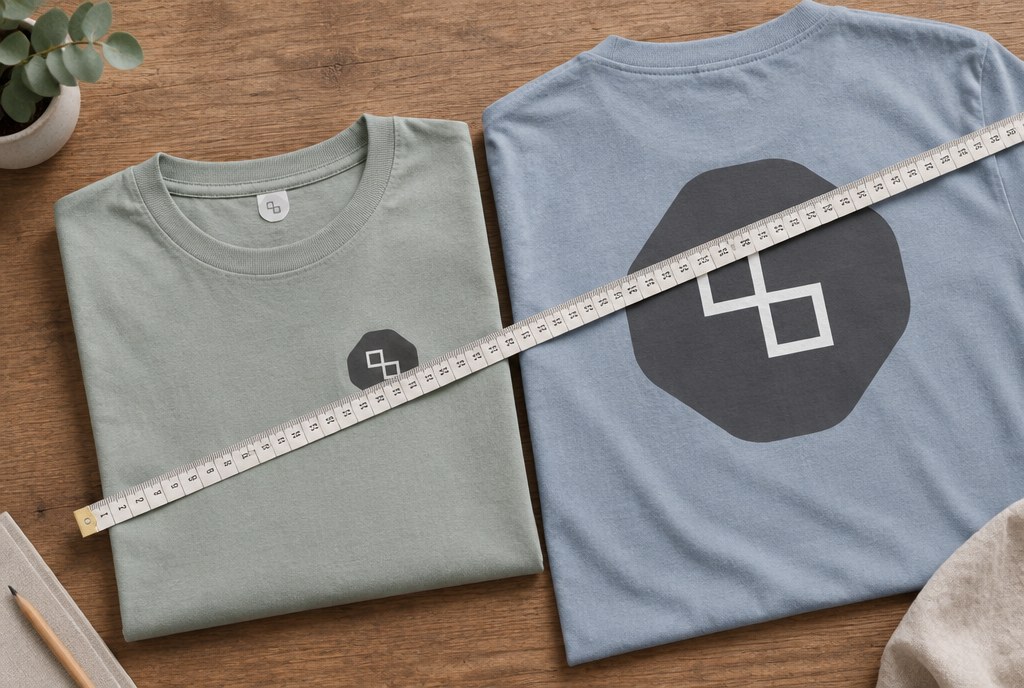
The standard print sizes on a T-shirt at our production facility are as follows: left chest 110×90 mm, front and back up to 280×210 mm, sleeve 80×60 mm, and embroidery up to 90×90 mm. These are the maximum areas within which a printed image reliably fits on an adult's T-shirt, polo shirt, hoodie or sweatshirt, without touching the seams, collar or pockets. If the artwork is prepared to these dimensions at 1:1 scale, no further adjustment is needed and the job can go into production right after the artwork is approved by email.
Standard print areas and maximum sizes
Sizes are given as width × height in millimetres. The largest areas (280×210 mm) apply to sizes S to XXL; for children's T-shirts and XS sizes, we usually reduce the area proportionally by 20–30% so the print doesn't extend to the side seams.
| Print area | Max. size (mm) | Suitable content |
|---|---|---|
| Left chest | 110×90 | Logo, name, job title |
| Centre chest (narrow strip) | 280×100 | Company name, tagline |
| Front (large area) | 280×210 | Graphic, illustration, campaign visual |
| Back | 280×210 | Large logo, contact details, number, sponsors |
| Back below collar | 280×60 | Website, tagline |
| Sleeve | 80×60 | Small logo, year, sponsor |
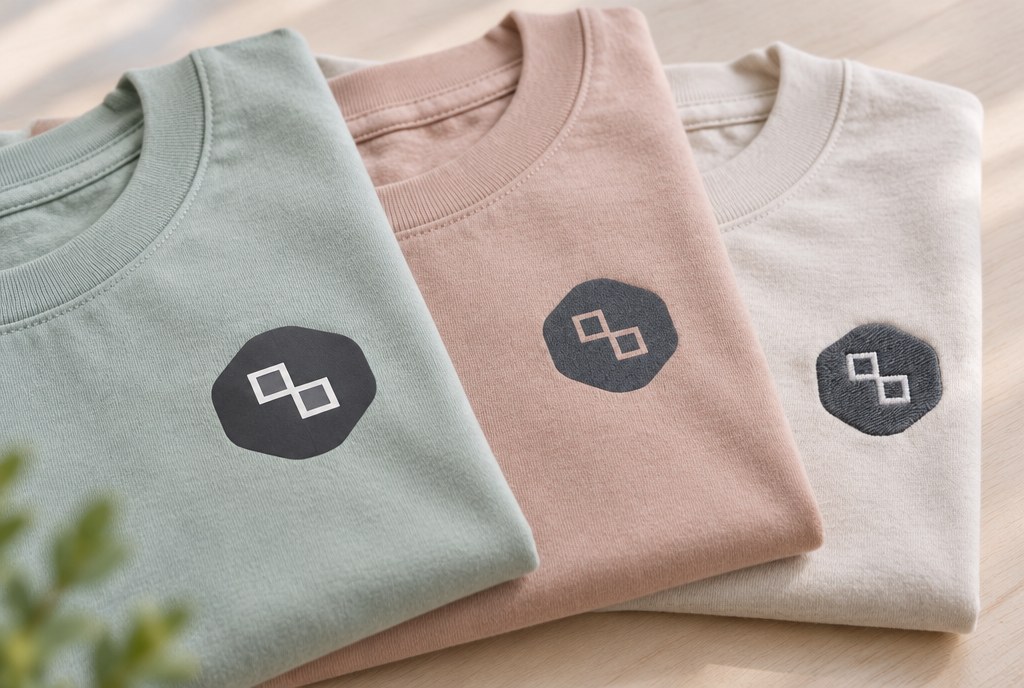
| Embroidery (chest or cap) | 90×90 | Logo without fine detail |
Exactly where to place the print
In practice, the placement of the image is just as important as its size. The reference measurements we use day to day:
- Left chest – top edge 70–90 mm below the shoulder seam, centred 70–80 mm to the left of the shirt's centre line.
- Front – top edge 70–80 mm below the collar seam, image centred on the centre line.
- Back – top edge 80–100 mm below the collar; if there's also a strip below the collar, it starts 50–60 mm below the seam.
- Sleeve – 60–80 mm below the sleeve seam, centred.
On hoodies with a pocket, the large front area is usually reduced to around 280×160 mm, as the print must not run into the pocket seam at the bottom. On polo shirts, we don't print large front areas at all – these are replaced with a chest print of 110×90 mm or embroidery of 90×90 mm, since the button placket would cut through the image.
How the printing technology affects the size
| Technology | Max. area | Minimum quantity | Notes |
|---|---|---|---|
| Screen printing | 280×210 mm | from 30–50 pcs | Each colour is a separate screen; cost-effective for larger runs |
| DTF transfer | 280×210 mm | from 1 pc | Full colour, photos, gradients, individual names per piece |
| Embroidery | 90×90 mm | from 10 pcs | No fine lines under 1 mm; durable on jackets, caps |
| Sublimation | entire area | from 1 pc | White polyester or special blanks only |
Single-colour screen printing on a 280×210 mm area and a full-colour DTF print of the same size look different: screen printing colour is more opaque and durable for large runs, while DTF allows each T-shirt to be printed with different text. For more on technologies and price differences, see clothing printing.
Artwork requirements
- Vector files: .ai, .eps, .pdf or .svg; colours in CMYK or specified as Pantone.
- Raster images – 300 dpi at actual size (e.g. a 280×210 mm print = approximately 3300×2480 px).
- Artwork at 1:1 scale, without crop marks and without background, unless the background needs to be printed.
- Text converted to outlines; the thinnest lines no less than 0.5 mm for screen printing and 1 mm for embroidery.
- If the T-shirt is dark, specify whether light-coloured elements should be printed in white.
Before production, we send you a visualisation of the artwork on the chosen T-shirt with the exact print size and placement; on request, we also prepare a 3D view with your logo. Production only begins after written approval. Examples of previous work can be viewed in our work.
Prices and timelines
The print price depends on the area, number of colours and quantity. As a guide, excl. VAT: DTF printing at chest size 110×90 mm starts from around EUR 4 per piece for small quantities, while for a run of 50–100 pcs with single-colour screen printing, the price per print location drops below EUR 2. Two print locations (chest + back) always cost more than one, as they are two separate processes. T-shirts themselves can be chosen from the T-shirts and hoodies categories.
Timelines: printed clothing usually takes 6–10 business days (production 4–7 business days depending on quantity + delivery 2–3 days). Own printing – stickers, business cards, posters – 1–3 business days. Urgent jobs by arrangement.
Examples from our catalogue
A few T-shirts from our catalogue on which we most often apply these print sizes (price excl. printing):
- Beagle 155 g/m² men's short-sleeve T-shirt – Cotton, 36 colour options, price from EUR 2.22/pc, at 1 pc,
- Stafford 190 g/m² men's short-sleeve T-shirt – Cotton, 41 colour options, price from EUR 3.06/pc, at 1 pc,
- Capri 170 g/m² women's short-sleeve T-shirt – Cotton, 34 colour options, price from EUR 2.90/pc, at 1 pc,
Frequently asked questions
What's the maximum print size on a T-shirt?
On the front and back – 280×210 mm. For the left chest we use 110×90 mm, for the sleeve 80×60 mm, and for embroidery up to 90×90 mm.
Can you print a larger area than 280×210 mm?
In some cases, yes, but then the print gets close to the side and sleeve seams, where the colour may not adhere evenly. We assess such jobs individually based on the artwork and shirt model.
What size should I choose for a small chest logo?
In practice, a logo width of 80–110 mm looks proportionate on both S and XXL sizes. Below 60 mm, fine text is no longer legible, especially in embroidery.
Does the print size change depending on the T-shirt size?
For adult sizes S–XXL, we use the same artwork. For children's sizes and XS, we reduce the area by 20–30% so the image doesn't touch the seams.
Can I order a single T-shirt?
Yes, with DTF transfer we work from 1 piece. Screen printing becomes cost-effective from around 30–50 pieces.
What file format should I send?
Vector graphics (.ai, .eps, .pdf, .svg) in CMYK colours, or raster at 300 dpi at actual size. Please convert text to outlines.
Send your logo and T-shirt model to info@attaprint.lv, call +371 25776699, or message us on WhatsApp at the same number – we'll prepare a quote with the print size, placement and timeline within one business day. Contact details are also available on the contacts page.
FAQ
What's the maximum print size on a T-shirt?
On the front and back – 280×210 mm. For the left chest we use 110×90 mm, for the sleeve 80×60 mm, and for embroidery up to 90×90 mm.
Can you print a larger area than 280×210 mm?
In some cases, yes, but then the print gets close to the side and sleeve seams, where the colour may not adhere evenly. We assess such jobs individually based on the artwork and shirt model.
What size should I choose for a small chest logo?
In practice, a logo width of 80–110 mm looks proportionate on both S and XXL sizes. Below 60 mm, fine text is no longer legible, especially in embroidery.
Does the print size change depending on the T-shirt size?
For adult sizes S–XXL, we use the same artwork. For children's sizes and XS, we reduce the area by 20–30% so the image doesn't touch the seams.
Can I order a single T-shirt?
Yes, with DTF transfer we work from 1 piece. Screen printing becomes cost-effective from around 30–50 pieces.
What file format should I send?
Vector graphics (.ai, .eps, .pdf, .svg) in CMYK colours, or raster at 300 dpi at actual size. Please convert text to outlines.