DTF vs Embroidery on T-Shirts: Which to Choose (+ Screen Printing)
A clear comparison: DTF or embroidery, and when screen printing pays off instead. Quantities, number of colours, indicative prices and print sizes.
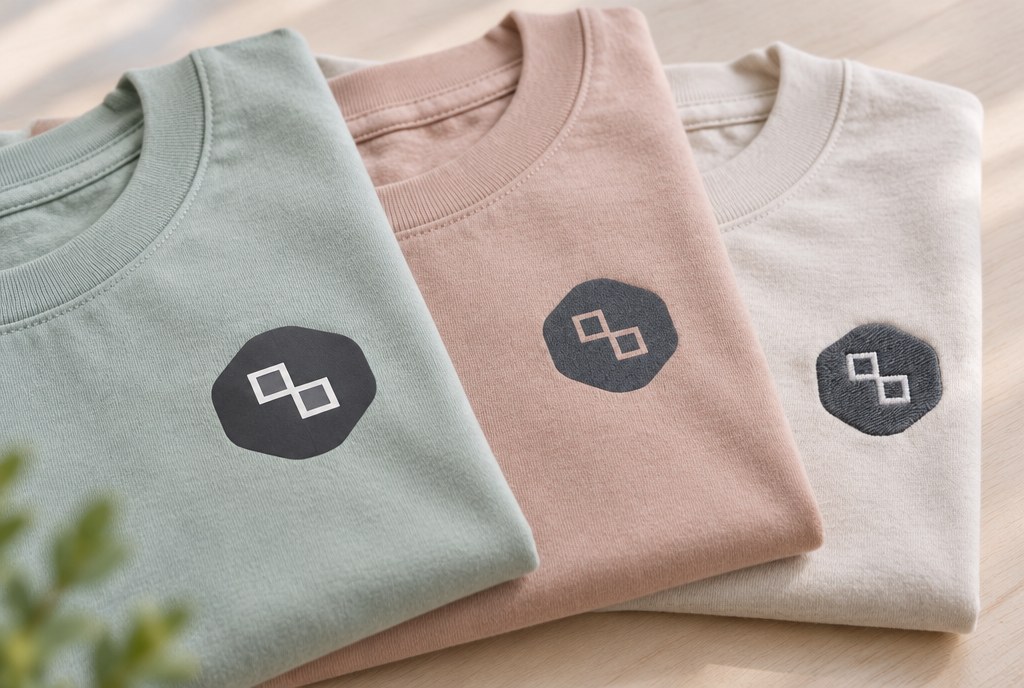
If the question is “DTF or embroidery”, the short answer is this: DTF transfer works out better for multicolour designs and small quantities from 1 piece, embroidery suits small logos up to 90×90 mm on polo shirts, jackets and caps where a polished, representative look matters. Screen printing only becomes cheaper from roughly 30–50 pieces per design, since each colour needs a separate screen. In practice, the choice comes down to three things: the number of colours in the design, the order quantity, and the garment material.
Three technologies in brief
DTF (Direct to Film) transfer. The design is printed onto a special film using CMYK plus white, then transferred onto the fabric with a heat press. The number of colours doesn't affect the price, so photos, gradients and multicolour logos cost the same as a single-colour mark. Works on cotton, polyester and blends, including dark fabrics.
Screen printing. Each colour is applied separately through a screen. Setup costs money and time, but every following T-shirt afterwards is cheap. The result is thin, flexible and very durable — which is why it's used by sports clubs, events and large batches of workwear.
Embroidery. The design is converted into a stitch program and sewn directly into the fabric. No colour transitions or fine detail, but plenty of substance and longevity. Best up to 90×90 mm — chest logos, caps, jackets, polo shirts, hoodie fronts.
Where you need a full-colour image on a polyester sports jersey, we also use sublimation. All technologies and standard print placements are described in the clothing printing section.
Comparison table
| Criterion | DTF transfer | Screen printing | Embroidery |
|---|---|---|---|
| Minimum quantity | from 1 pc | from 20–30 pcs | from 1 pc (one-off programming) |
| Number of colours | unlimited, price unchanged | each colour = a separate screen | 1–12 thread colours |
| Fine detail, gradients | yes | limited | no |
| Setup fee | small or none | from approx. 15–20 EUR per colour | programming from approx. 20 EUR |
| Price at 100 pcs (chest) | approx. 3–5 EUR/pc | approx. 1.50–3 EUR/pc | approx. 3.50–6 EUR/pc |
| Feel on fabric | thin film | almost unnoticeable | raised, thicker |
| Wash durability | good (30–40 °C, turned inside out) | very good | very good |
| Best-suited garment | T-shirts, hoodies, children's clothing | T-shirts, sweatshirts in large batches | polo shirts, jackets, caps, workwear |
Prices are indicative, excl. VAT. The exact price depends on quantity, print size, number of placements and the garment model itself.
How quantity shifts the choice
The main tipping point is setup cost. With DTF, it's minimal, so 5 T-shirts still work out reasonably priced. With screen printing, setup is spread across the whole order — at 20 pieces it still noticeably raises the price, at 200 pieces it practically disappears.
| Quantity, one design | Recommended technology | Why |
|---|---|---|
| 1–10 pcs | DTF | no screens and no minimum batch |
| 10–30 pcs | DTF or embroidery | screen printing setup doesn't pay off yet |
| 30–100 pcs | screen printing (1–3 colours) or DTF (multicolour) | the point where we calculate both options |
| 100+ pcs | screen printing; logo — embroidery | lowest price per piece |
At 30–60 pieces we usually prepare two quotes so you can see the difference in numbers.
Design decides more often than budget
When DTF is the clear choice
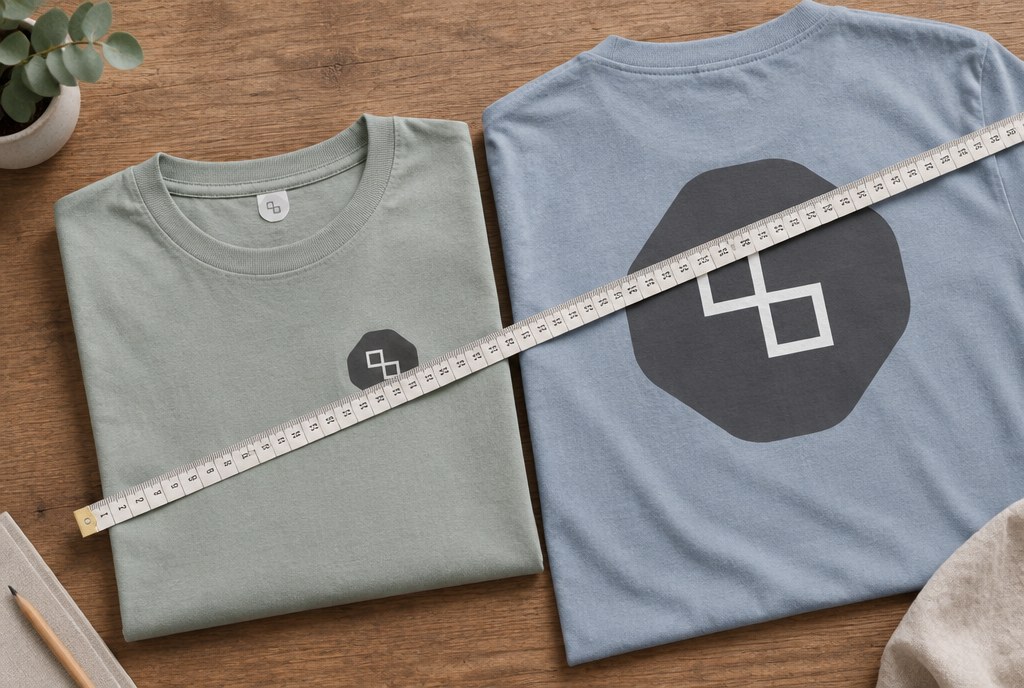
Photos, gradients, more than 4 colours, thin outline drawings, personalised T-shirts with names or numbers. DTF also works well when the same design needs to go on different sizes and colours. Standard placements: left chest 110×90 mm, front or back up to 280×210 mm, sleeve 80×60 mm.
When embroidery is the clear choice
A company logo on polo shirts, jackets or caps, where the print needs to look solid and last for years. Embroidery doesn't wear out from frequent washing and doesn't crack. Limitation: logos with fine text under 4 mm letter height and delicate gradients will need to be simplified.
When screen printing is the clear choice
Event T-shirts in batches of 100+, sports club kits, promotional shirts for shops. One or two colours, a large area, the lowest price per piece. Screen printing also "disappears" into the fabric best — the T-shirt stays soft.
Material and garment choice
Cotton T-shirts suit all three technologies. For polyester sports shirts, DTF or sublimation is safer, since screen-printing ink can "migrate" colour on synthetics. For hoodies and sweatshirts with a thick fleece lining, embroidery on the chest works well, but for a large design on the back, screen printing or DTF is more cost-effective. For waterproof jackets, pay attention to the lining — embroidery pierces through it, so it's sometimes better to choose DTF or a ready-made embroidered patch.
Files, artwork and timelines
Send designs in vector format (.ai, .eps, .pdf, .svg); raster images need at least 300 dpi at the actual print size, colours in CMYK. For screen printing and embroidery, please also specify the number of colours and, if needed, Pantone shades. Artwork is approved by email — before production we send a visualisation with the print size and placement.
Timelines: garment printing usually takes 6–10 business days (production 4–7 business days depending on quantity, plus delivery 2–3 days). Own printing — stickers, business cards, posters — 1–3 business days. Urgent jobs by arrangement. You can see examples of previous work in the our work section.
Frequently asked questions
Which is more durable — DTF or embroidery?
Embroidery is more durable, since it's thread sewn into the fabric and can't peel off. Quality DTF printing withstands hundreds of washes if washed at 30–40 °C, the T-shirt is turned inside out, and the print isn't ironed directly.
From how many pieces does screen printing become cheaper than DTF?
Usually from 30–50 pieces per design with 1–2 colours. For multicolour designs, the threshold shifts higher — with four colours, screen printing only pays off from around 100 pieces.
Can you print just one T-shirt?
Yes. DTF and embroidery work from 1 piece. Embroidery has a one-off programming fee from approximately 20 EUR, so for a single piece DTF is often more cost-effective.
How large can the design be?
Standard sizes: left chest 110×90 mm, front and back up to 280×210 mm, sleeve 80×60 mm, embroidery up to 90×90 mm. Larger areas are possible by arrangement, depending on the garment model.
Can any logo be reproduced in embroidery?
Almost any, but fine detail and gradients need to be simplified. Letters should ideally be at least 4–5 mm tall; thread colours are matched to the closest shade of your logo colours.
How many colours can be used in a DTF print?
Unlimited — DTF prints in full colour, so the price doesn't change with the number of colours. The only limitation is very fine lines under 0.3 mm.
Send us your design file, T-shirt model and approximate quantity to info@attaprint.lv, call, or message us on WhatsApp at +371 25776699 — we'll prepare a quote with a technology recommendation, print size and timeline within one business day.
FAQ
Which is more durable — DTF or embroidery?
Embroidery is more durable, since it's thread sewn into the fabric and can't peel off. Quality DTF printing withstands hundreds of washes if washed at 30–40 °C, the T-shirt is turned inside out, and the print isn't ironed directly.
From how many pieces does screen printing become cheaper than DTF?
Usually from 30–50 pieces per design with 1–2 colours. For multicolour designs, the threshold shifts higher — with four colours, screen printing only pays off from around 100 pieces.
Can you print just one T-shirt?
Yes. DTF and embroidery work from 1 piece. Embroidery has a one-off programming fee from approximately 20 EUR, so for a single piece DTF is often more cost-effective.
How large can the design on a T-shirt be?
Standard sizes: left chest 110×90 mm, front and back up to 280×210 mm, sleeve 80×60 mm, embroidery up to 90×90 mm. Larger areas are possible by arrangement, depending on the garment model.
Can any logo be reproduced in embroidery?
Almost any, but fine detail and gradients need to be simplified. Letters should ideally be at least 4–5 mm tall; thread colours are matched to the closest shade of your logo colours.
How many colours can be used in a DTF print?
Unlimited — DTF prints in full colour, so the price doesn't change with the number of colours. The only limitation is very fine lines under 0.3 mm.