Printing on Recycled Materials: What to Know Before Ordering
How printing on recycled material differs from standard printing: colour tone, technology choice, 3–10 business day turnaround and approximate prices.
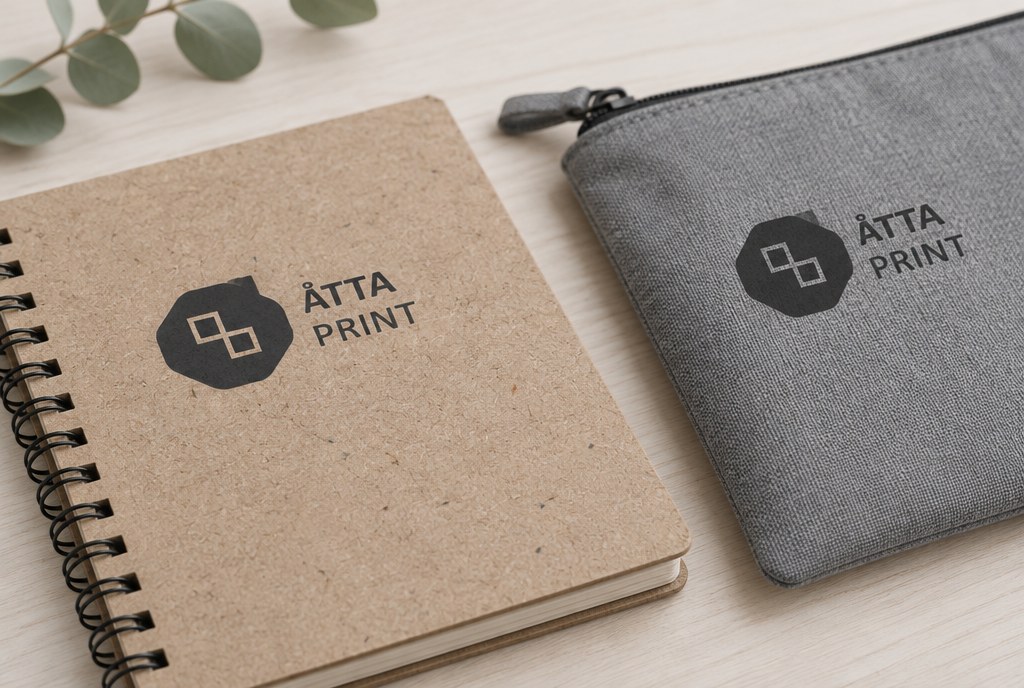
Printing on recycled material technically works the same as on new raw material, but there are three differences to keep in mind: the surface is often greyer or more mottled, so colours come out 5–15% duller; recycled paper absorbs more ink, so large dark areas are better replaced with line graphics; and RPET fabric has lower heat resistance, so sublimation and heat-press temperatures need to be reduced by 10–20°C. In practice, this means a one- or two-colour logo on recycled material looks just as good as on standard material, but a full-colour photo needs a sample first. Turnaround times stay the same — 5–10 business days after artwork approval for printed promotional products, 2–5 business days for paper products.
Which recycled materials actually show up in orders
Conversations about "eco" products usually come down to four material groups, each with its own behaviour under printing.
- RPET — polyester made from recycled plastic bottles. Used for bags, backpacks, T-shirts, jackets, umbrellas. Printing: screen printing, DTF, embroidery, sublimation (at a lower temperature).
- Recycled cotton (rCotton) — usually 60–80% recycled fibre blended with new cotton for durability. The tone is rarely pure white, more often light grey.
- Recycled paper and cardboard — for business cards, flyers, brochures, tags, notebooks. Uncoated, so it's matte and slightly porous.
- Recycled plastic — pen bodies, mugs, bottles, tech accessories. Often has visible marbling or speckling within the material.
Bamboo, cork and straw-fibre composites deserve a separate mention — they aren't technically recycled materials, but clients usually group them together. Laser engraving works well on these, as the natural surface gains contrast without any added ink.
How colours change and what to do at the artwork stage
The main mistake is expecting the same result as on a white coated surface. The base tone of recycled paper is around 88–92% whiteness versus 96–100% for coated paper, and the uncoated surface "pulls in" ink, causing the halftone dot to spread.
Practical solutions we offer:
- Check your logo in a single-colour version. If the brand works in one colour, recycled material isn't a problem.
- Avoid light tones that rely on a white background — for example, light yellow on recycled cardboard practically disappears.
- For dark colours, allow for slightly thicker lettering since ink tends to spread — at least 6 pt for text and 0.25 mm for lines.
- If a white element is needed, on textiles this is solved with screen printing or DTF with a white base layer; white is not digitally printed on paper.
We always need artwork in vector format (.ai, .eps, .pdf) in CMYK mode. If a Pantone colour is specified, note it separately — on a recycled surface we can match it more precisely with screen printing than with digital printing.
Choosing the right technology by material
| Material | Best-suited printing | Note |
|---|---|---|
| RPET bag, backpack | Screen printing in 1–3 colours, DTF | Screen printing requires low-temperature curing |
| RPET / rCotton T-shirt | DTF, screen printing | Sublimation only on light-coloured RPET, 10–20°C lower temperature |
| Recycled cotton sweatshirt | Embroidery, screen printing | Embroidery covers surface irregularities |
| Recycled paper (business cards, flyers) | Digital printing, offset | Expect a matte, slightly duller result |
| Recycled plastic (pens, bottles) | Pad printing, UV printing, laser engraving | Marbled body affects colour perception |
| Bamboo, cork | Laser engraving | No ink needed, contrast depends on material density |
For promotional products from our catalogue, the choice of recycled materials is currently wide: RPET bags and backpacks, recycled plastic pens, notebooks with recycled paper pages and cardboard covers, stainless steel thermal mugs and bottles with partially recycled plastic trim. We check availability and colours for specific models at the time of order.
Approximate prices
The prices below are approximate, excl. VAT, with single-colour printing. The exact price depends on quantity, number of colours and the specific model.
| Product | Quantity | Approx., EUR/pc |
|---|---|---|
| Recycled paper business cards | 100 / 500 | from 0.25 / from 0.12 |
| A5 flyers, recycled paper | 250 / 1000 | from 0.22 / from 0.09 |
| A5 notebook with recycled paper pages | 50 / 250 | from 3.90 / from 2.90 |
| Recycled plastic pen | 100 / 500 | from 0.90 / from 0.65 |
| RPET tote bag | 50 / 300 | from 3.50 / from 2.40 |
| RPET T-shirt with DTF printing | 10 / 100 | from 14.00 / from 10.50 |
Recycled materials are typically 5–20% more expensive than the equivalent made from new raw material — this applies to the material, not the printing. Printing costs don't change.
Turnaround times and samples
For printed promotional products, the standard turnaround is 5–10 business days after artwork approval. For paper products with recycled material, allow 2–5 business days; for printed textiles, 5–8; for engraved or pad-printed promotional products, 7–10. Rush jobs are possible by arrangement.
If your order exceeds 200 pieces or colour accuracy is critical, we recommend a physical sample. A single sample usually takes 2–3 business days, and its cost is included in the total for larger orders. We also work with single pieces, so a sample can be ordered as a standalone job.
How to talk about recycled material correctly in your communications
If you plan to write "made from recycled material" on a product or packaging, specify an exact percentage — for example, "body made from 80% recycled plastic". General claims without a figure are considered unsubstantiated under EU consumer protection regulations. For every product in our catalogue, we can provide material composition information to use in your texts.
Another practical point — packaging. It makes little sense to order RPET bags and then wrap them individually in plastic bags. On request, we deliver them in combined cardboard packaging.
For more on specific products and printing options, see the printing services section and the clothing printing page.
Frequently asked questions
Does printing on recycled material last just as long?
Yes, if the right technology is chosen. DTF and screen printing on RPET fabric withstand 30–50 wash cycles at 30°C, just like on standard polyester. The only important factor is the correct curing regime, as recycled polyester can deform at too high a temperature.
Why do colours on recycled paper look different from on screen?
Because the base tone isn't pure white and the surface isn't coated. In practice, this gives a 5–15% duller impression, especially in blue and yellow tones. If colour accuracy matters, we prepare a sample on the same paper before a large print run.
Does recycled material cost more?
The material is typically 5–20% more expensive, while the printing cost stays the same. At larger quantities, the difference becomes less noticeable, since most of the cost is setup and printing.
Can recycled plastic be engraved?
Laser engraving on recycled plastic works unevenly, since the material isn't homogeneous. For such products, we use pad printing or UV printing instead. We recommend laser engraving for metal, bamboo and cork.
How long does an order take?
For printed promotional products, 5–10 business days after artwork approval: paper products 2–5, printed textiles 5–8, engraved or pad-printed promotional products 7–10. Rush jobs are assessed individually.
If you have a specific product and logo, send your artwork to info@attaprint.lv or message us on WhatsApp at +371 25776699 — project manager Madara will reply with information on material composition and the most suitable printing technology. We prepare quotes within one business day.
FAQ
Does printing on recycled material last just as long?
Yes, if the right technology is chosen. DTF and screen printing on RPET fabric withstand 30–50 wash cycles at 30°C, just like on standard polyester. The only important factor is the correct curing regime, as recycled polyester can deform at too high a temperature.
Why do colours on recycled paper look different from on screen?
Because the base tone isn't pure white and the surface isn't coated. In practice, this gives a 5–15% duller impression, especially in blue and yellow tones. If colour accuracy matters, we print a sample on the same paper before a large print run.
Does recycled material cost more?
The material is typically 5–20% more expensive, while the printing cost stays the same. At larger quantities, the difference becomes less noticeable, since most of the cost is setup and printing.
Can recycled plastic be engraved?
Laser engraving on recycled plastic works unevenly, since the material isn't homogeneous. For such products, we use pad printing or UV printing instead. We recommend laser engraving for metal, bamboo and cork.
How long does an order take?
Usually 3–10 business days: paper products 3–5, printed textiles 5–8, engraved or pad-printed promotional products 7–10. Rush jobs are assessed individually.