Print area: where to place a logo on a product and how big it can be
A practical guide to print areas: typical sizes for pens, mugs, bags, T-shirts and caps, technology limitations, and indicative prices.
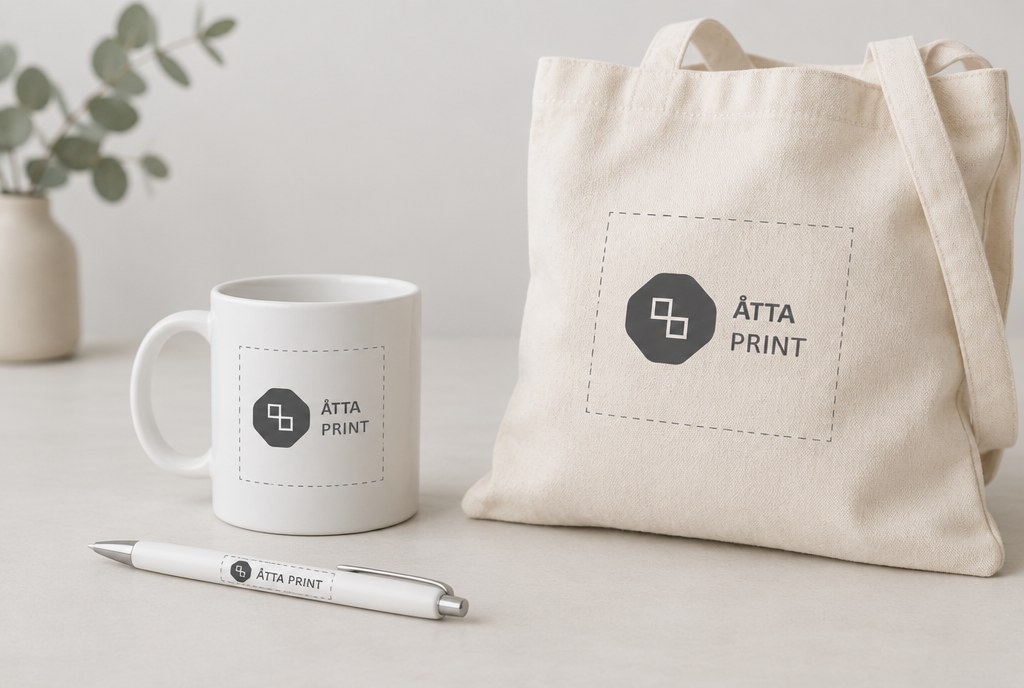
The print area is the part of a product's surface where a logo can technically be applied — on a pen this is usually about 40×6 mm, on a ceramic mug 80×80 mm on one side (up to 200×80 mm wrapped around), on a tote bag 250×250 mm, and on the chest of a T-shirt up to 300×400 mm. These limits aren't a matter of preference — they're set by the product's shape, material and the chosen printing technology. Below is a summary of the typical sizes we work with every day.
What determines the limits of the print area
Three main factors: surface geometry, material and equipment. A flat surface allows a larger area than a curved one — on a cone-shaped bottle, printing starts to distort if it's wider than 60–70 mm. Seams, zips, handles and loops physically block the frame — a screen printing frame or pad printing cliché can't touch the surface closer than 8–10 mm from a seam.
Another often-overlooked factor is the safety margin. Even if the technical area is 100×50 mm, we'd recommend designing the logo at 90×45 mm, to allow for a ±1–2 mm positioning tolerance. On textiles the tolerance is bigger (up to 5 mm), since fabric stretches.
Typical print areas by product group
| Product | Location | Typical area | Technology |
|---|---|---|---|
| Pen (plastic/metal) | Barrel, clip | 40×6 mm; clip 25×5 mm | Pad printing, laser engraving |
| Ceramic mug 300 ml | One side / wrap-around | 80×80 mm / 200×80 mm | Sublimation, ceramic printing |
| Thermal mug 350–450 ml | Centre of body | 60×60 mm or 180×50 mm wrap-around | UV printing, laser engraving |
| Water bottle 500–750 ml | Body | 50×70 mm; up to 200×60 mm wrap-around | Screen printing, UV printing |
| Thermal bottle 500 ml | Body | 40×50 mm | Laser engraving |
| Notebook A5 | Cover, bottom corner | 100×60 mm; A4 notebook 150×80 mm | Screen printing, foil stamping |
| Tote bag | Front, centred | 250×250 mm | Screen printing, DTF |
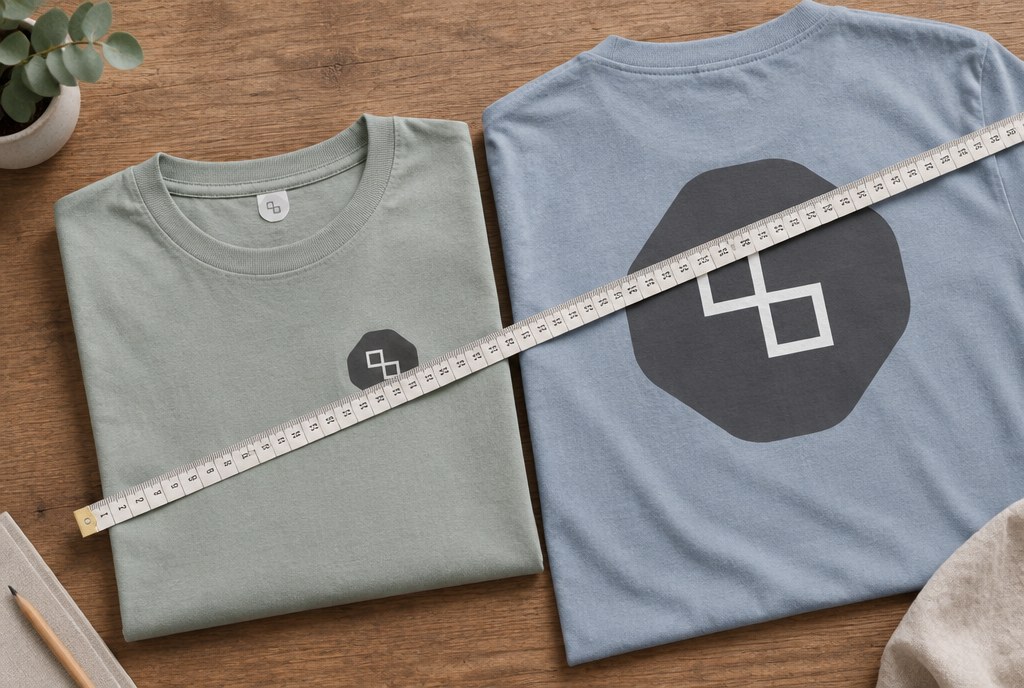
| T-shirt | Chest, back, sleeve | 300×400 mm; left chest 90×90 mm | DTF, screen printing |
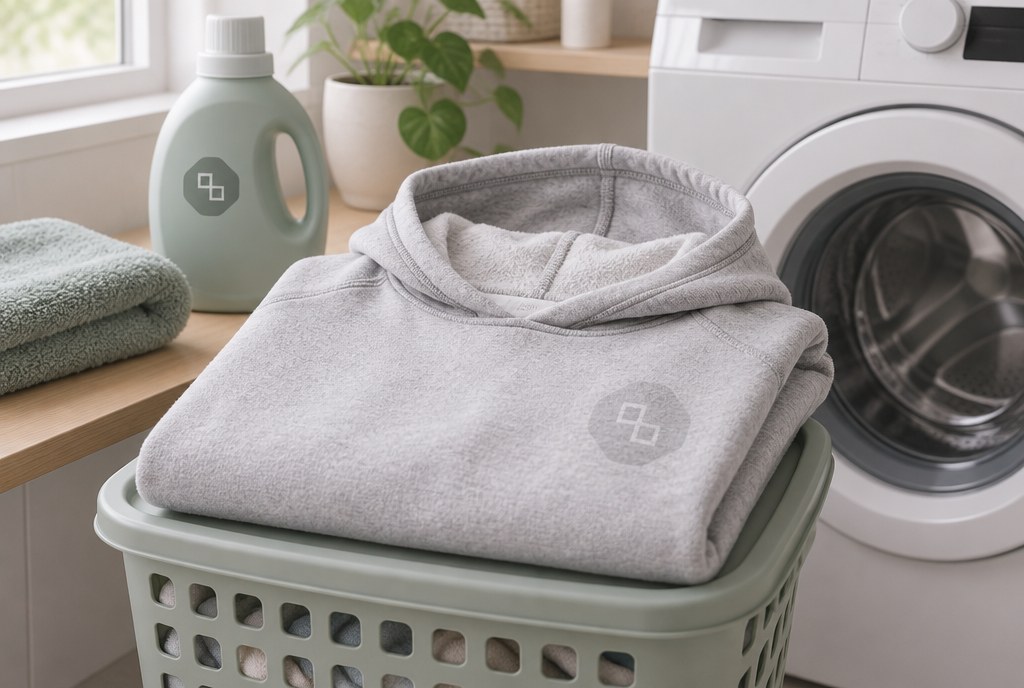
| Hoodie | Chest, back | 280×350 mm (pocket limits the bottom edge) | DTF, embroidery |
| Baseball cap | Front, side | 100×50 mm; side 60×30 mm | Embroidery |
| Umbrella | One panel | 200×150 mm | Screen printing |
| Towel 50×100 cm | Bottom edge | 200×100 mm | Embroidery, sublimation |
These sizes are indicative — each specific model in our catalogue has its own technical drawing, which we send along with the artwork before production. You can browse a wider selection in our promotional products section.
How technology affects the area and level of detail
Pad printing
Designed for small, curved areas — pens, keyrings, USB drives. The maximum practical area is around 50×20 mm, and each colour is applied separately. A fine line below 0.3 mm may not reproduce well.
Screen printing
Economical from 30–50 pieces, with good solid colour coverage on textiles and tote bags. On a T-shirt the practical limit is 300×400 mm, and the number of colours is usually up to 4–6 — each extra colour means a new frame and affects the price.
DTF
Suitable for full-colour images and small runs, even a single piece. The area is limited by the film format: A4 (210×297 mm) or A3 (297×420 mm). Photos, gradients and multi-colour logos can be produced without extra stencils — see apparel printing.
Embroidery
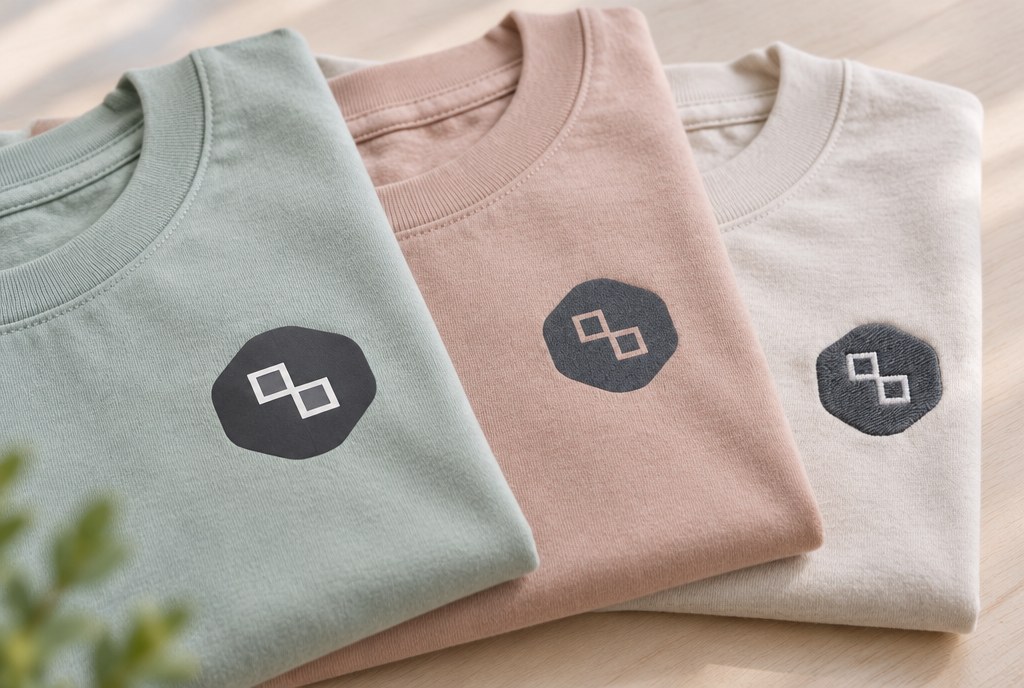
The most durable solution for caps, polo shirts and workwear. Optimal size is 60–100 mm wide; fine text below 4 mm in height tends to blur together when embroidered. For a cap front, the thickness of the embroidery is also a limiting factor — depth up to 5–6 mm.
Sublimation and UV printing
Sublimation only works on white or light-coloured polyester and specially coated items (mugs, towels, mouse mats), but it does allow printing across the entire surface. UV printing suits rigid materials and allows full-colour printing on a metal bottle or mug.
Indicative printing prices
Prices are indicative, excl. VAT, per unit, and do not include the cost of the product itself. The exact amount depends on quantity, number of colours and size of the print area.
| Technology | 25 pcs | 100 pcs | 500 pcs |
|---|---|---|---|
| Pad printing, 1 colour | from EUR 0.90 | from EUR 0.45 | from EUR 0.25 |
| Screen printing on textile, 1 colour | from EUR 3.50 | from EUR 2.50 | from EUR 1.50 |
| DTF A5 | from EUR 6.00 | from EUR 5.00 | from EUR 4.00 |
| Embroidery up to 8,000 stitches | from EUR 6.00 | from EUR 5.00 | from EUR 4.00 |
| Sublimation on a mug | from EUR 2.80 | from EUR 1.90 | from EUR 1.40 |
| Laser engraving | from EUR 2.20 | from EUR 1.50 | from EUR 1.10 |
For screen printing and pad printing, stencil/cliché preparation should be added (approximately EUR 15–35 per colour); for embroidery, digitising (approximately EUR 20–30 one-off). DTF and UV printing have no setup fee, which makes them more cost-effective for small orders.
How to prepare your file
Submit your logo as vector graphics — .ai, .eps or .pdf with fonts converted to outlines, colours in CMYK or Pantone. A raster image is only suitable for DTF and sublimation, and in that case it must be at least 300 dpi at the actual print size.
If you're not sure what area is available for a particular product, send us your logo and the product name — we'll prepare a visualisation with the actual scale. Production time is usually 5–10 business days after artwork approval, depending on the product and quantity; urgent jobs can be arranged by agreement. You can browse our full range of printing services in our online shop.
Frequently asked questions
Can a logo be placed across the entire surface of a product?
Full-surface printing is possible with sublimation (mugs, towels, polyester textiles) and, in some cases, UV printing wrapped around the object. Most promotional products only offer a pre-defined print area, since seams, handles and curves prevent the equipment from reaching the whole surface.
How small can a logo be and still be legible?
In pad printing and screen printing, text height shouldn't be smaller than 1.5 mm, and line thickness no less than 0.3 mm. In embroidery, the minimum letter height is 4 mm. If a logo includes a small tagline, we usually recommend removing it and keeping only the mark with the name.
Can both sides of a product be printed?
Yes, for most mugs, bags, bottles and T-shirts. The second side is calculated as a separate print position, so the price roughly doubles, except for sublimation, where wrap-around printing is a single process.
What happens if the logo is wider than the allowed area?
We scale it down proportionally to the maximum size and send you the artwork for approval. We don't produce prints that have been forcibly stretched or placed over the edges, as the result would be poor quality.
Do you work with single pieces?
Yes. DTF, sublimation, UV printing and laser engraving are all suitable for a single piece. For screen printing and pad printing, the minimum economical quantity is around 25–30 pieces due to stencil/cliché costs.
Send us your logo and product name at info@attaprint.lv, call us, or message us on WhatsApp at +371 25776699 — our project manager Madara will check the available print area and prepare a quote within one business day. Our address: Kandavas iela 29A, Riga.
FAQ
Can a logo be placed across the entire surface of a product?
Full-surface printing is possible with sublimation (mugs, towels, polyester textiles) and, in some cases, UV printing wrapped around the object. Most promotional products only offer a pre-defined print area, since seams, handles and curves prevent the equipment from reaching the whole surface.
How small can a logo be and still be legible?
In pad printing and screen printing, text height shouldn't be smaller than 1.5 mm, and line thickness no less than 0.3 mm. In embroidery, the minimum letter height is 4 mm. If a logo includes a small tagline, we usually recommend removing it and keeping only the mark with the name.
Can both sides of a product be printed?
Yes, for most mugs, bags, bottles and T-shirts. The second side is calculated as a separate print position, so the price roughly doubles, except for sublimation, where wrap-around printing is a single process.
What happens if the logo is wider than the allowed area?
We scale it down proportionally to the maximum size and send you the artwork for approval. We don't produce prints that have been forcibly stretched or placed over the edges, as the result would be poor quality.
Do you work with single pieces?
Yes. DTF, sublimation, UV printing and laser engraving are all suitable for a single piece. For screen printing and pad printing, the minimum economical quantity is around 25–30 pieces due to stencil/cliché costs.