Caring for a Printed T-Shirt: How to Wash It Without Fading the Logo
Practical tips on washing and drying printed T-shirts — temperature, detergents, ironing, and the differences between screen printing, DTF, sublimation and embroidery.
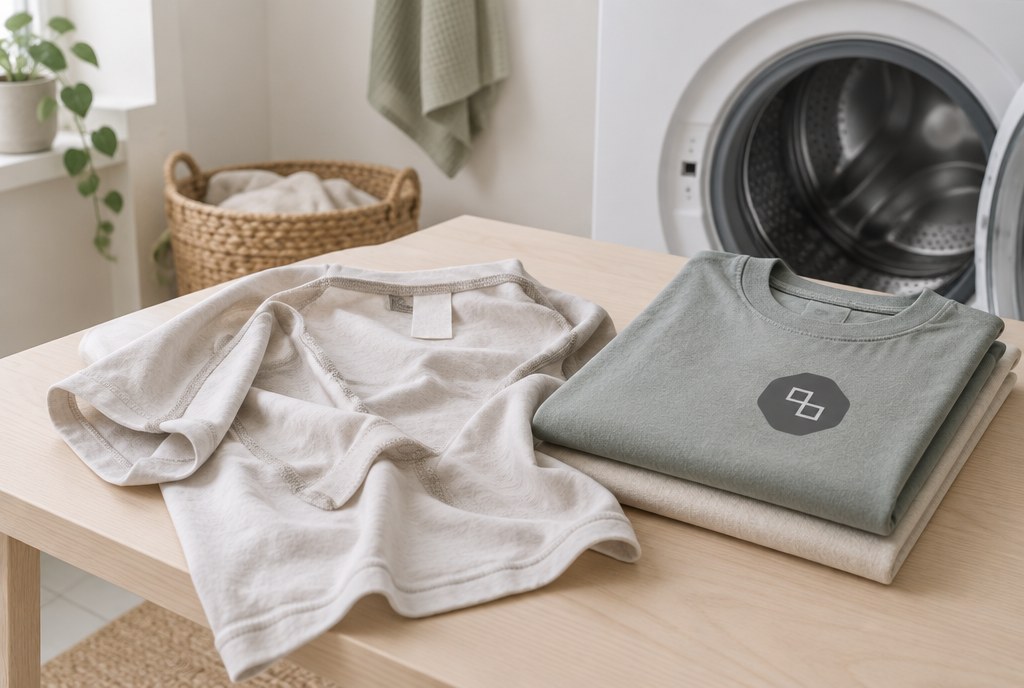
Caring for a printed T-shirt is simple if you follow four basic rules: wash at 30 °C, turn the shirt inside out, skip fabric softener and bleach, and dry on a line rather than in a tumble dryer. With this routine, good-quality screen printing or DTF printing can withstand 40–60 washes with no visible fading, whereas at 60 °C with a tumble dryer and softener the same print starts cracking after just 10–15 washes. It's best to wash the shirt for the first time no sooner than 24 hours after receiving the print, so the colour and adhesive fully stabilise.
Why prints fade
Printing doesn't get damaged by water itself, but by three factors: temperature, mechanical friction and chemicals. Hot water softens plastisol ink and DTF adhesive, friction inside the washing machine drum and tumble dryer wears it down, while fabric softener and chlorine bleach break down the bond between the ink and the fabric fibres.
Ironing deserves a special mention too. Placing a hot iron directly onto plastisol or DTF print can melt it within seconds — and there's no fixing it afterwards. So only iron from the inside, or through a cotton cloth.
Washing routine, step by step
- Turn the shirt inside out. This way the print rubs against itself rather than against other laundry or the drum wall.
- Choose 30 °C and a gentle programme. If your machine has a "cotton eco 30" or "sports" setting, that works well.
- Reduce the spin speed to 600–800 rpm. Higher speeds crease the print and cause micro-cracks.
- Use a liquid detergent without bleach. Powder with granules acts as an abrasive.
- No fabric softener at all. If you want a softer fabric, add half a cup of white vinegar to the rinse compartment.
- Dry on a hanger or line, in the shade. Direct sunlight fades both the fabric and the ink.
Never scrub stains directly on the print with a brush — clean around it with your fingertips and a liquid detergent.
Each printing technology has its own routine
We offer garment printing in four main technologies, and their durability varies. The table below gives general recommendations, which we can adjust for your specific order.
| Technology | Max. temperature | Tumble dryer | Ironing | Durability (number of washes) |
|---|---|---|---|---|
| Screen printing (plastisol) | 30–40 °C | Not recommended | From the inside, up to 150 °C | 50–60+ |
| DTF (film transfer) | 30 °C | No | From the inside only | 40–50 |
| Sublimation (polyester) | 30–40 °C | OK, low setting | From the inside | 60+ (colour is in the fibre) |
| Embroidery | 30–40 °C | OK, low setting | Around the embroidery, not over it | Practically unlimited |
Screen printing
Screen printing ink forms a thin, flexible layer on the fabric. It's one of the most durable methods, but it doesn't like sudden temperature swings. If a shirt has a large, dense print, don't tumble dry it — the hot-air cycle creates that characteristic "cracked" texture.
DTF
DTF is convenient for small orders and multicolour designs, but it relies on polyurethane adhesive. So wash DTF shirts at 30 °C, never tumble dry, and don't iron from the outside. A properly cared-for DTF logo still looks fully coloured after 40 washes, but at 60 °C the edges start peeling after just 10 washes.
Sublimation
Sublimation ink penetrates the polyester fibre, so it doesn't peel and can't be felt with a finger. For sports shirts, it's the most durable option — relevant for sports clubs that wash kits after every game. The only limitation: sublimation only works on light-coloured polyester fabrics.
Embroidery
Embroidery doesn't fade, but it can pucker the fabric or unravel if the shirt is washed too aggressively. For polo shirts and garments with embroidery, we recommend a delicates bag — especially when the embroidery is near a zip.
Common mistakes we see in returned shirts
- Fabric softener every wash. After 5–6 washes, the print surface turns matte and dusty grey.
- "Just 20 minutes" in the dryer. That's enough for DTF edges to start lifting.
- Ironing from the front. The most common irreversible damage.
- Washing together with zips and jeans. Metal parts scratch the ink layer.
- Bleach against sweat stains. Bleach removes the stain — and the print.
How print quality itself affects longevity
Even perfect care won't fix badly cured ink. In screen printing, plastisol needs to cure in a tunnel dryer at around 160 °C; DTF film needs to be pressed at the right temperature and pressure for the specific fabric. That's why, for every new fabric type, we prepare a test sample before producing a batch and run it through a wash test.
The second key factor is the shirt itself. On 100% cotton fabric weighing 160–180 g/m², the print holds up well, but on very thin or highly stretchy fabric (e.g. 95/5 cotton-elastane), any film-based print is put under more strain. If the garment is intended for long-term use — staff uniforms, sports club training shirts — we recommend a denser fabric from our T-shirt range.
Care instructions as part of your order
If the printed shirts are intended for employees, a school team or event participants, it's a good idea to pass on care instructions in writing. For larger orders, we can prepare a short A6 care reminder card or a sticker for the packaging — a cheap addition that genuinely extends the garment's lifespan.
The lead time for printed shirts is usually 5–10 business days after artwork approval, depending on the technology and quantity; screen printing for larger runs takes longer than DTF for a few pieces. We also work with single pieces, but from 20–30 shirts the price per unit drops significantly.
If you're not sure which printing technology suits your fabric and design best, send us your design (preferably .ai, .eps or .pdf, CMYK) to info@attaprint.lv or message us on WhatsApp at +371 25776699 — we'll prepare a quote with a recommended technology and care routine within one business day. Project manager Madara will also answer any questions about samples and test prints; contact details are available on the Contacts page.
FAQ
At what temperature should I wash a printed T-shirt?
The recommended temperature is 30 °C, up to a maximum of 40 °C for screen printing, sublimation and embroidery. For DTF printing, stick strictly to 30 °C. Reduce the spin speed to 600–800 rpm.
When can I wash the shirt for the first time after printing?
No sooner than 24 hours after receiving it. During this time the colour and adhesive fully stabilise in the fabric. Shirts are usually finished a few days before handover, so in practice this doesn't delay use.
Why shouldn't I use fabric softener?
Softener forms a thin layer on the fibres and weakens the bond between the ink and the fabric. After 5–6 washes, the print becomes matte and greyish. For softer fabric, you can add half a cup of white vinegar to the rinse compartment instead.
Can a printed T-shirt go in the tumble dryer?
For screen printing and DTF — no, the hot-air cycle causes cracking and lifts the edges of the film. Sublimation and embroidery can be tumble dried on a low setting. The safest option in all cases is drying on a hanger in the shade.
How long does the print last with proper care?
Quality screen printing withstands 50–60 or more washes, DTF around 40–50, sublimation barely fades at all since the colour is inside the fibre, and embroidery lasts as long as the garment itself.
How do I iron a shirt with a logo print?
Only from the inside or through a cotton cloth, without steam directly on the print. An iron touching plastisol or DTF print directly will melt it beyond repair.