DTF vs Screen Printing for 100 T-shirts: Which Costs Less
Comparing DTF and screen printing for 100 T-shirts: screen preparation, price per piece, number of colours, durability and turnaround times, with indicative figures.
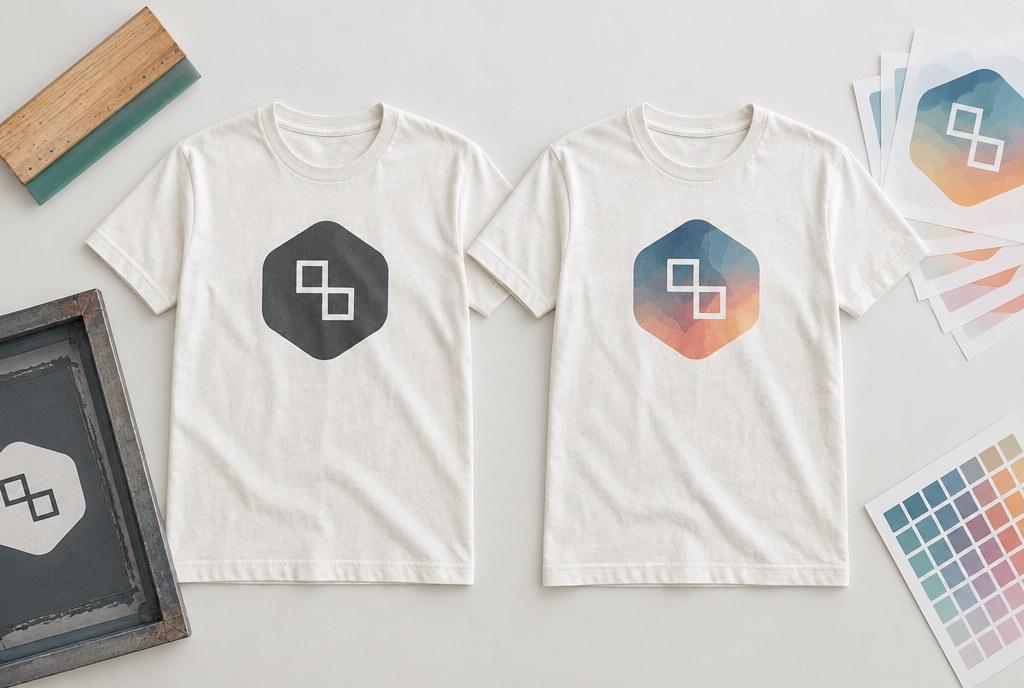
For 100 T-shirts, the answer to "DTF or screen printing?" depends mainly on the number of colours in the design: if the logo has 1–2 colours and is the same on every shirt, screen printing usually costs around EUR 0.80–1.20 per print (including screen preparation), while DTF comes to roughly EUR 1.50–2.50. If the design is a full-colour photo or gradient, screen printing is no longer economical at 100 pcs, and DTF remains the only sensible option. Below is how each price is built up and where the tipping point lies between the two technologies.
How the price is built up in screen printing
Screen printing costs are made up of two parts: a one-off setup cost and the price per print. A separate screen is made for every colour in the design and every print location — roughly EUR 15–25 per screen. This means a three-colour logo on the chest plus a one-colour print on the back already adds up to four screens, i.e. around EUR 60–100 in setup costs, which is spread across 100 shirts.
The actual printing itself is cheap, and the larger the run, the lower the price per piece. At 100 shirts, one colour usually costs around EUR 0.55–0.80 per print; at 300 pcs, it drops by a further 20–30%. That's why screen printing is a technology that "pays off" on repeat orders: the screens can be reused, and on the second order the setup fee is lower or not charged at all.
How the price is built up in DTF heat transfer
DTF (direct-to-film) pricing depends on the print area, not on the number of colours. There is practically no one-off setup fee — you only pay for the printed film area and the pressing. A full-colour image, photo or fine gradient costs the same as a single-colour print of the same size.
Rough figures for 100 shirts: a chest print, left side, 110×90 mm — around EUR 1.20–1.60; an A4-size print on the front or back (up to 280×210 mm) — around EUR 1.80–2.60; a small sleeve print, 80×60 mm — from EUR 0.90. The price per piece drops slowly as the run grows, since each film is printed and pressed individually.
Price comparison: 100 T-shirts
The table below shows indicative totals for printing only (shirts not included), excl. VAT. The exact price depends on the design, number of print locations and fabric.
| Design on 100 T-shirts | Screen printing | DTF | Better value |
|---|---|---|---|
| 1 colour, 110×90 mm on chest | ~20 EUR screens + 100 × 0.65 = ~85 EUR | 100 × 1.40 = ~140 EUR | Screen printing |
| 2 colours, A4 on front | ~40 EUR screens + 100 × 1.20 = ~160 EUR | 100 × 2.10 = ~210 EUR | Screen printing |
| 3 colours on chest + 1 colour on back | ~80 EUR screens + 100 × 1.90 = ~270 EUR | 100 × 2.80 = ~280 EUR | About equal |
| Full-colour photo, A4 | Practically unfeasible (6+ screens) | 100 × 2.30 = ~230 EUR | DTF |
| 100 shirts with 5 different designs (20+20+20+20+20) | 5 × setup = not economical | ~230 EUR | DTF |
The practical rule is simple: up to 2–3 colours and a single design, screen printing is 20–40% cheaper at 100 pcs. From 4 colours upwards, or with photos or several different designs in one order, DTF wins on both price and logistics.
Quality, feel and durability
Screen printing
The ink soaks into the fabric, so the print is thinner, more flexible and sits "flush" with the shirt. It typically withstands 50+ washes at 40°C, doesn't shine and doesn't crack if dried correctly. A white base layer is needed on dark fabric, which slightly increases both price and print thickness.
DTF
The print is durable, vivid and precise even at 1 mm letter size, but feels like a thin, flexible film to the touch. It typically withstands around 30–50 washes if washed at 30–40°C, turned inside out, and not ironed directly over the print. DTF works on cotton, polyester and blended fabrics alike, including sportswear, where plastisol screen-printing ink doesn't always hold well.
Turnaround times and files
Screen printing requires time to make the screens, so 100 shirts are usually ready in 5–8 business days after artwork approval. A DTF run without screens usually takes 3–6 business days. Urgent jobs can be arranged by agreement, provided the required shirt model, size and colour are in stock.
Both technologies work best with vector graphics (.ai, .eps, .pdf, .svg) in CMYK mode; for DTF, we also accept raster files at 300 dpi at actual size with a transparent background. Standard print locations: left chest 110×90 mm, front and back up to 280×210 mm, sleeve 80×60 mm. Before production, we send you the artwork with dimensions and placement on the shirt for approval by email.
How to choose for your order
- Single logo in 1–2 colours, 100+ pcs, repeat order expected → screen printing; you save on screen fees next time.
- Full-colour design, photos, gradients → DTF, regardless of quantity.
- Different sizes and multiple designs in one order (e.g. team numbers or names) → DTF.
- Polyester sportswear shirts and jackets → DTF or sublimation.
- A unified corporate clothing line with a 4+ colour logo → also compare embroidery (up to 90×90 mm), which often looks more suitable on polo shirts and hoodies.
You can choose T-shirt, polo and hoodie models in the clothing category — separately T-shirts, hoodies and polo shirts. For more on the technologies and examples of previous work, see clothing printing.
FAQ
At what quantity does screen printing become cheaper than DTF?
With a single-colour logo, the tipping point is usually 25–40 pcs: below that, the screen setup fee "eats up" the saving; above it, screen printing becomes cheaper. With a three-colour design, the tipping point shifts to 80–150 pcs.
Can both technologies be combined for 100 shirts?
Yes. We often print the chest logo using screen printing (one colour, large quantity), while individual names or numbers on the back are done with DTF transfer. Overall, this works out cheaper than doing everything in DTF.
How long does a DTF print last?
Washed at 30–40°C and turned inside out, it typically withstands around 30–50 washes without visible change. Tumble drying and direct ironing over the print shorten its lifespan.
Do you have to pay for screens every time?
On a repeat order with the same design and the same colours, the setup fee is lower or not charged at all, provided not too much time has passed between orders. We state this in the quote.
What about dark-coloured shirts?
With screen printing, a white base layer is needed on dark fabric — this means an extra screen and a small price addition. With DTF, the white base is already part of the process, so the price is the same on dark and light fabric.
Can I order fewer than 100 pcs?
Yes, we also work with single pieces. For small quantities, DTF makes more sense, as there's no screen setup cost involved.