Food Label Example: Requirements, Material, Price
A real project example from Atta Print: 2,000 label stickers for a home bakery, printed on matte white self-adhesive film with lamination — material choice, mandatory information, prices and turnaround times.
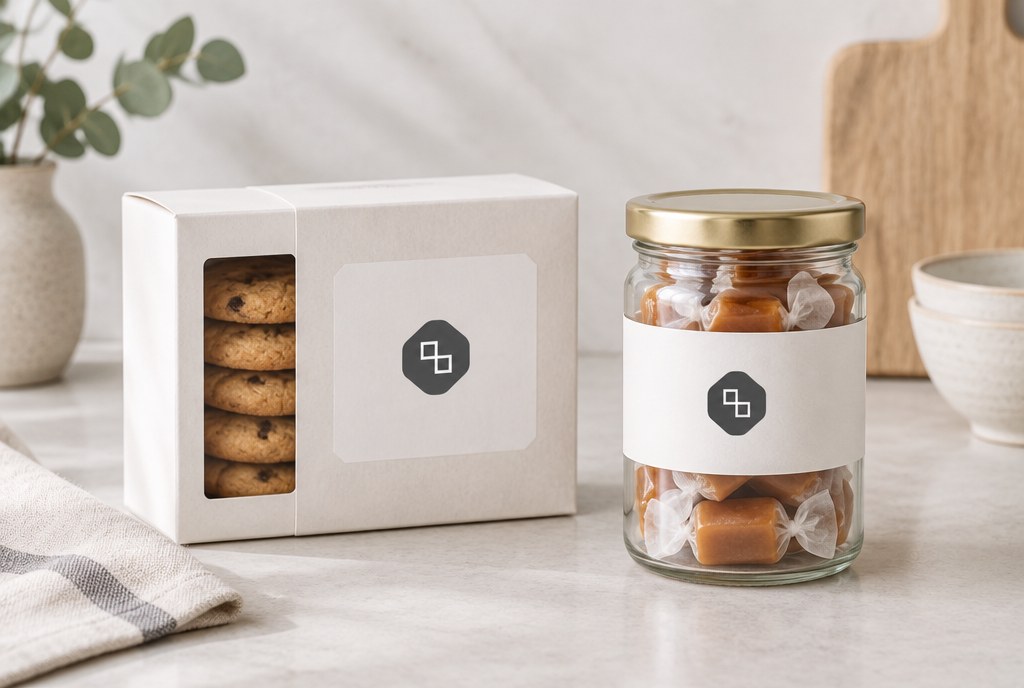
This food label example comes from a project completed this spring: for a local home bakery, we produced 2,000 labels in 60×90 mm format on matte white self-adhesive film with matte lamination, at a price from around €0.11 per piece excl. VAT, with a 5 business day turnaround. Before printing, we prepared a written quote with a material sample and received the client's consent to publish the technical details and photos of the job — at the client's request, we don't disclose the company name. Below we describe in detail how we chose the material and what had to be included on the label.
The task and starting situation
The client bakes cookies and caramels in small batches and had previously used paper stickers printed at home. There were three problems: the stickers absorbed fat from the packaging, the corners started peeling after a couple of days, and the small font size made the ingredients hard to read.
Goal: one label design for three product types, with space on each for the batch number and expiry date to be stamped with a date marker. Print run of 2,000 pcs, of which 800 with one design and 1,200 with two designs.
Which material we chose and why
Three parameters matter most for a food label: adhesive strength on the specific packaging, resistance to moisture and fat, and whether the label will stay at room temperature, in the fridge or in the freezer.
- Matte white self-adhesive film (PP) — this is what we chose. It doesn't absorb fat or moisture, sticks well to paper bags, cardboard boxes and glass jars, and you can write on the matte surface with a pencil or marker.
- Gloss self-adhesive film — brighter colours, suitable for jars and bottles with photographic designs; harder to write on by hand.
- Paper stickers — cheaper, but only suitable for dry environments and short storage periods. In this particular case, they fell off almost immediately.
- Transparent film — useful when you want a "no label" effect on glass; keep in mind that white text needs to be printed as a separate layer.
We planned matte lamination on top. It costs roughly 15–20% of the label price, but protects the print from friction during transport and from fat on people's hands when the product is on a shop shelf. If the product goes into the fridge or will have condensation on it, we almost always recommend lamination.
Important: these labels stick to the outside of the packaging and don't come into direct contact with food. If a label is intended for direct contact with the product, this needs to be agreed separately — the choice of material is then much narrower.
What must be included on a food label
The content of the labelling is governed by EU Regulation No. 1169/2011. Before approving the artwork, we went through the checklist with the client:
- Product name.
- List of ingredients in descending order by weight.
- Allergens highlighted (bold or a different font) — in baking, these are usually wheat, milk, eggs and nuts.
- Net weight in grams.
- Expiry date ("best before" or "use by") and batch number.
- Storage conditions.
- Manufacturer's name and address in Latvia.
- Nutritional values per 100 g.
Letter height: the x-height must be at least 1.2 mm, but if the largest surface of the packaging is smaller than 80 cm², 0.9 mm is permitted. In practice, this means that on a 60×90 mm label, real space must be allocated for the ingredients and nutritional information — in our case, we rearranged the nutrition table horizontally so the text didn't have to be shrunk.
The manufacturer is responsible for the accuracy of the labelling content; we only check the technical parameters — font size, contrast, and trim margins.
Format, contour cutting and production
We produced the labels on sheets of 12 pcs, with contour cutting and rounded corners at a 3 mm radius — sharp corners are the first to peel off. We left a 2 mm bleed and a 3 mm safe zone from the edge for text in the artwork.
If the product is labelled by hand in small batches, sheets are more convenient and cheaper. If a labelling machine is planned, you need a roll with a specified winding direction and inner diameter — this needs to be known before printing. For more on materials and formats, see sticker printing.
Indicative prices
Example for a 60×90 mm label on matte self-adhesive film with lamination, prices excl. VAT and indicative — the exact amount depends on format, material and the number of designs within one print run.
| Quantity | Price per pc | Total (approx.) |
|---|---|---|
| 100 | from €0.38 | €38 |
| 500 | from €0.17 | €85 |
| 1000 | from €0.13 | €130 |
| 2000 | from €0.11 | €220 |
| 5000 | from €0.10 | €500 |
Lamination adds roughly 15–20%; without lamination, the price is correspondingly lower. Multiple designs within one print run usually don't change much, as long as the total quantity stays the same — this is more cost-effective than ordering each design separately.
Files and turnaround times
Printing requires vector graphics — .ai, .eps or .pdf, colours in CMYK, fonts converted to outlines, images at a minimum of 300 dpi. If you only have a Word or Canva file, we can help convert it into print-ready artwork.
The standard turnaround for stickers is 2–5 business days from artwork approval; more complex contour cutting or very large print runs may take longer, which we inform you about already in the quote. Urgent jobs are handled by separate agreement. Before a large print run, we usually prepare one sample sheet so the client can see the colours and font size on real packaging.
If you also need price tags, cards or a booklet with recipe descriptions, we can produce them within the same order — see printing services.
Frequently asked questions
How small a print run is possible?
We also work with small print runs — from 50–100 pcs. Below 100 pcs, setup work accounts for most of the cost, so the price per piece is higher; from 1,000 pcs onwards, it starts to drop significantly.
Will the label withstand the fridge and condensation?
Yes, if you choose polypropylene self-adhesive film with lamination. Paper stickers swell and peel off in moisture. For the freezer, this needs to be specified separately, as a different adhesive is required there — standard adhesive doesn't hold at low temperatures.
Can labels be placed in direct contact with food?
Standard labels are designed for the outside of packaging. If the label will touch the product, this needs to be mentioned already in the request, so we can choose a suitable material or find an alternative solution.
Do you check whether the labelling complies with requirements?
We check the technical side — letter height, contrast, allergen highlighting, safe zones. The food manufacturer is responsible for the labelling content's compliance with regulations.
Can space be left for the expiry date?
Yes, this is common practice. We leave a blank field where the date and batch number are stamped with a date marker or written with a marker pen — on matte film, this doesn't smear.
How long does it take to get a quote?
We prepare a quote within one business day, provided the format, print run and number of designs are known.
Send us your packaging size and planned print run to info@attaprint.lv, call +371 25776699 or message us on WhatsApp at the same number — project manager Madara will prepare a quote within one business day. Contact details and address: Atta Print contacts.
FAQ
How small a print run is possible?
We also work with small print runs — from 50–100 pcs. Below 100 pcs, setup work accounts for most of the cost, so the price per piece is higher; from 1,000 pcs onwards, it starts to drop significantly.
Will the label withstand the fridge and condensation?
Yes, if you choose polypropylene self-adhesive film with lamination. Paper stickers swell and peel off in moisture. For the freezer, this needs to be specified separately, as a different adhesive is required there — standard adhesive doesn't hold at low temperatures.
Can labels be placed in direct contact with food?
Standard labels are designed for the outside of packaging. If the label will touch the product, this needs to be mentioned already in the request, so we can choose a suitable material or find an alternative solution.
Do you check whether the labelling complies with requirements?
We check the technical side — letter height, contrast, allergen highlighting, safe zones. The food manufacturer is responsible for the labelling content's compliance with regulations.
Can space be left for the expiry date?
Yes, this is common practice. We leave a blank field where the date and batch number are stamped with a date marker or written with a marker pen — on matte film, this doesn't smear.
How long does it take to get a quote?
We prepare a quote within one business day, provided the format, print run and number of designs are known.