Artwork Mistakes in Print Files: 12 Reasons Why Printing Goes Wrong
12 common mistakes in print artwork for T-shirts – from JPG logos and RGB colours to elements that are too thin – and how to avoid them before submitting your file.
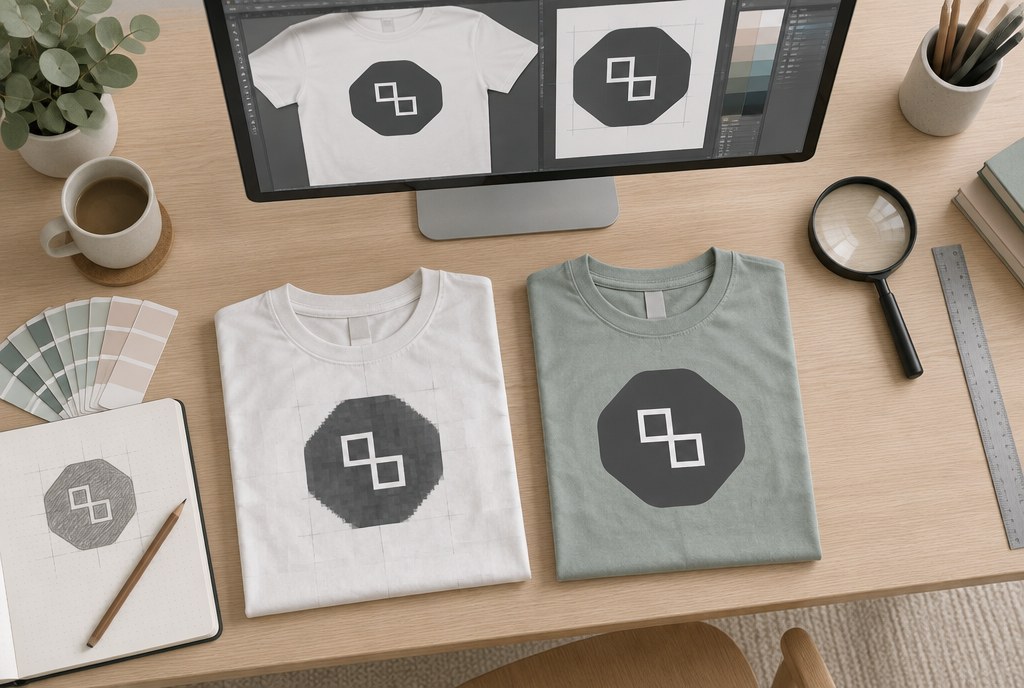
Most reprints in garment printing don't happen at the production stage but in the file itself: roughly 8 out of 10 artworks we receive need correcting in at least one point. The most common artwork mistakes are a raster logo at 72 dpi, text with unembedded fonts, RGB colours, and sizes that don't match the standard printing area (left chest 110×90 mm, front or back up to 280×210 mm, sleeve 80×60 mm, embroidery up to 90×90 mm). Below are 12 specific reasons and how to fix them before sending the file.
Files and formats (1–4)
1. Logo as a JPG taken from a website. 72 dpi is fine for screens, but printing needs 300 dpi at actual size. A logo that's 500 px wide, stretched to 280 mm, turns into a blurry patch with visible pixels. Solution: vector graphics (.ai, .eps, .pdf, .svg) or a raster file of at least 300 dpi at the final size.
2. Artwork as a screenshot from Word, PowerPoint or Canva. These files don't contain print colour information, and elements shift when opened on a different computer. Canva can export a PDF with vector content – that's acceptable, but a PNG screenshot is not.
3. Text not converted to outlines. If a font isn't embedded or converted to outlines, our system replaces it with another one, and the spacing breaks. Before saving: text → outlines (Create Outlines).
4. Logo with a built-in white background. A white square around the logo prints as an actual white square in DTF printing – on a black T-shirt it looks like a sticker. You need a transparent background (PNG with alpha channel or vector without a background object).
Colours (5–7)
5. RGB instead of CMYK. Bright blues, oranges and neon shades in an RGB file become duller once converted to CMYK. If the colour is a core brand element, specify the Pantone code – in screen printing, we mix colours according to it.
6. Number of colours not specified. In screen printing, each colour is a separate screen frame. 1 colour, 1 position starts from €3.50/pc (from 50 pcs – €2.50, from 100 pcs – €1.90) plus a €35.00 setup fee; if the artwork has 4 colours, the setup fee and the price per piece increase accordingly. Often it's enough to redraw the logo in a single colour.
7. Gradients and transparency for screen printing. A smooth transition in screen printing is reproduced with halftone dots and often looks rough on fabric. Photos and gradients are better suited to DTF heat transfer (up to A4 from €6.00/pc, from 50 pcs – €4.20).
Sizes and placement (8–10)
8. No print size specified in millimetres. A file named "logo.pdf" with no size means we have to guess whether it's 80 mm or 250 mm wide. Be specific: "width 250 mm, back, 80 mm from the collar seam".
9. Print overlaps seams, pockets or a zipper. On the front of a hoodie, the pocket and drawstrings limit the available area; a heat press can't apply even pressure on an uneven surface. Check placement on the actual model, not on an abstract rectangle.
10. One artwork for all sizes. A 280 mm wide image on an XS kids' T-shirt runs over the side seams. For orders with a wide size range, we usually prepare two versions of the artwork – this should be planned for from the start.
Technology-specific details (11–12)
11. Elements that are too thin. In screen printing, lines thinner than 0.5 mm and text below 6 pt clog the screen. In embroidery, letter height below 4–5 mm becomes illegible because the thread "fills it in". We simplify or enlarge fine logos.
12. Embroidery artwork with photos or halftones. Embroidery works with a number of thread colours, not a photograph. Up to 10,000 stitches, the price starts from €5.50/pc (from 50 pcs – €3.80) plus a €25.00 digitising fee; a more complex image means more stitches and higher cost, as well as a thicker, stiffer result on the fabric.
What each technology requires from the artwork
| Technology | Ideal file | Colours | Price from (excl. VAT) | Setup |
|---|---|---|---|---|
| Screen printing | vector, colours separated | 1–4, Pantone | €3.50/pc (1 colour) | €35.00 |
| DTF transfer | vector or 300 dpi PNG with transparent background | full colour | €6.00/pc (up to A4) | €0.00 |
| Embroidery | vector, simplified shapes | 1–6 thread shades | €5.50/pc (up to 10,000 stitches) | €25.00 |
Prices are indicative and decrease with larger quantities; the exact amount is calculated based on the garment model, print size and number of colours. For more on options, see the garment printing section, and you can browse the models in the T-shirts and hoodies categories.
How to check your artwork in 5 minutes
- Open the file and zoom the logo to 400% – if the edges blur, it's not a vector.
- Check the colour mode: CMYK or Pantone, not RGB.
- Convert text to outlines and save as a PDF.
- Overlay the actual print frame (e.g. 110×90 mm for the chest) on the artwork and check that everything fits.
- Remove the white background and any stray objects outside the image.
- Specify in your email: print location, size in mm, number of colours, garment model and sizes.
Once the file is in order, we'll send you a quote and an artwork visualisation for approval within one business day; on request, we can also prepare a 3D view with your logo on the specific model. For examples of previous work, see our work.
Frequently asked questions
Can you redraw a logo in vector format?
Yes. Redrawing a simple logo is usually included free of charge as part of artwork preparation; for complex images with lots of detail, we agree on the scope of work separately and specify it in the quote.
What resolution is needed for DTF printing?
300 dpi at the final size. This means an image 280 mm wide needs a file roughly 3300 px wide. Lower resolution shows up on fabric as a soft, blurry outline.
Why does screen printing have a €35 setup fee, but DTF doesn't?
In screen printing, a separate screen is made for each colour – this is a one-off setup regardless of quantity. DTF printing is done digitally without making forms, so small runs are more cost-effective; from around 50–100 pieces, screen printing becomes cheaper per piece.
How small can text be and still be readable when printed?
In screen printing and DTF, the practical limit is 6 pt, or roughly 2 mm letter height. For embroidery, the minimum is 4–5 mm; we recommend removing or enlarging smaller text, otherwise it blurs together.
How long does an order take?
Our own printing – stickers, business cards, posters – takes 1–3 business days. Garment printing and promotional products with a logo usually take 6–10 business days (production 4–7 business days depending on quantity, plus delivery 2–3 days). We review urgent orders individually.
Can artwork be approved over the phone?
No. We approve artwork in writing by email – this protects both sides from misunderstandings about size, colour and placement.
Send your file to info@attaprint.lv or WhatsApp +371 25776699, and we'll check the artwork and prepare a quote within one business day. If you're not sure which technology to choose, give us a call – we'll recommend the best option for your logo and quantity (see the Contacts section).
FAQ
Can you redraw a logo in vector format?
Yes. Redrawing a simple logo is usually included free of charge as part of artwork preparation; for complex images with lots of detail, we agree on the scope of work separately and specify it in the quote.
What resolution is needed for DTF printing?
300 dpi at the final size. An image 280 mm wide needs a file roughly 3300 px wide. Lower resolution shows up on fabric as a soft, blurry outline.
Why does screen printing have a €35 setup fee, but DTF doesn't?
In screen printing, a separate screen is made for each colour – this is a one-off setup regardless of quantity. DTF printing is done digitally without making forms, so small runs are more cost-effective; from around 50–100 pieces, screen printing becomes cheaper per piece.
How small can text be and still be readable when printed?
In screen printing and DTF, the practical limit is 6 pt, or roughly 2 mm letter height. For embroidery, the minimum is 4–5 mm; we recommend removing or enlarging smaller text, otherwise it blurs together.
How long does an order take?
Our own printing – stickers, business cards, posters – takes 1–3 business days. Garment printing and promotional products with a logo usually take 6–10 business days (production 4–7 business days depending on quantity, plus delivery 2–3 days). We review urgent orders individually.
Can artwork be approved over the phone?
No. We approve artwork in writing by email – this protects both sides from misunderstandings about size, colour and placement.