T-shirt Size Chart: How to Collect Sizes from Your Team
A practical size chart for T-shirts and polo shirts, plus instructions on how to collect your team's sizes in one table without mistakes or repeat orders.
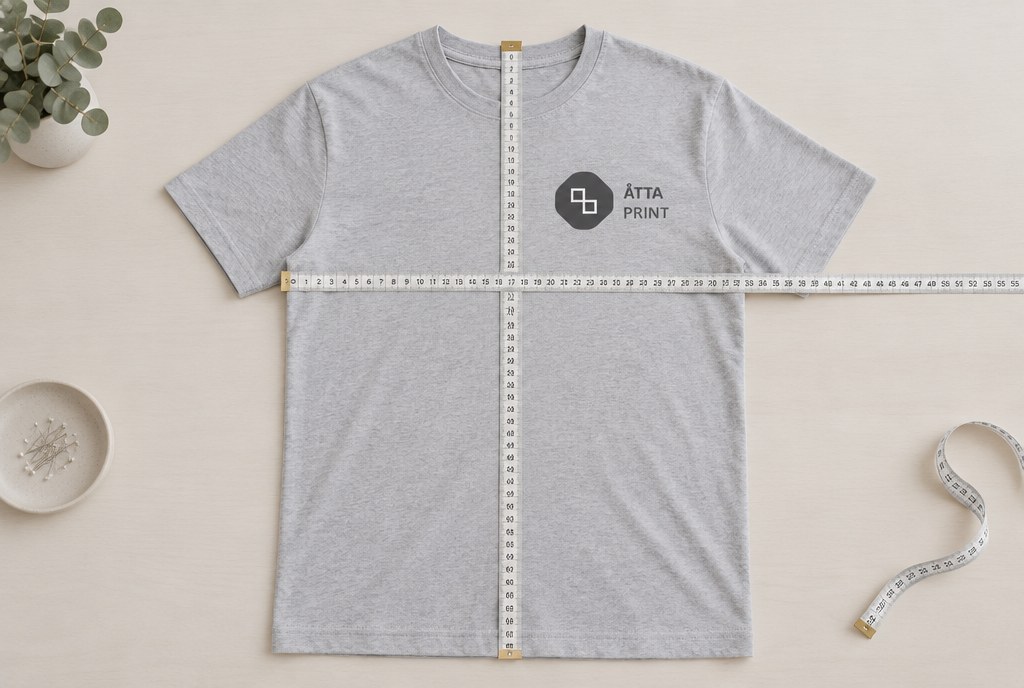
A T-shirt size chart should be read using two numbers: the half-chest width (measured flat, from one underarm to the other) and the length from the shoulder seam. For unisex T-shirts, the half-chest width typically increases by 2 cm per size — S is approximately 46–47 cm, M 49–51 cm, L 53–55 cm, XL 57–59 cm — though a ±2 cm variation is possible depending on the model. It's best to collect sizes from your team in one shared table with a fixed deadline and a 5–10% buffer, since once an order goes into production, sizes can no longer be changed.
Reference T-shirt size chart (unisex)
Measurements are taken on a shirt laid flat, in centimetres. Compare the half-chest width to a measurement of your own shirt, not to your body measurements.
| Size | Half-chest width (cm) | Length from shoulder (cm) | Approximate body chest measurement (cm) |
|---|---|---|---|
| XS | 44 | 68 | 84–88 |
| S | 47 | 70 | 90–94 |
| M | 50 | 72 | 96–100 |
| L | 54 | 74 | 102–107 |
| XL | 58 | 76 | 108–113 |
| 2XL | 62 | 78 | 114–120 |
| 3XL | 66 | 80 | 121–127 |
Women's fit and polo shirts
Women's-fit shirts are narrower at the sides and shorter: S is approximately 42 cm half-chest width and 62 cm length, M — 45 cm and 64 cm, L — 48 cm and 65 cm. Polo shirts generally follow the same half-chest measurements as the T-shirt chart, but the cut is straighter and the fabric heavier (piqué 200–220 g/m²), so people who prefer a looser fit often go up one size.
Children's sizes are given by height: 98/104, 110/116, 122/128, 134/146, 152/164. For school and sports club orders, it's best to ask for height in cm rather than "size by age" — children in the same class can vary considerably.
How to collect sizes from your team: 6 steps
- Choose the model before sending the survey. Each model has its own size chart. Confirm the specific T-shirt or polo first (T-shirts, sweatshirts and jackets), and only then send out a questionnaire with that model's measurements.
- Prepare one shared table. A Google Form or shared spreadsheet with columns: first name, surname, fit (unisex / women's / children's), size, personalisation (name or number), notes.
- Attach the size chart to the question. If people can see the half-chest width chart, the number of errors drops significantly. Ask them to measure their most comfortable shirt rather than guess.
- Set a deadline and a reminder. In practice, for a team of 20–30 people, the survey takes 3–5 days: the first day brings responses from some participants, the rest reply after a reminder.
- Add a buffer. 5–10% extra shirts in medium sizes (M, L, XL) cover new employees and sizing mistakes. A separate follow-up order later costs more, since setup fees apply again.
- Check the total before confirming. The sum of all sizes must match the total number of shirts — this is the most common mistake in confirmed quotes.
Example size breakdown for a 50-shirt order
| Size | Company team | Sports club |
|---|---|---|
| S | 5 | 4 |
| M | 12 | 10 |
| L | 14 | 15 |
| XL | 11 | 12 |
| 2XL | 6 | 6 |
| 3XL | 2 | 3 |
These are reference breakdowns to use when a survey isn't possible (for example, when the shirts are intended for event attendees or as gifts).
Printing technology and price
The size breakdown doesn't affect the printing price, but the total quantity does, significantly. Screen printing becomes cost-effective from 50 pieces, since setup is around 35.00 EUR regardless of the run size. DTF is more cost-effective for small quantities and personalisation (a different name on each shirt), as there's no setup fee.
| Printing | 1–19 pcs | from 20 pcs | from 50 pcs | from 100 pcs | from 250 pcs | Setup |
|---|---|---|---|---|---|---|
| Screen printing, 1 colour, 1 position | from 3.50 | from 3.50 | from 2.50 | from 1.90 | from 1.50 | 35.00 EUR |
| DTF transfer up to A4 | from 6.00 | from 5.00 | from 4.20 | from 4.20 | from 4.20 | 0.00 EUR |
| Embroidery up to 10,000 stitches | from 5.50 | from 4.50 | from 4.00 | from 4.00 | from 4.00 | 25.00 EUR |
Prices are approximate, in EUR per piece excl. VAT, and apply only to the printing — the cost of the T-shirt or polo shirt is added separately, depending on the model, fabric weight and colour. We prepare an exact price once we have the size list and artwork; more about the technologies in the apparel printing section.
Common mistakes when collecting sizes
- Changing sizes after confirmation. Once shirts are printed, the size can no longer be changed. Always send the final list by email as one single file or table.
- Mixing different models. If part of the team wants polo shirts and part wants T-shirts, these are two separate size lists — the fits don't match.
- Women's fit without a heads-up. Women's models are narrower; if someone normally wears a unisex L, they often need an XL or a looser fit in the women's model.
- "One size bigger because of the print." Printing doesn't affect the size. Cotton shirts may shrink 1–2 cm in length after washing at 40°C, but width changes are minimal.
- Personalisation not specified. If shirts need names or numbers, these should be entered in the same table next to the size, spelled correctly with any diacritics.
Files and deadlines
Send your logo as vector artwork (.ai, .eps, .pdf), CMYK. For screen printing, specify the number of colours; for DTF, a vector file or a high-resolution file (at least 300 dpi at actual size) is enough. The standard turnaround for printing is 5–10 business days from confirmation of the artwork and size list; personalised orders with individual names tend to be closer to the upper end. Rush jobs are possible by agreement.
We also work with single pieces — for example, one sample shirt to check sizing before a team order is a commonly used solution. Our other printing services are available in the shop section.
Frequently asked questions
How do I correctly measure a shirt if the chart shows the half-chest width?
Lay your most comfortable shirt flat on a surface, smooth out any creases, and measure the distance from one underarm seam to the other, 2 cm below the armpit. This figure is the half-chest width to compare against the chart.
Can an order include both unisex and women's-fit shirts?
Yes. The printing price stays the same, since the total run is counted together, but the size list must be submitted separately for each fit, to avoid mixing up, for example, unisex M with women's M.
How big a buffer should we add?
5–10% of the total quantity, mostly in medium sizes. For a 50-shirt order, that's 3–5 extra shirts, which is cheaper than a separate follow-up order with a new setup fee.
Can we get a sample before placing the order to check the size?
Yes, one shirt or polo, with or without printing, is possible. This is common practice for sports clubs and companies ordering for the first time.
How should children's sizes be determined for school orders?
Ask for height in centimetres rather than age, and use the height ranges 98/104 up to 152/164. Differences within a class can be significant, so going by age often leads to the wrong size.
Send your size list and logo to info@attaprint.lv or message us on WhatsApp at +371 25776699 — we prepare a quote with the exact price per shirt and printing within one business day. Project manager Madara will help you choose the right model and printing technology for your quantity.
FAQ
How do I correctly measure a shirt if the chart shows the half-chest width?
Lay your most comfortable shirt flat on a surface, smooth out any creases, and measure the distance from one underarm seam to the other, 2 cm below the armpit. This figure is the half-chest width to compare against the chart.
Can an order include both unisex and women's-fit shirts?
Yes. The printing price stays the same, since the total run is counted together, but the size list must be submitted separately for each fit, to avoid mixing up, for example, unisex M with women's M.
How big a size buffer should we add for a team order?
5–10% of the total quantity, mostly in medium sizes. For a 50-shirt order, that's 3–5 extra shirts, which is cheaper than a separate follow-up order with a new setup fee.
Can we get a sample before placing the order to check the size?
Yes, one shirt or polo, with or without printing, is possible. This is common practice for sports clubs and companies ordering for the first time.
How should children's sizes be determined for school orders?
Ask for height in centimetres rather than age, and use the height ranges 98/104 up to 152/164. Differences within a class can be significant, so going by age often leads to the wrong size.