Number of Logo Colours in Printing: How Many Colours Pay Off
How the number of logo colours affects printing costs: in screen printing, each colour needs a separate screen. DTF and UV printing don't change the price based on colour count.
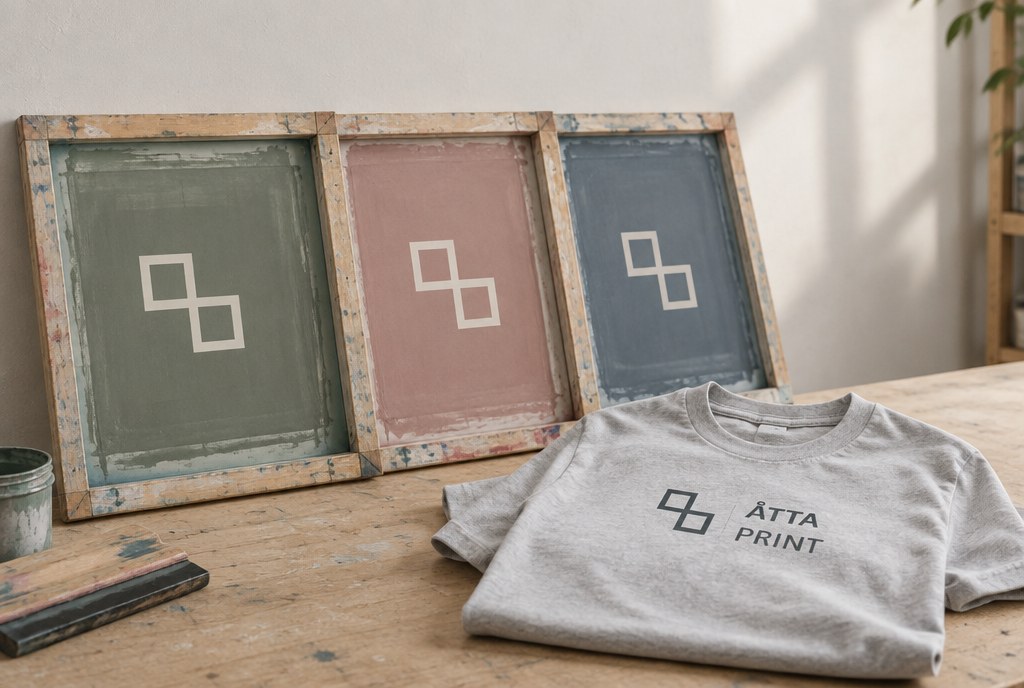
Short answer: the number of logo colours in printing only affects the price in technologies where each colour needs a separate form — screen printing, pad printing and screen printing on mugs. In practice, one colour is the cheapest option, two colours usually increase the cost by 25–40%, and three or more colours at small quantities (up to 50 pcs) often cost more than the product itself. By contrast, in DTF, sublimation and UV printing, the number of colours doesn't change the price — there you pay for the size of the printed area.
Why colours cost extra: the setup work
In screen printing and pad printing, each colour is a separate step: preparing the film, exposing the screen or making the printing plate (cliché), mixing the colour to match the Pantone code, setting up the machine, and achieving precise colour registration. This setup is a one-off cost regardless of whether you print 30 or 3,000 units.
That's why at large quantities, the number of colours is almost irrelevant — the setup cost spreads across more pieces. At 20–50 pieces, it's the main part of the price. As a rough guide, screen preparation in Latvia starts from EUR 15, and a pad printing cliché from EUR 20 (excl. VAT).
Where the number of colours doesn't change the price
- DTF printing on textiles — full-colour image, including gradients and photographs.
- Sublimation on mugs, towels, polyester clothing.
- UV printing on bottles, thermal mugs, pens, plastic and metal.
- Digital printing on paper — business cards and flyers are printed in CMYK, so one colour or five costs the same.
- Stickers — die-cut stickers are also produced in full colour.
Rough price comparison by number of colours
Below are rough prices per piece for printing (excl. VAT, excl. product cost), assuming a quantity of 100 pcs:
| Technology | 1 colour | 2 colours | 3–4 colours | Full colour |
|---|---|---|---|---|
| Screen printing on T-shirt | from EUR 1.50 | from EUR 1.80 | from EUR 2.60 | not available |
| Pad printing (pens) | from EUR 0.25 | from EUR 0.45 | from EUR 0.70 | not available |
| DTF on textile | from EUR 4.00 | from EUR 4.00 | from EUR 4.00 | from EUR 4.00 |
| Sublimation on mug | — | — | — | from EUR 2.00 |
| UV printing on bottle/thermal mug | from EUR 1.50 | from EUR 1.50 | from EUR 1.90 | from EUR 2.20 |
| Embroidery (up to 5,000 stitches) | from EUR 4.00 | from EUR 4.00 | from EUR 4.50 | — |
Figures are approximate. The exact price depends on quantity, print area, material and number of locations (front + sleeve already counts as two locations).
How to choose the number of colours in practice
1–2 colours: the safest option
One or two tones work everywhere — on textiles, pens, notebooks, bags. If your logo is based on two colours, you'll never need to redraw the file just because the chosen technology doesn't allow more. This is also why most Latvian sports clubs and municipal logos use two colours.
3–4 colours: acceptable from 100 pieces
At 100+ pieces, setup costs are no longer critical. However, keep in mind that each additional colour increases the risk of misregistration on stretchy fabric and extends the lead time by 1–2 business days.
Gradients and photo effects
If your logo contains a transition from one tone to another, screen printing and pad printing are practically not an option — they use a halftone pattern that looks coarse on fabric. In such cases, we recommend DTF or sublimation. The garment printing section shows which methods we use for which material.
One colour, but several background tones
A common mistake: a customer chooses navy, red and grey T-shirts with the same logo. On dark fabric, screen printing requires a white base layer under the colour — that's an extra screen pass, essentially a second colour. The solution is simple: also prepare a single-colour white version of your logo for dark-coloured items. It costs nothing and saves EUR 0.40–0.80 per piece.
The same logic applies to mugs and thermal mugs — on a black thermal mug, a light single-colour logo looks cleaner and costs less than a full-colour image with a white base.
How to prepare the file
Send your logo as vector graphics (.ai, .eps or .pdf) with colours in CMYK or Pantone codes. If the colours in the file are RGB, we'll convert them, but the result on the material may differ by one shade — especially bright greens and oranges. Also specify the minimum line thickness: lines thinner than 0.25 mm can clog in screen printing and bleed in pad printing.
If you don't have a vector file, we can redraw your logo — this usually costs EUR 20–40 depending on complexity and takes one business day.
Lead times
| Job | Lead time |
|---|---|
| DTF or sublimation, up to 50 pcs | 5–7 business days |
| Screen printing 1–2 colours, 100 pcs | 5–8 business days |
| Screen printing 3–4 colours | 7–10 business days |
| Embroidery (including programme setup) | 7–10 business days |
Lead time is counted from artwork approval. Urgent jobs can be done faster by arrangement. You can browse our full range in the promotional products catalogue.
Frequently asked questions
How many colours is the most cost-effective option for a logo?
One colour. Two colours usually increase the printing cost by 25–40% at quantities up to 100 pcs. From 250 pieces, the difference between one and two colours shrinks to just a few cents per piece.
Is a full-colour logo always more expensive?
No. In DTF, sublimation and UV printing, the number of colours doesn't affect the price at all — you pay for the printed area. Full colour is only more expensive in screen printing and pad printing.
Can you print just 1 piece?
Yes, we also work with single pieces, but then digital methods are recommended — DTF, sublimation or UV printing, which have no setup costs. Screen printing for a single piece isn't economically justified.
How do I get an exact brand colour?
Specify the Pantone code. In screen printing and pad printing, the colour is mixed to match the code, giving a close match. In digital methods (DTF, UV), the colour is built from CMYK, so certain bright tones may differ — we'll inform you of this before starting the job.
Can a logo with a gradient be printed on a T-shirt?
Yes, with DTF or sublimation. In screen printing, a gradient is created using a halftone pattern and looks dotted on fabric, so we don't recommend it for such files.
Send us your logo file and approximate quantity at info@attaprint.lv or WhatsApp +371 25776699 — we'll tell you which technology is the cheapest for your specific case. We prepare quotes within one business day.
FAQ
How many colours is the most cost-effective option for a logo?
One colour. Two colours usually increase the printing cost by 25–40% at quantities up to 100 pcs. From 250 pieces, the difference between one and two colours shrinks to just a few cents per piece.
Is a full-colour logo always more expensive?
No. In DTF, sublimation and UV printing, the number of colours doesn't affect the price at all — you pay for the printed area. Full colour is only more expensive in screen printing and pad printing.
Can you print just 1 piece?
Yes, we also work with single pieces, but then digital methods are recommended — DTF, sublimation or UV printing, which have no setup costs. Screen printing for a single piece isn't economically justified.
How do I get an exact brand colour?
Specify the Pantone code. In screen printing and pad printing, we mix the colour to match the code, giving a close match. In digital methods, the colour is built from CMYK, so certain bright tones may differ — we'll inform you of this before starting the job.
Can a logo with a gradient be printed on a T-shirt?
Yes, with DTF or sublimation. In screen printing, a gradient is created using a halftone pattern and looks dotted on fabric, so we don't recommend it for such files.