Furniture manufacturer labels, catalogues and exhibition stands: a guide
Which labels, care instructions, catalogues and exhibition materials a furniture manufacturer needs. Materials, sizes, turnaround times and indicative prices.
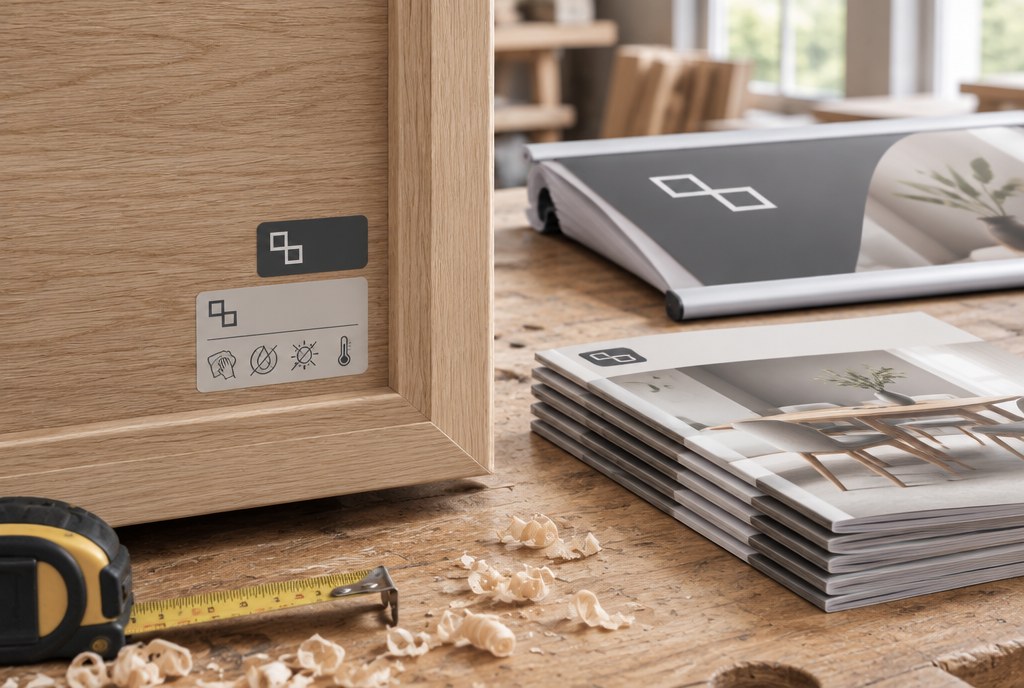
In practice, furniture manufacturer labelling covers three separate tasks: a product identification sticker (model, batch, date, traceability code), a material and care instruction for the buyer, and transport marking on packaging. For all three we print a range of materials — from paper on rolls to PP film and vinyl that withstand warehouse humidity and cleaning agents. We produce our own printed goods (stickers, catalogues, posters) in 1–3 business days, while promotional products with a logo usually take 6–10 business days.
What labels a furniture workshop needs
In furniture manufacturing (NACE 31.00), a single product unit usually carries several types of marking, each with different requirements:
- Product identification label — model name, article number, batch, production date, barcode or QR code. Often needed on rolls so it can be fed into a thermal printer or applied on a conveyor line.
- Material and care instruction — fabric, filling, wood type, cleaning pictograms. This usually needs several languages: LV, EN, and often LT, ET, RU or DE for export.
- Assembly and warning labels — weight limits, anti-tip fixing, "do not stand on drawers". We print these on durable PP film, as they stay on the furniture for its entire lifetime.
- Brand label or seal — a metallised or transparent sticker with contour cutting, applied to the packaging.
- Transport marking — large A5/A4 labels with order number and address, usually white matte paper.
How to choose the material
Paper stickers are the cheapest option and work well for internal logistics and cardboard boxes. PP film doesn't tear and withstands moisture — we recommend it for care instructions and warning labels that stay on the product. Vinyl suits outdoor conditions and washable surfaces, while transparent and metallised material works well for brand marking on the finished furniture or packaging. See all options in the stickers section.
| Marking | Material | Typical size | Format |
|---|---|---|---|
| Barcode identification | White paper | 50×30 mm | Roll |
| Care instruction (3–5 languages) | PP film | 90×60 or 100×70 mm | Roll / sheet |
| Warning label | PP film | 60×40 mm | Roll |
| Brand label | Metallised, contour-cut | Ø 40 mm | Sheet |
| Transport label | Paper | A5 or A4 | Sheet |
Indicative pricing: small paper stickers on a roll from around EUR 0.03–0.08/pc at 1,000 pcs; PP film is roughly 1.5–2 times more expensive. Prices excl. VAT; the exact price depends on size, material, quantity and number of colours.
Catalogues, price sheets and technical specifications
In furniture retail, a printed catalogue still does the job — especially in talks with B2B clients, architects and interior designers. In practice, manufacturers order three types of publications:
- Collection catalogue — A4 or square format, 16–48 pages, stapled or glued; 250 gsm cover, 150 gsm inner pages, matte lamination on the cover.
- Fabric and finish sheet — a single A4 sheet on 300 gsm card, which can be placed in a folder together with actual material samples.
- Technical sheet per model — dimensions, drawing, load specifications, assembly diagram. These are often needed in small quantities and with frequent revisions, so digital printing from 1 piece is more cost-effective than offset.
For small quantities and quick updates, we use digital printing, which also covers business cards, showroom opening invitations and calendars for clients.
Exhibition stand: what to prepare
At a furniture exhibition, the stand is mostly the product itself, but the brand still needs to be visible from a distance. The minimum set:
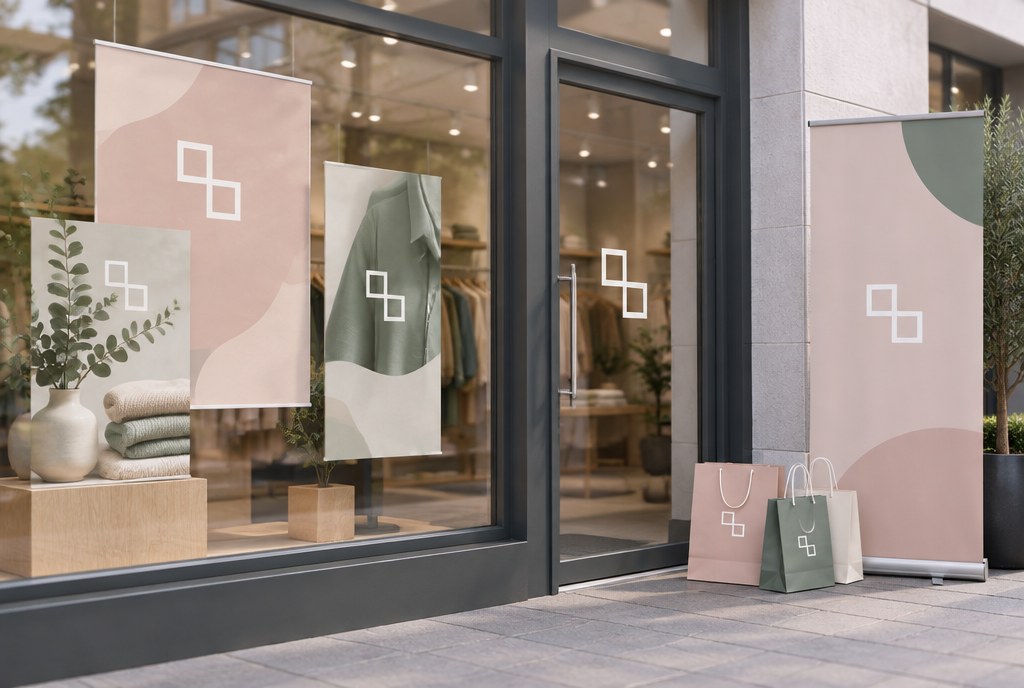
- Roll-up banner stand 100×200 cm with collection visuals — easy to transport and also works in a showroom. Indicatively from around EUR 70 per set with cassette.
- PVC banner with eyelets for the back of the stand or a facade, sized to the stand's height.
- Beach flags at the entrance or around the production site.
- Posters A2–A0 with collection photos and a QR code linking to the catalogue.
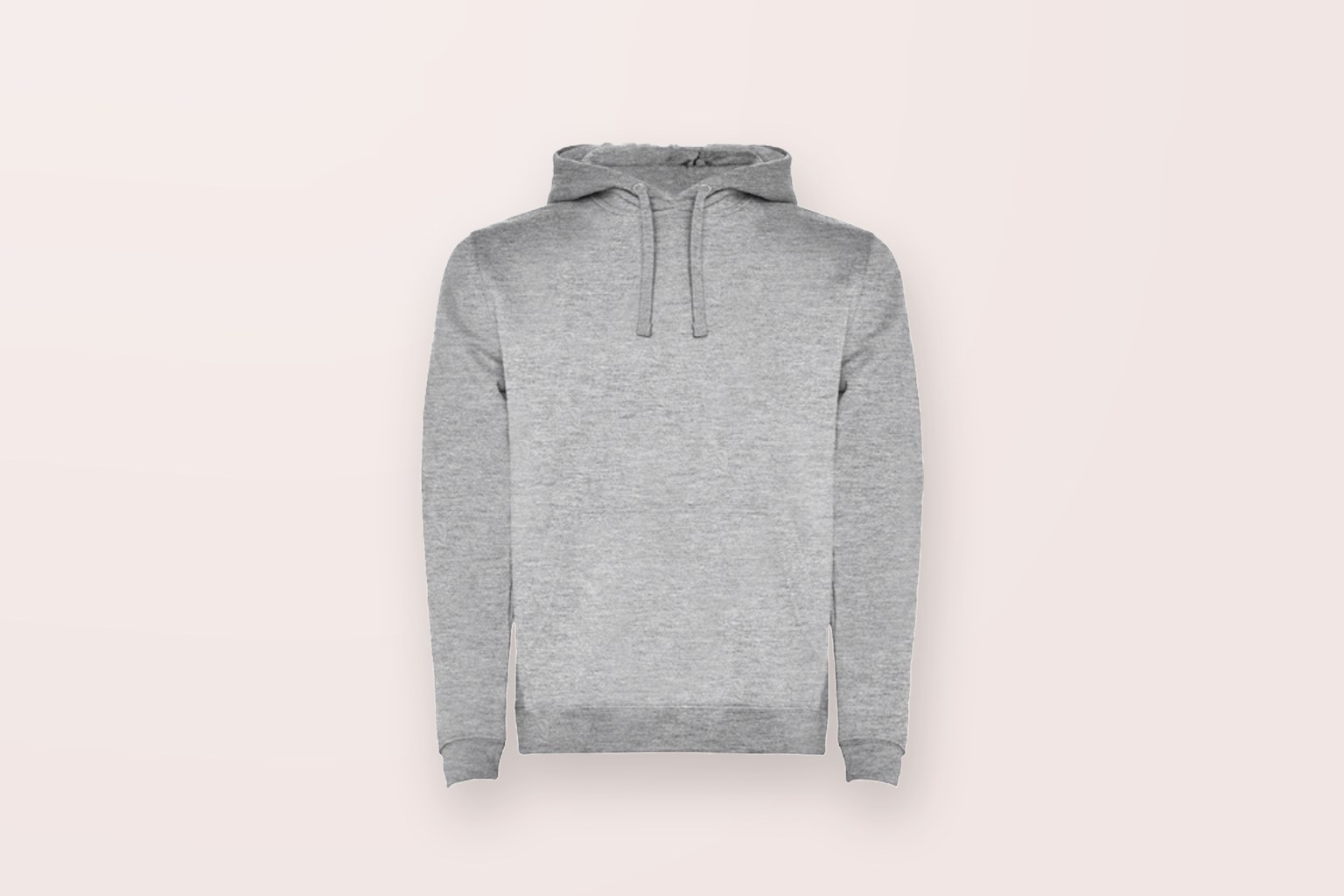
We print all large-format items to your dimensions — see banners and roll-up stands and large-format printing. Stand staff usually also need matching outfits: polo shirts or hoodies with embroidery on the left chest (up to 90×90 mm) look tidier than full-front printing.
Files and turnaround times
Send artwork as vector graphics (.ai, .eps, .pdf, .svg), CMYK; raster images at 300 dpi. For die-cut stickers, mark the cut line on a separate layer and leave a 2 mm bleed. Before production, we send the artwork for approval by e-mail.
Turnaround times: stickers, business cards, posters and catalogues — 1–3 business days; promotional products with printing — usually 6–10 business days (production 4–7 business days + delivery 2–3 days). Urgent jobs can be arranged by agreement.
Frequently asked questions
What's the minimum quantity for labels?
We also work with small quantities — sheets from a few dozen pieces. For rolls, it's economically reasonable to start from around 500–1,000 pcs per design, since most of the setup work is the same regardless of quantity.
Does the care instruction label withstand moisture and cleaning?
Yes, if it's printed on PP film or vinyl. Paper isn't suitable for this — after the first wet cleaning, the text becomes illegible. If the label is on the underside or back of the furniture and isn't cleaned, paper is fine.
Can you print several languages on one label?
Yes. In practice, 3–5 languages fit on a 90×60 mm label if you use pictograms and a 6 pt font. If there's more text, we recommend a fold-out label or a QR code linking to an instruction page on your website.
How many pages is cost-effective for a furniture collection catalogue?
The most common option is 16–24 pages in A4 format, stapled. The page count should be divisible by 4. If your collection changes every season, print smaller quantities more often rather than 5,000 copies at once.
Can I order a roll-up stand and labels in one order?
Yes, everything is produced in one location at Kandavas iela 29A, Riga, and you'll see each item quoted separately with its own price and turnaround time. See examples of our work — our work.
What should I send to get a quote?
For labels — size, material, quantity, sheets or rolls; for a catalogue — page count, format, paper; for a stand — dimensions and where the stand will be used. If you don't have artwork yet, a logo and description are enough.
Write to info@attaprint.lv or call +371 25776699 (also WhatsApp) — we prepare a quote with prices, printing areas and turnaround times for each item within one business day.
FAQ
What's the minimum quantity for labels?
We also work with small quantities — sheets from a few dozen pieces. For rolls, it's economically reasonable to start from around 500–1,000 pcs per design, since most of the setup work is the same regardless of quantity.
Does the care instruction label withstand moisture and cleaning?
Yes, if it's printed on PP film or vinyl. Paper isn't suitable for this — after the first wet cleaning, the text becomes illegible. If the label is on the underside or back of the furniture and isn't cleaned, paper is fine.
Can you print several languages on one label?
Yes. In practice, 3–5 languages fit on a 90×60 mm label if you use pictograms and a 6 pt font. If there's more text, we recommend a fold-out label or a QR code linking to an instruction page on your website.
How many pages is cost-effective for a furniture collection catalogue?
The most common option is 16–24 pages in A4 format, stapled. The page count should be divisible by 4. If your collection changes every season, print smaller quantities more often rather than 5,000 copies at once.
Can I order a roll-up stand and labels in one order?
Yes, everything is produced in one location at Kandavas iela 29A, Riga, and you'll see each item quoted separately with its own price and turnaround time.
What should I send to get a quote?
For labels — size, material, quantity, sheets or rolls; for a catalogue — page count, format, paper; for a stand — dimensions and place of use. If you don't have artwork yet, a logo and description are enough.