Paper weight in printing: uses of 80, 130, 170 and 300 g/m²
What paper weight do you need for flyers, booklets, posters and business cards? A practical guide with a comparison table and indicative prices.
Paper weight in printing is measured in grams per square metre (g/m²), and in practice the choice is based on four main levels: 80 g/m² is standard office and document paper, 130 g/m² is the weight used for flyers and catalogue inner pages, 170 g/m² is the weight for higher-quality flyers, booklets and posters, while 250–350 g/m² is used for business cards, covers and postcards. On the Latvian market, the standard for business cards is 300–350 g/m², for A5 flyers it's 130 or 170 g/m², and for A2–A0 posters it's 130–200 g/m². Below is a table with specific uses and indicative prices excluding VAT.
What g/m² actually means
Weight is the mass in grams of one square metre of paper. It's not the same as thickness in millimetres, although the two usually correlate: the higher the weight, the thicker and stiffer the sheet. However, two papers of the same weight can feel quite different – uncoated (offset) paper at 170 g/m² is bulkier and softer, while coated 170 g/m² is thinner, smoother and reproduces colour more vividly.
The other key parameter is the surface finish: matt, gloss or uncoated. A gloss surface gives richer colours and higher contrast, while matt gives a calmer tone and better readability for text pages. Uncoated paper is the only type that's comfortable to write on with an ordinary pen, which is why it's chosen for forms, questionnaires and notebook inner pages.
80 g/m² – documents, forms, internal materials
This is the classic A4 office paper. It's used for invoices, contracts, forms, internal regulations, seminar handouts and black-and-white multi-page documents. 80 g/m² is see-through against light, so it's practically never used for advertising flyers – double-sided printing "shows through".
Closely related weights include 90–100 g/m² for branded letterhead forms and 120 g/m² for letter paper, where a slightly more solid feel is desired.
130 g/m² – flyers and multi-page booklets
130 g/m² coated paper is the most commonly ordered flyer material. The sheet is already opaque, costs are low, and for large quantities it's the most economical option for A5 or A6 advertising in mailboxes, at checkouts or at events.
The same weight is used for booklet and catalogue inner pages when the page count is 16 or more – this keeps the publication from becoming too heavy and ensures it folds well. For café menus, 130 g/m² is too thin if the menu is handled every day.
170 g/m² – quality flyers, posters, menus
170 g/m² is a compromise between price and feel in the hand. The sheet already holds its shape, doesn't bend easily, and colours look richer. We recommend it for:
- A5 and A4 flyers handed out to customers in person;
- single-sheet menus and drinks lists (often laminated);
- folded booklets with 4–6 pages;
- indoor posters and prints in A3–A2;
- catalogue covers, when the inner pages are 130 g/m².
250–350 g/m² – business cards, postcards, covers
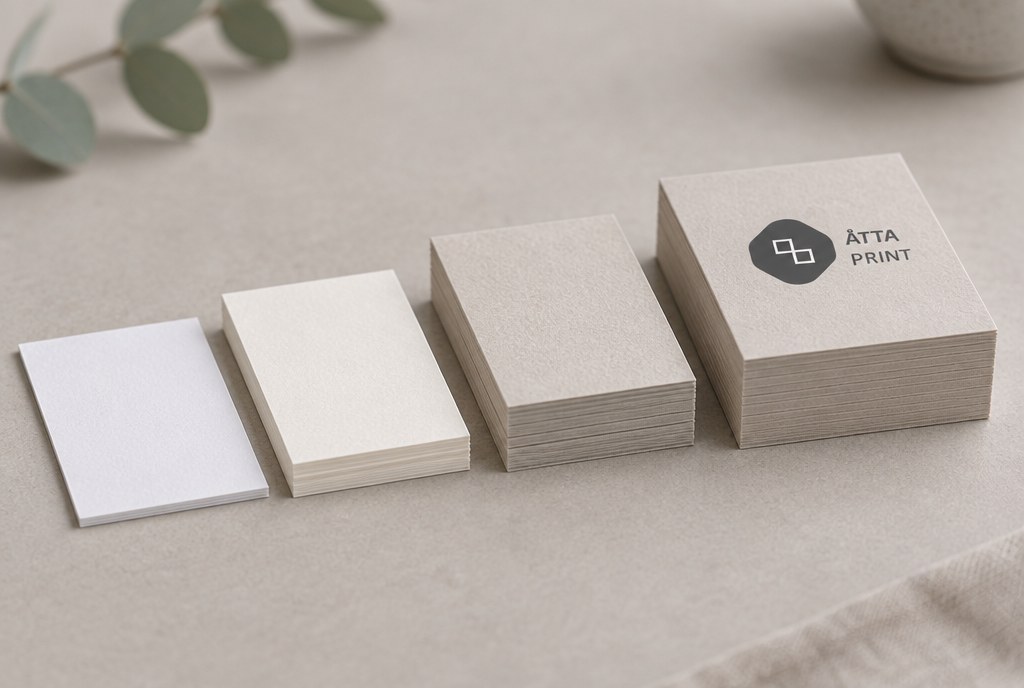
Business cards thinner than 250 g/m² look unfinished. The standard solution is 300 g/m², a more solid option is 350 g/m², or a two-layer laminate in the 600 g/m² range. The same group includes gift cards, loyalty cards, menu covers, invitations, price tags and packaging elements. All of these products can be finished with matt or gloss lamination, which protects against scuffing and moisture. You can view samples and sizes in the business cards and cards section.
Comparison table
| Weight | Typical product | Surface | Indicative price excl. VAT |
|---|---|---|---|
| 80 g/m² | Forms, documents, A4 handouts | Uncoated | from EUR 0.10/sheet (colour printing) |
| 100–120 g/m² | Letterhead forms, letter paper | Uncoated | from EUR 0.15/sheet |
| 130 g/m² | A5/A6 flyers, catalogue inner pages | Coated matt/gloss | 100 pcs A5 from EUR 35 |
| 170 g/m² | A5/A4 flyers, booklets, A3 posters | Coated matt/gloss | 100 pcs A5 from EUR 45 |
| 200–250 g/m² | Menus, postcards, price tags | Coated + lamination | from EUR 0.60/pc |
| 300 g/m² | Business cards, cards, invitations | Coated, laminated | 100 pcs business cards from EUR 25 |
| 350 g/m² | Business cards with a firmer feel, covers | Coated, laminated | 100 pcs from EUR 30 |
Prices are indicative and apply to double-sided colour printing. The exact amount depends on quantity, format, lamination and finishing – the unit price for 1000 pcs is usually 3–5 times lower than for a run of 100 pcs. You can browse the full range of printing services in the shop section.
How to choose: three practical questions
How long will the material need to last? A flyer for a one-day event only needs 130 g/m². A menu used for six months needs 250–300 g/m² with lamination.
Will it be written on? If so, choose uncoated paper or matt lamination – an ordinary pen won't write on a glossy surface.
How many pages will the publication have? A 32-page catalogue made from 170 g/m² paper ends up heavy and folds poorly; it's better to use 130 g/m² for the inner pages and 250–300 g/m² for the cover.
Files and deadlines
We accept artwork in vector format (.ai, .eps, .pdf) in CMYK colour space, with a 3 mm bleed. For raster images, the print resolution should be 300 dpi at actual size; for large-format printing, 150 dpi is sufficient. The standard turnaround time is 2–5 business days, depending on the product and quantity; urgent jobs can be arranged separately.
Frequently asked questions
What paper weight is best for flyers?
For large runs of A5 and A6 flyers – 130 g/m², but if flyers are handed directly to customers and need to look more solid, choose 170 g/m². Below 115 g/m², double-sided printing starts to show through the sheet.
Are 300 g/m² business cards mandatory?
Not mandatory, but 300 g/m² is the market standard. 250 g/m² is an acceptable budget option, while 350 g/m² or a two-layer paper is a choice if you want a notably stiff card.
What's the difference between matt and gloss paper?
Gloss gives more vivid colours and higher contrast, but it reflects light and shows fingerprints clearly. Matt is calmer, more pleasant to read and more practical for products that are handled frequently.
What paper is needed for posters and prints?
For indoor posters in A3–A0, we use 130–200 g/m² paper. If the poster will be used repeatedly or in a damp environment, it's better to choose PVC or photo banner material – available in our banners and roll-up stands section.
What's the minimum order quantity?
We also work with single pieces – digital printing allows this. The unit price drops starting from around 100 pcs, and is significantly lower from 500–1000 pcs.
If you're not sure which weight to choose, email info@attaprint.lv or call or WhatsApp us at +371 25776699 – tell us where the material will be used, and we'll suggest the most suitable option. We prepare quotes within one business day.
FAQ
What paper weight is best for flyers?
For large runs of A5 and A6 flyers – 130 g/m², but if flyers are handed directly to customers and need to look more solid, choose 170 g/m². Below 115 g/m², double-sided printing starts to show through the sheet.
Are 300 g/m² business cards mandatory?
Not mandatory, but 300 g/m² is the market standard. 250 g/m² is an acceptable budget option, while 350 g/m² or a two-layer paper is a choice if you want a notably stiff card.
What's the difference between matt and gloss paper?
Gloss gives more vivid colours and higher contrast, but it reflects light and shows fingerprints clearly. Matt is calmer, more pleasant to read and more practical for products that are handled frequently.
What paper is needed for posters and prints?
For indoor posters in A3–A0, we use 130–200 g/m² paper. If the poster will be used repeatedly or in a damp environment, it's better to choose PVC or photo banner material.
What's the minimum order quantity?
We also work with single pieces – digital printing allows this. The unit price drops starting from around 100 pcs, and is significantly lower from 500–1000 pcs.