Screen printing: how it works and when it pays off
We explain how screen printing works, how much screen preparation costs, and from what quantity it becomes cheaper than DTF printing.
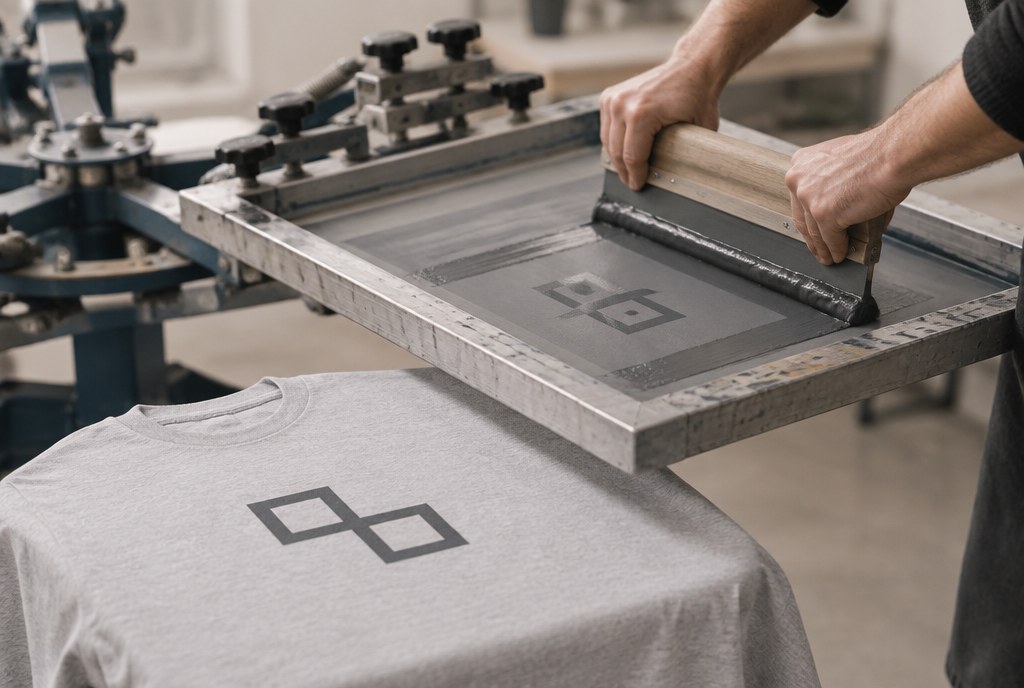
Screen printing is a printing technology where ink is pushed through a stencil (screen) onto fabric or another material — each colour needs its own screen. Screen preparation costs approximately 15–25 EUR per colour per layout, so screen printing starts to pay off from around 30–50 units, and at 100+ T-shirts it's almost always the cheapest method. The standard turnaround is 5–10 business days, depending on the number of colours and quantity.
How screen printing works technically
The process consists of four stages, which explains why the price depends so heavily on the number of colours.
- Splitting the file by colour. The vector design is split into separate layers — one per colour. If a logo has three colours, there will be three screens.
- Making the screen. A synthetic mesh stretched on a frame is coated with light-sensitive emulsion, exposed to UV light and washed out. Wherever ink needs to go, the mesh stays open.
- Setting up on the carousel. The screens are mounted, positioned (registered) and a test print is made. For multi-colour jobs, this is the most time-consuming stage.
- Printing and curing. Ink is pushed through the screen onto the fabric with a squeegee, then the print is cured in a tunnel dryer at 150–160 °C. Properly cured plastisol ink withstands hundreds of washes.
This is exactly why, in screen printing, it's not the printing itself that costs the most, but the preparation. Once the screens are ready, each additional unit is cheap.
When screen printing beats DTF
DTF (film transfer) printing doesn't require screens, so it's convenient for 1–30 pieces and multicolour photographic images. Screen printing wins on quantity and large print areas.
| Situation | Recommended method |
|---|---|
| 1–20 T-shirts, multicolour image | DTF |
| 30–50 units, 1–2 colours | Screen printing or DTF (needs calculation) |
| 100+ units, 1–4 colours | Screen printing |
| Large print area, A3 on the back | Screen printing |
| Photo with gradients | DTF or sublimation |
| Tote bags, large quantities | Screen printing |
Approximate screen printing prices per print (one colour, A4 area), excl. VAT and excl. garment price:
| Quantity | Price per print | Screens |
|---|---|---|
| 25 pcs | from 3.50 EUR | 15–25 EUR / colour |
| 50 pcs | from 2.60 EUR | 15–25 EUR / colour |
| 100 pcs | from 1.90 EUR | 15–25 EUR / colour |
| 250 pcs | from 1.70 EUR | 15–25 EUR / colour |
| 500 pcs | from 1.50 EUR | 15–25 EUR / colour |
These figures are indicative — the exact price depends on the number of colours, print size, number of locations (front, back, sleeve) and fabric. We prepare a quote based on your specific file and quantity; you can also browse the full garment printing range on our website.
What materials screen printing works on
Best results come on cotton and cotton/polyester blends: T-shirts, polo shirts, hoodies, tote bags, aprons, towels. On 100% polyester sportswear, colour migration should be expected, so a blocking base colour is used, or we recommend sublimation instead.
For dark fabrics, a white base layer is printed under the light colour — this is an extra screen pass, so printing on a black T-shirt costs more than the same design on a white one. Very fine lines under 0.3 mm and small text under 6 pt can clog the screen, so designs sometimes need slight adjustment.
Colour accuracy
Colours are mixed according to a Pantone reference, so screen printing is more precise than digital printing when a brand colour is strictly defined. If the file only has CMYK values, we match the closest shade and show a test print before the full run.
What files are needed
- Vector graphics: .ai, .eps or .pdf with text converted to outlines.
- Pantone or CMYK colours specified.
- Scale 1:1 or the desired print size specified in millimetres.
- If you only have JPG/PNG, we can redraw it as vector — approximately 20–40 EUR depending on complexity.
Standard print sizes: A4 or A3 on the front of a T-shirt, up to A3 on the back, 80–100 mm in the pocket area, 200–250 mm wide on a tote bag.
Turnaround and quantities
A screen printing job usually takes 5–10 business days from design approval: 1–2 days for screens and setup, the rest for printing, curing and quality control. Rush orders are possible by arrangement if the garments are in stock.
The practical minimum order for screen printing is 20–25 pieces. For smaller quantities we offer DTF or embroidery — we can also handle a single piece, just with a different method. We can supply ready-made T-shirts from our catalogue or print on garments you provide, if agreed in advance.
Frequently asked questions
From how many pieces is screen printing cheaper than DTF?
In practice, the threshold is 30–50 units for one or two colours. At 100 pieces, screen printing usually costs 30–50% less than DTF, since the screen cost is spread across the whole run.
How much do screens cost, and do I have to pay for them again?
A single-colour screen costs approximately 15–25 EUR. If you repeat the same design at the same size within a year, you usually won't need to pay for screens again — we keep them on file.
How many colours can be printed in one design?
Technically up to 6 colours. In practice, 1–3 colour designs are the most cost-effective; each additional colour increases both the screen cost and setup time.
Does screen printing survive washing?
Yes. Properly cured plastisol prints withstand 50+ washes at 40 °C. We recommend washing inside out and not ironing directly over the print.
Can you print on my own garments?
Yes, but the fabric and seam placement need to be checked beforehand. We take responsibility for the print only, not the garment itself, so we recommend providing 1–2 spare pieces.
How long does an order take?
The standard turnaround is 5–10 business days from artwork approval. Rush jobs can be arranged on request.
Send us your design file, quantity and preferred garment to info@attaprint.lv or message us on WhatsApp +371 25776699 — we'll prepare a quote with the price per piece and screen costs within one business day. See our other services at the attaprint.lv shop.
FAQ
From how many pieces is screen printing cheaper than DTF?
In practice, the threshold is 30–50 units for one or two colours. At 100 pieces, screen printing usually costs 30–50% less than DTF, since the screen cost is spread across the whole run.
How much do screens cost, and do I have to pay for them again?
A single-colour screen costs approximately 15–25 EUR. If you repeat the same design at the same size within a year, you usually won't need to pay for screens again — we keep them on file.
How many colours can be printed in one design?
Technically up to 6 colours. In practice, 1–3 colour designs are the most cost-effective; each additional colour increases both the screen cost and setup time.
Does screen printing survive washing?
Yes. Properly cured plastisol prints withstand 50+ washes at 40 °C. We recommend washing inside out and not ironing directly over the print.
Can you print on my own garments?
Yes, but the fabric and seam placement need to be checked beforehand. We take responsibility for the print only, not the garment itself, so we recommend providing 1–2 spare pieces.
How long does an order take?
The standard turnaround is 5–10 business days from artwork approval. Rush jobs can be arranged on request.