Sublimation Mugs: How a Full-Colour Image Is Made
How sublimation on a mug turns printing into an image inside the ceramic glaze, what the technology's limits are, and how long the print survives washing.
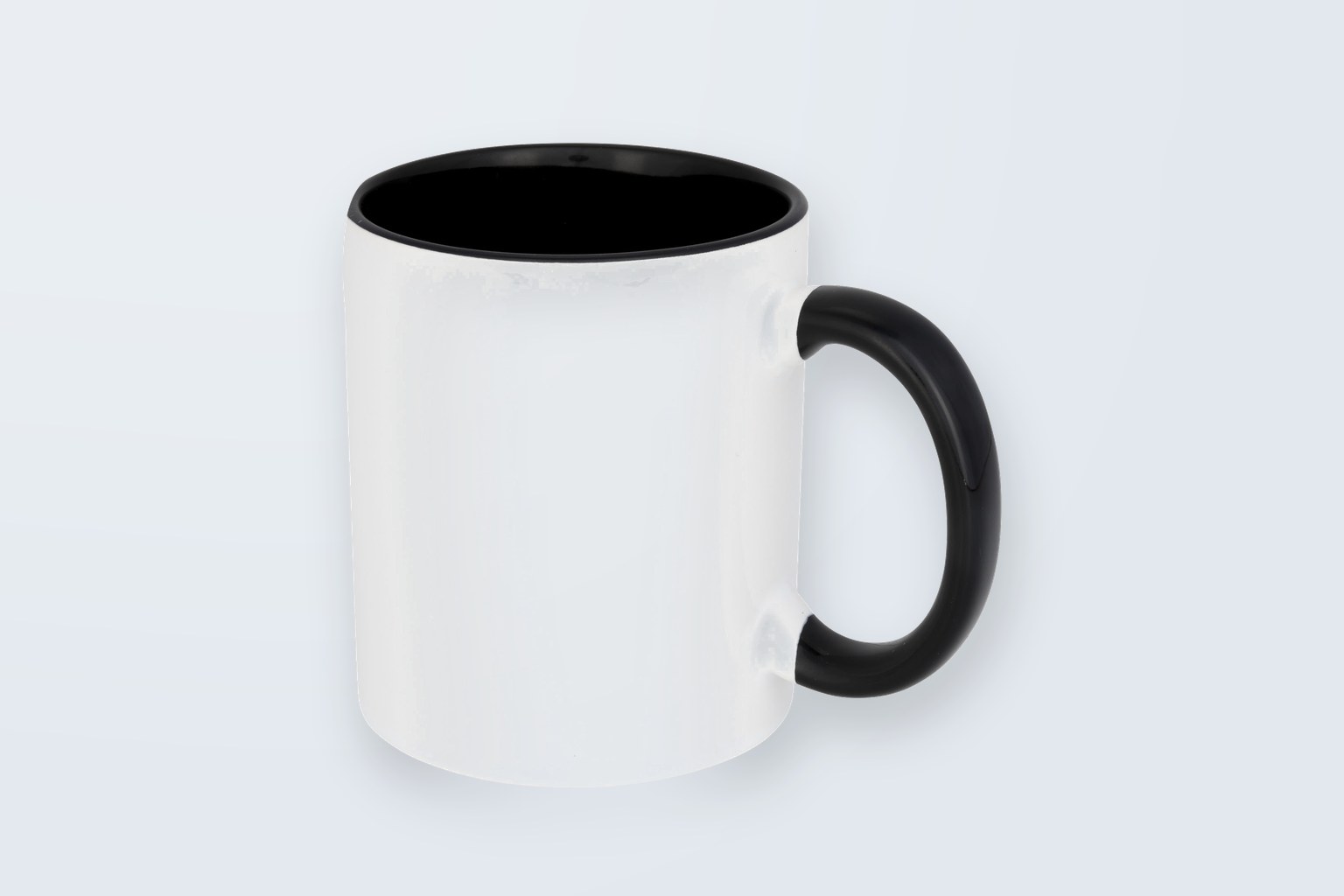
Sublimation on a mug is a process where special ink transfers from paper into a gas state at 180–200°C over roughly 2.5–4 minutes and soaks into the mug's polyester coating beneath the glaze — that's why the image can't be felt with a finger and never peels off. It's the only technology that lets you print a photo, a gradient, or a full-colour illustration on a mug without any limit on the number of colours, and we do it starting from just 1 piece. Ceramic sublimation mugs in our catalogue start from €2.30/pc (excl. VAT); the printed price depends on quantity.
How sublimation physically happens
The process has four steps and takes about 10 minutes per mug in one cycle, including preparation.
- Printing on transfer paper. We print the image with sublimation inks on special paper, mirrored. The paper only carries the ink — it's not the final product.
- Fixing onto the mug. The paper is wrapped tightly around the mug with heat-resistant tape. If the paper shifts, the image smears or a double outline appears.
- Pressing. The mug goes into a mug press, where a heating element wraps around its perimeter. 180–200°C for 2.5–4 minutes — the exact time depends on the thickness of the mug's wall.
- Cooling. After pressing, the paper is removed immediately while still hot. The mug cools within a few minutes, and the image is already part of the coating.
The key thing to understand: sublimation ink doesn't sit on top of the surface like a lacquer or a film. Under heat, the polyester coating briefly opens up, the ink penetrates inside, and as it cools, the coating seals it in. That's why you can't feel any raised edge when you touch it.
What sublimation can and can't do
Can
- Full-colour images — photos, gradients, soft shadows, an unlimited number of colours at the same price.
- Printing 360° around the mug (except for the handle and a narrow strip next to it).
- An individual image on each mug in a set — 30 mugs with 30 different names or photos cost the same as 30 identical ones.
Can't
- Print white. Sublimation ink is transparent and contains no white pigment. White in the image = the mug's own white surface. Sublimation doesn't work on a black or dark-tinted mug.
- Print on any material. It needs a polyester coating or polyester fabric. A regular shop-bought ceramic mug without a coating can't be printed on this way.
- Match exact Pantone colours. Sublimation is a CMYK process; corporate colours are reproduced approximately, and saturated dark tones can come out slightly different from how they look on paper.
- Print right to the edges. Around the handle and at the bottom, a 5–10 mm unprinted strip remains — the press doesn't reach there.
Durability: how long the print lasts
Since the image sits beneath the glaze coating, it doesn't peel or scratch off with a spoon. In practice, a quality ceramic sublimation mug withstands several hundred dishwasher cycles. Over time, the only change you might notice is a slight loss of colour vibrancy from harsh detergent and prolonged exposure to 65°C+ temperatures.
| Factor | Effect on the print |
|---|---|
| Hand washing | Practically none — the print stays for years |
| Dishwasher | Suitable; slight fading possible in the long run |
| Hot drinks, microwave | No issues for ceramic; don't microwave metal bottles |
| Scratching with a spoon or brush | The image is under the coating, so it doesn't scratch off |
| Direct sunlight for years | Slow UV fading, as with any CMYK print |
Files: how to prepare the image
Vector graphics (.ai, .eps, .pdf, .svg) work best, or a raster image at 300 dpi at actual size in CMYK. The standard print area for a 330 ml mug is roughly 200×90 mm; for a 240 ml mug, it's slightly smaller.
Two practical tips. First, a dark background that runs right to the edge is best planned with a 3–5 mm margin — the mug is round, and a slight shift during wrapping is unavoidable. Second, don't use very fine text below 6 pt: sublimation ink spreads slightly under heat, and small lines become blurred. We send the artwork for approval by email before production, with a 3D preview on request.
Examples from our catalogue
A few examples from our catalogue:
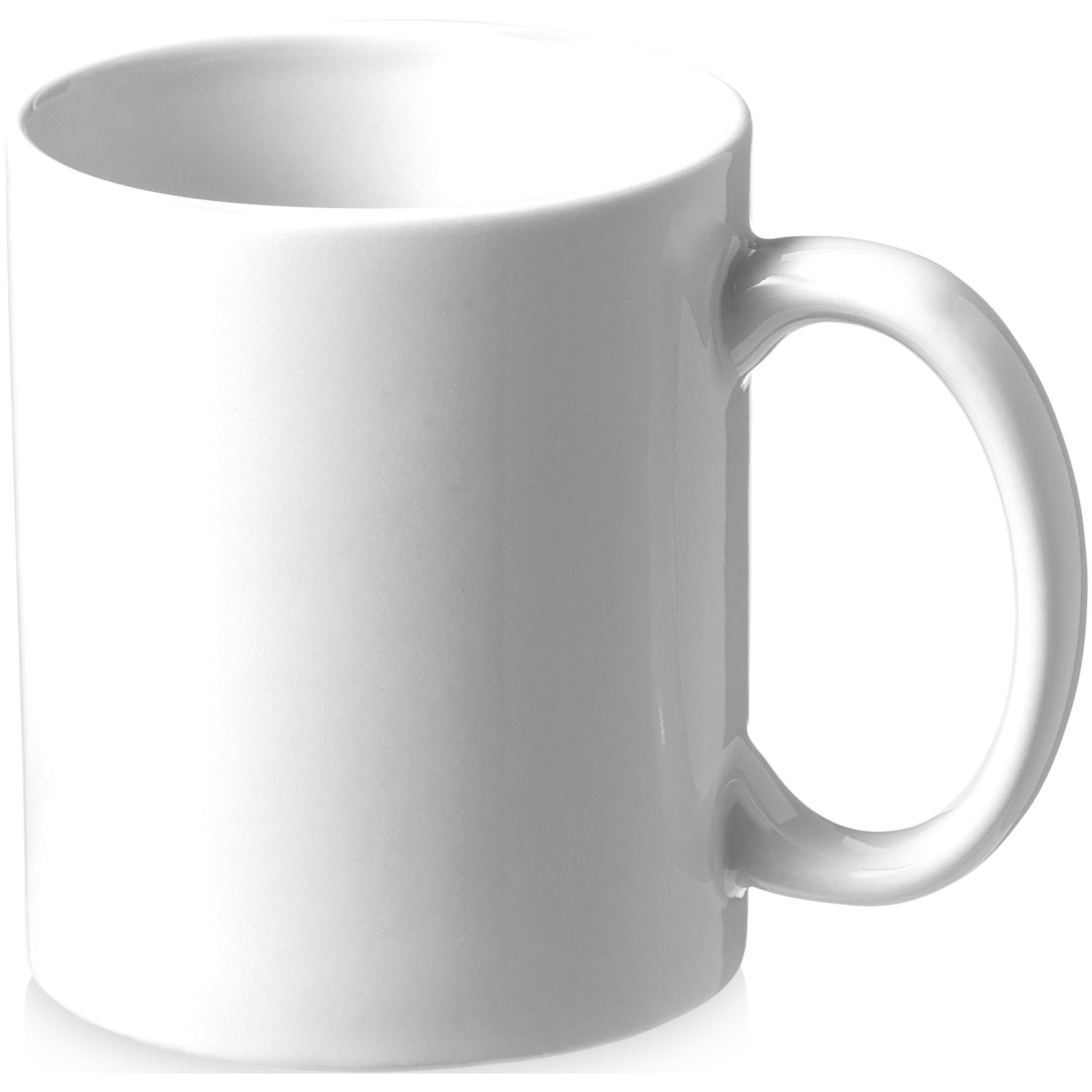
- Pic 330 ml ceramic mug for sublimation printing – a classic white ceramic mug, full-colour sublimation all around, from €2.30/pc at 1 pc and from €2.25 at 100 pcs.
- Bari 240 ml ceramic sublimation mug – a smaller coffee mug, one body colour, sublimation, from €2.93/pc, from €2.81 at 100 pcs.
- Pix 330 ml ceramic sublimation mug with coloured interior – ceramic with a coloured interior in 4 colour options, full-colour sublimation on the outside, from €2.96/pc.
- Billie 300 ml ceramic sublimation mug with cork details – ceramic with wood/cork elements, sublimation, from €4.29/pc, from €4.20 at 100 pcs.
Where else the same technology is used
Sublimation isn't only for mugs. On polyester fabric, it produces an image that doesn't form a film and doesn't affect the fabric's breathability — that's why we use it for sports shirts and textile advertising. For example, Beach Flag Standard (from €20.16/pc, from €15.68 at 100 pcs) and Beach Flag Pro (from €26.32/pc) are made of polyester with sublimation printing, where the image is visible on both sides.
Timelines and prices
Mug sublimation from 1 piece is usually ready in 2–5 business days, if the item is in stock. Promotional products with printing from the catalogue take 6–10 business days (production 4–7 business days + delivery 2–3 days). Urgent jobs can be arranged by agreement.
The artwork setup fee and the price per piece are shown for each item in the quote. The cost of one mug consists of the item price plus printing; at 50–100 pcs, the price per piece drops noticeably, since the setup cost is spread across the whole run. All prices mentioned are indicative and exclude VAT.
FAQ
Can a sublimation mug be washed in a dishwasher?
Yes. The image is absorbed into the coating beneath the surface, so it doesn't peel off. In the long run, washing daily with a strong detergent may cause the colours to lose a bit of vibrancy, but the print stays intact.
Can a black or dark mug be printed on?
Not with sublimation — the ink is transparent and isn't visible on a dark background, and there's no white colour in sublimation. For dark mugs, we use other technologies, such as laser engraving or colour printing.
How many colours can be used in the image, and does that affect the price?
The number of colours doesn't affect the price. Sublimation is a full-colour CMYK process, so a photo costs the same as a one-word text.
Can each mug in a set have a different image?
Yes. Personalisation with different names, photos, or numbers doesn't change the printing price, since each mug is pressed separately. You just need to send an organised list of files.
What format should the artwork be sent in?
Vector graphics (.ai, .eps, .pdf, .svg) or a raster image at 300 dpi at actual size, in CMYK. If you only have a logo in JPG format, we'll assess whether the quality is sufficient or whether it needs to be redrawn.
Is the minimum order one mug?
Yes, we also work with just 1 piece. At larger quantities, the price per piece drops — for example, the Pic 330 ml mug from €2.30 at 1 pc and from €2.25 at 100 pcs (excl. VAT).