Sublimation Printing: Why Only White Polyester and Ceramics Work
Sublimation printing only colours polyester fibre and polymer-coated surfaces, and the ink has no white colour. We explain why, and what to do with cotton and dark materials.
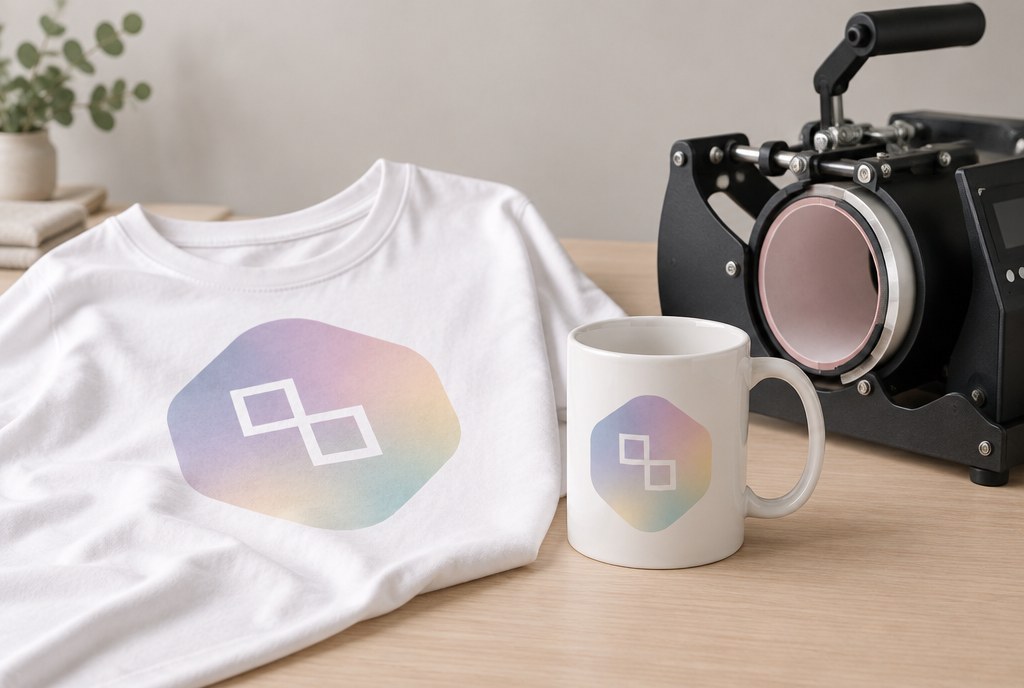
Sublimation printing only works on white or light-coloured polyester fabrics and ceramics with a special polymer coating, because at 190–200°C the dye turns into a gas and bonds only with the molecular structure of polyester — it simply doesn't take to cotton fibre. The second reason is straightforward: sublimation ink has no white colour, so the image always mixes with the tone of the base material, and on a dark surface it simply disappears. In practice, this means sublimation is ideal for a sports shirt, mug or towel, but it's not a solution for a black cotton T-shirt.
How sublimation works physically
Sublimation ink is printed onto special transfer paper. The paper is placed on the item and pressed in a heat press at 190–200°C for 40–60 seconds (for mugs, in a mug press at 180–200°C for 3–6 minutes, depending on the equipment). At this point, the solid dye turns straight into vapour, skipping the liquid state; the polyester's polymer chains expand and absorb the dye. As it cools, the polymer contracts and the dye stays inside the fabric.
That's exactly why a sublimation print can't be felt — there's no film, no layer of ink sitting on top. It doesn't crack, doesn't peel, and practically never washes out, since there's nothing on the surface to rub off. In exchange, you have to accept two firm limitations: material and colour.
Why polyester is required
Cotton is a natural cellulose fibre without polymer chains that could "close around" the dye. If you print sublimation on cotton, the image is visible at first, but after the first two washes it fades by 50–80%.
A rough guide to fabric composition:
| Fabric composition | Result | Recommendation |
|---|---|---|
| 100% polyester | Vibrant, long-lasting | Optimal |
| 65% polyester / 35% cotton | Slightly faded, "vintage" effect | Acceptable if that's the goal |
| 50/50 | Noticeably dull | Not recommended |
| 100% cotton | Washes out | Not suitable — use DTF transfer or screen printing instead |
For sports shirts, performance wear and microfibre towels, polyester is the standard, so sublimation works there without compromise. For everyday T-shirts and sweatshirts, which are mostly cotton or cotton blends, we offer other methods — see our clothing printing section.
Why the base needs to be white
Sublimation ink is translucent and has no white colour. The printer works in CMYK, and the "white" in the image is formed by the material itself. If the base is grey, the image comes out greyish; if it's red, blue printing turns purple; if it's black, it's invisible.
Some practical consequences:
- White parts of a logo and text cut-outs will appear in the fabric's colour, not white.
- Light shades (sand, light grey, pastels) can be used, but colours will shift slightly — we match this against a sample beforehand.
- If the design absolutely needs a white element on a dark background, sublimation is not an option.
Ceramics and other hard materials
A ceramic mug itself isn't polyester, so it's coated with a translucent polymer layer — that's what absorbs the dye. A regular shop-bought mug without this coating isn't suitable for sublimation: the image would wash off after the very first wash. That's why we always use special sublimation mugs for this method.
The same applies to:
- white ceramic mugs, 330 ml — the most common option, printed at 360 degrees or on one side;
- coloured mugs with a white interior or a white print area;
- thermal mugs and flasks with a polyester powder-coated surface;
- tiles, metal plates, puzzles, mouse mats, microfibre towels.
See mug printing and available models in our mugs section, and thermal flasks in the thermal flasks section.
When sublimation isn't suitable: alternatives
| Method | Material | Dark base | Minimum quantity | Notes |
|---|---|---|---|---|
| Sublimation | White polyester, coated ceramics | No | 1 pc | Print can't be felt, unlimited colours |
| DTF transfer | Cotton, polyester, blends | Yes (with white base layer) | 1 pc | Thin flexible film layer |
| Screen printing | Cotton, blends | Yes | From ~30–50 pcs | Cost-effective for large runs, limited colours |
| Embroidery | Almost anything | Yes | 1 pc | Most durable, but no photographic gradients |
In practice, the solution is often combined: polyester kits with sublimation for a sports team, but cotton training shirts with DTF transfer, so the logo looks consistent across both.
Files, deadlines and indicative prices
Vector graphics (.ai, .eps, .pdf) in CMYK colour space are preferred for designs; for photos, at least 300 dpi at actual size. Sublimation printing allows unlimited colours and gradients, so photos, gradients and full-coverage designs don't cost more than a single colour — unlike screen printing.
| Product | 1–9 pcs | 25 pcs | 100+ pcs |
|---|---|---|---|
| Ceramic mug 330 ml, full colour | from €8.00 | approx. €5.50 | from €3.50 |
| Coated thermal mug | from €18.00 | approx. €14.00 | on request |
| Polyester sports shirt | from €14.00 | approx. €11.00 | from €8.50 |
| Microfibre towel | from €12.00 | approx. €9.50 | on request |
Prices are indicative, excl. VAT, and depend on the product model, print area and quantity. Standard turnaround is 5–10 business days after artwork approval; rush jobs by arrangement. See other printing services in our shop section.
Frequently Asked Questions
Can sublimation be printed on a black T-shirt?
No. Sublimation ink is translucent and isn't visible on dark material. For black or dark clothing, we use DTF transfer, screen printing or embroidery.
How much polyester does the fabric need for a good result?
100% is optimal. From 65% polyester, the result is still acceptable, but the colours will be 20–30% duller. Below 50%, we don't recommend sublimation.
Can I use my own mug?
Only if it has a sublimation polymer coating. The image won't hold on regular shop-bought ceramics. If you're not sure, send us a photo or bring one sample to Kandavas Street 29A.
How many washes does a sublimation print withstand?
On 100% polyester, the print practically never washes out for the entire lifetime of the garment, since the dye sits inside the fibre. Mugs can go in the dishwasher if you use a gentle cycle and a non-abrasive detergent.
Is sublimation more expensive than screen printing?
For small runs (1–20 pcs), sublimation is usually cheaper, since there's no setup cost per colour. From around 50 pieces with a simple 1–2 colour logo, screen printing becomes more cost-effective.
Can you make just one piece?
Yes, we also work with single items — that's one of the key advantages of sublimation.
Send us your design and chosen product at info@attaprint.lv or message us on WhatsApp at +371 25776699 — project manager Madara will prepare a quote within one business day. If you're not sure about the material, we'll recommend the most suitable printing technology before you place your order.
FAQ
Can sublimation be printed on a black T-shirt?
No. Sublimation ink is translucent and isn't visible on dark material. For black or dark clothing, we use DTF transfer, screen printing or embroidery.
How much polyester does the fabric need for a good result?
100% is optimal. From 65% polyester, the result is still acceptable, but the colours will be 20–30% duller. Below 50% polyester, we don't recommend sublimation.
Can I use my own mug?
Only if it has a sublimation polymer coating. The image won't hold on regular shop-bought ceramics. If you're not sure, send us a photo or bring one sample to Kandavas Street 29A.
How many washes does a sublimation print withstand?
On 100% polyester, the print practically never washes out for the entire lifetime of the garment, since the dye sits inside the fibre. Mugs can go in the dishwasher if you use a gentle cycle and a non-abrasive detergent.
Is sublimation more expensive than screen printing?
For small runs (1–20 pcs), sublimation is usually cheaper, since there's no setup cost per colour. From around 50 pieces with a simple 1–2 colour logo, screen printing becomes more cost-effective.
Can you make just one piece?
Yes, we also work with single items — that's one of the key advantages of sublimation compared to screen printing.