Pad printing: how a logo gets onto a pen
Pad printing is the main technology for logo printing on pens: one colour per pass, a print area typically up to 50x8 mm, and a turnaround of 5–10 business days.
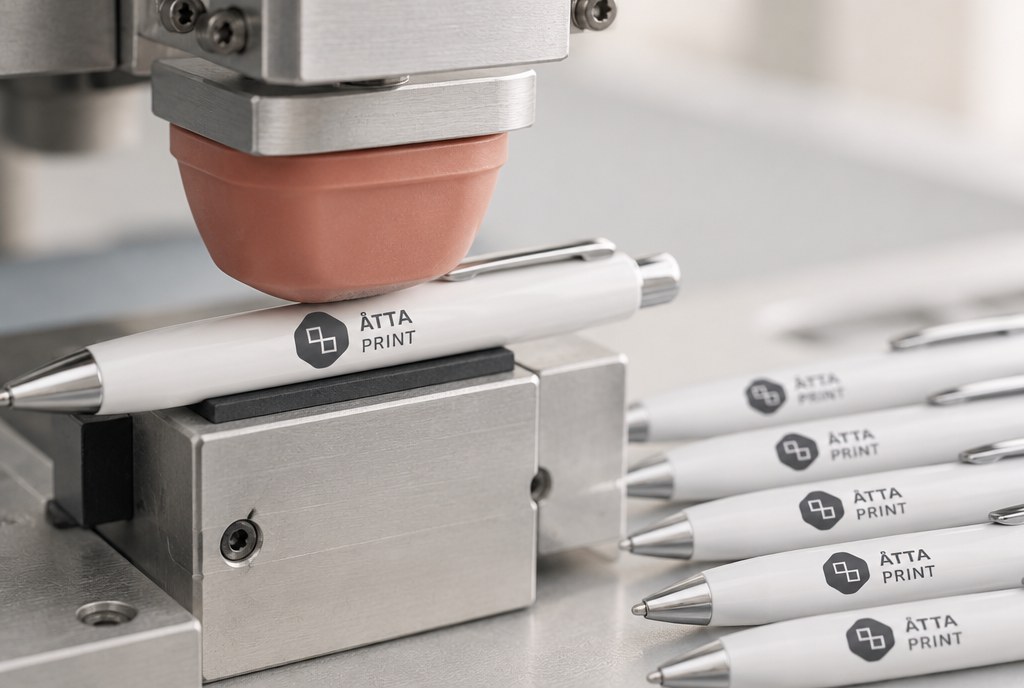
Pad printing is the main technology behind getting a logo onto a pen: ink from an engraved metal plate (cliché) is picked up by a soft silicone pad and pressed onto the round body of the pen. Each pass prints one colour, the typical print area on a pen clip or barrel is 40–50 mm long and 6–8 mm high, and the standard turnaround is 5–10 business days. The technology works even for batches of 50 pieces, but it becomes cost-effective from 100–250 pieces upwards.
How pad printing works technically
The process consists of four steps, each of which affects the final result:
- Making the cliché. Your logo is exposed and etched into a thin steel or polymer plate. The etching depth is only 20–25 microns — this determines how much ink stays on the surface.
- Applying the ink. The cliché is coated with ink, and a doctor blade wipes off the excess, leaving ink only in the etched areas.
- Transfer via the pad. The silicone pad lowers onto the cliché, picks up the ink layer, and then presses it onto the pen. The silicone deforms and adapts to the round surface — which is why pad printing works where screen printing can't.
- Drying. The ink dries in air or under a UV lamp. A pause is needed between colours so the next colour doesn't mix with the previous one.
Each colour means a separate cliché and a separate pass. A two-colour logo on a pen is realistically doable; three colours are less common, as the risk of misalignment by 0.2–0.3 mm increases on such a small area.
What pad printing can and can't do
Strengths: round and concave surfaces, very fine lines, plastic, metal, lacquered wood surfaces, durable adhesion to the body. A properly printed logo on a pen withstands everyday use for several years.
Limitations worth knowing at the sketch stage already:
- Colour gradients and photographs aren't possible. Pad printing is a solid-colour technology; gradients and halftones blend together on a small area.
- Minimum text size is about 5–6 pt, minimum line thickness — 0.25–0.3 mm. A thinner logo element simply fills in with ink.
- Dark pen + light logo sometimes requires two passes of white ink so the colour doesn't look grey.
- Print area size. On a thin metal pen clip, you can realistically print 30x5 mm; on a plastic barrel — up to 50x8 mm.
Pad printing compared to other methods
| Method | Where used | Colours | Suitability for pens |
|---|---|---|---|
| Pad printing | Plastic, metal, round surfaces | 1–3 (each separate) | Base solution, colour logos |
| Laser engraving | Metal and aluminium bodies | No colour, metal tone | Very durable, elegant, but monochrome |
| Screen printing | Flat or large cylindrical surfaces | 1–4 | Rarely for pens, area too small |
| UV digital printing | Flat plastic parts | Full colour | Good for cases, not round bodies |
In practice, most orders come down to a choice between pad printing (if the logo is coloured or the pen is plastic) and laser engraving (if the pen is metal and you want a more durable effect).
Indicative prices and quantities
Pen prices consist of two components: the pen itself and the printing. Printing is calculated separately as the cliché (a one-off cost per colour) and the printing cost per piece.
| Quantity | Pen from our catalogue | Pad printing, 1 colour, per pc | Cliché (one-off, per colour) |
|---|---|---|---|
| 50 pcs | from EUR 0.45 | approx. EUR 0.25 | EUR 20–25 |
| 250 pcs | from EUR 0.38 | approx. EUR 0.15 | EUR 20–25 |
| 500 pcs | from EUR 0.33 | approx. EUR 0.10 | EUR 20–25 |
| 1000 pcs | from EUR 0.28 | approx. EUR 0.07 | EUR 20–25 |
All prices are indicative, excl. VAT, and depend on the specific model, number of colours, and deadline. For example, 250 plastic pens with a single-colour logo usually come to around EUR 0.55–0.65 per piece including printing, while at 1000 pieces it drops below EUR 0.40. See the models and prices in the pens section, or browse the full range of promotional products with a logo.
What files are needed
Pad printing requires vector graphics: .ai, .eps or a vector .pdf, with text converted to outlines. Specify colours as Pantone numbers — on plastic, colour is mixed to the Pantone scale rather than printed in CMYK halftone, so "roughly blue" won't work here.
Before production, we prepare a visual showing the logo's scale and placement on the specific model. If the original logo has fine lines or a tiny tagline, we offer a simplified version for printing — this is standard practice for small areas, not a compromise on quality.
Turnaround times
The standard turnaround for pad-printed pens is 5–10 business days from artwork approval: 1 day for the visual, 1–2 days for the cliché, and the rest for printing and quality control. If the products are already in stock and the logo is single-colour, urgent cases can be closer to 5 business days by separate agreement. For large volumes (from 1000 pcs), allow 7–10 business days.
Frequently asked questions
How many colours can be printed on one pen?
Technically up to three, but we recommend one or two in practice. Each colour requires a separate cliché and a separate pass, so a three-colour logo in a 40x7 mm area is sensitive to misalignment and more expensive.
Will the print peel off?
Properly dried pad-printing ink on plastic or lacquered metal withstands everyday use and friction in a pocket. Adhesion is weaker on silicone and some oily plastics — in such cases, we test the pen beforehand.
What's the minimum order quantity?
We also work with small volumes, but for pens, an economically sensible minimum is 50 pieces, since the cliché cost of EUR 20–25 is spread across the whole run.
What happens if I don't have a vector logo?
Send us whatever you have — an image or a scan. We'll prepare the vectorisation ourselves; for a simple logo this usually takes 15–30 minutes of work and is added to the quote as a separate line item.
Can pad printing be used for other products too?
Yes — keyrings, pencils, plastic casings, some bottles and flasks. For metal mugs and bottles, we more often use laser engraving or other methods that better withstand washing.
Send your logo and planned quantity to info@attaprint.lv, call us, or message us on WhatsApp at +371 25776699 — we'll prepare a quote and visual within one business day. Our address and working hours are available on the contacts page.
FAQ
How many colours can be printed on one pen?
Technically up to three, but we recommend one or two in practice. Each colour requires a separate cliché and a separate pass, so a three-colour logo in a 40x7 mm area is sensitive to misalignment and more expensive.
Will the print peel off?
Properly dried pad-printing ink on plastic or lacquered metal withstands everyday use and friction in a pocket. Adhesion is weaker on silicone and some oily plastics — in such cases, we test the pen beforehand.
What's the minimum order quantity?
We also work with small volumes, but for pens, an economically sensible minimum is 50 pieces, since the cliché cost of EUR 20–25 is spread across the whole run.
What happens if I don't have a vector logo?
Send us whatever you have — an image or a scan. We prepare the vectorisation ourselves; for a simple logo this usually takes 15–30 minutes of work and is added to the quote as a separate line item.
Can pad printing be used for other products too?
Yes — keyrings, pencils, plastic casings, some bottles and flasks. For metal mugs and bottles, we more often use laser engraving or other methods that better withstand washing.