Heat Transfer Printing: When to Use It and How Durable It Is
How heat transfer printing works, which print runs it suits best, and how many washes it withstands. Approximate prices and turnaround times in Latvia.
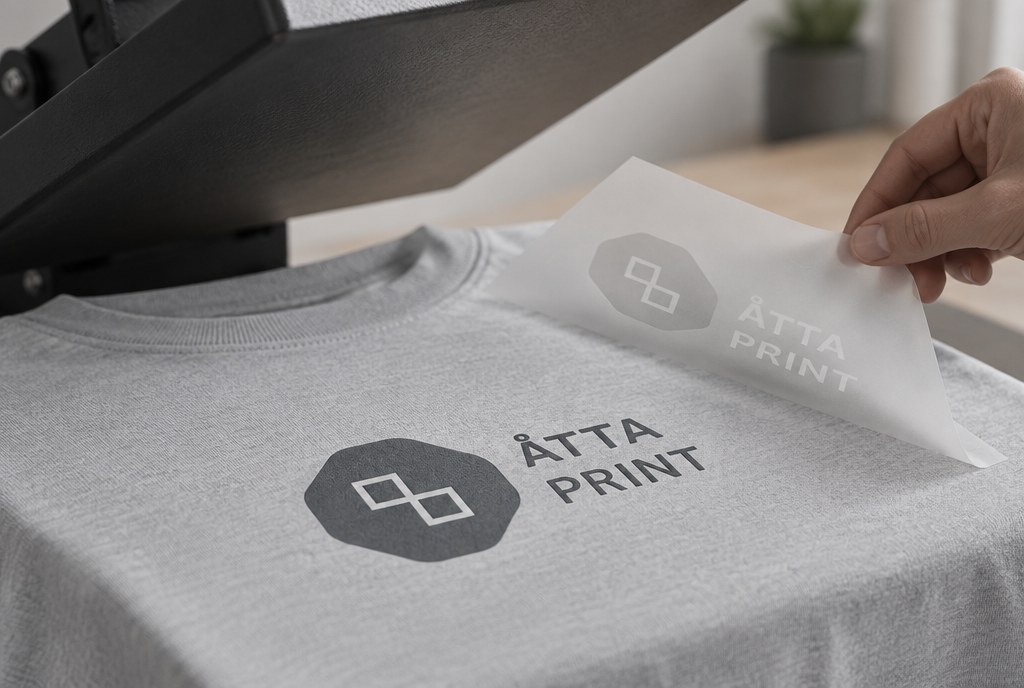
Heat transfer printing is a technology where the design is first printed or cut onto a special film or paper, then transferred onto fabric using a heat press (usually 150–170 °C, 10–20 seconds, under pressure). A well-applied heat transfer withstands 30–50 washes at 30–40 °C, while cheaper films start cracking after just 15–20 washes. This method is cost-effective for runs of 1 to about 50 pieces, where screen printing isn't yet economical — roughly from 4 EUR per piece excl. VAT.
What heat transfer really is and its variations
In practice, the term "transfer" covers several different technologies. What they all have in common is that the design is applied to fabric using heat and pressure, rather than being printed directly through a screen.
Cut film (flex and flock)
A single-colour design is cut from polyurethane film, the excess is peeled off by hand, and the remainder is transferred onto the fabric. Flex is smooth and thin (around 80 microns), while flock is velvety with a textured finish. This method works well for numbers, names, logos with 1–2 colours, and sports kits. Durability is good — 40–50 washes, since the film is thick and flexible.
DTF (Direct to Film)
The design is printed with CMYK + white ink onto PET film, coated with hot-melt adhesive powder, and then pressed onto the fabric. DTF allows printing photographs, gradients, and an unlimited number of colours without extra charges per colour. Today it's the most commonly used form of heat transfer for small print runs. Durability — 30–50 washes, provided the print isn't ironed directly or dried at very high temperatures.
Sublimation
Technically also a heat transfer method, but the dye soaks into the polyester fibre rather than sitting on top as a film. The print isn't tactile and barely wears off, but it only works on light-coloured polyester fabrics. Sublimation isn't suitable for dark cotton T-shirts.
When heat transfer is the right choice
- Runs of 1–50 pieces. Screen printing requires preparing a separate screen for each colour, so it only pays off from around 30–50 pieces per design.
- Multi-coloured or photographic images. A four-colour logo costs the same in DTF as a single-colour one.
- Personalisation. A different name, number, or date on each T-shirt — something not possible with screen printing without separate preparation.
- Faster turnaround. Without screens to prepare, the preparation process is shorter.
- Uneven surfaces and small areas — sleeves, collars, the front of caps, bag pockets.
Screen printing, on the other hand, is the right choice for 100+ T-shirts with the same 1–3 colour design: the cost per piece drops significantly, and the ink soaks into the fabric. Read more about the differences between methods in our garment printing section.
Durability: what "30–50 washes" actually means
The lifespan of a print depends on three factors: film quality, pressing settings, and how the garment is cared for. A well-applied DTF print on a cotton T-shirt, washed at 30 °C inside out, keeps its appearance for 2–3 years of regular use.
| Technology | Durability (washes) | Feel on fabric | Suitable fabric |
|---|---|---|---|
| DTF | 30–50 | Thin, flexible layer | Cotton, polyester, blends |
| Flex film | 40–50 | Smooth film, noticeable | Cotton, polyester |
| Flock film | 30–40 | Velvety, textured | Cotton, fleece |
| Sublimation | 100+ | Not noticeable | Light polyester only |
| Screen printing | 50+ | Soaks into fabric | Cotton, blends |
Care instructions that genuinely extend lifespan
- Wash at 30 °C, inside out, without bleach or fabric softener.
- Don't iron directly over the print; if needed, iron through a cloth or from the inside.
- Don't tumble dry at high temperatures — the tumble dryer is the most common cause of damage to the film.
- Wait at least 24 hours after receiving the print before the first wash.
Approximate prices and turnaround times
Prices are listed excl. VAT and are approximate — the final amount depends on the print area, number of colours, number of print locations on the garment, and the quantity. Garments can be supplied by the customer or ordered from our catalogue.
| Quantity | DTF, A5 area (EUR/pc.) | DTF, A4 area (EUR/pc.) |
|---|---|---|
| 1–5 | from 6 | from 8 |
| 10–25 | from 5 | from 6 |
| 50–100 | from 4 | from 5 |
| 200+ | on request | on request |
Standard turnaround is 5–10 business days from artwork approval; urgent orders can be arranged by separate agreement. If the garment needs to be ordered from our catalogue, add delivery time to the turnaround.
What files are needed
The best option is vector graphics — .ai, .eps, or .pdf with text converted to outlines. If the design is photographic, .png or .tiff with a transparent background works, with a resolution of at least 300 dpi at the actual print size. Colours should be prepared in CMYK; keep in mind that bright neon shades on screen will print slightly more muted. If you don't have a file, our designers can prepare one — artwork setup from 20 EUR.
Before placing a large order, we recommend ordering a single sample first. It costs a bit more per piece than within a bulk order, but it lets you check the colour, size, and placement on the specific fabric.
Frequently asked questions
Can heat transfer be applied to any fabric?
DTF and flex film work on cotton, polyester, and their blends, as well as on bags and fleece. Issues arise with water-repellent and membrane fabrics, and fabrics that can't withstand 150 °C. For nylon jackets, we use low-temperature films — this is agreed on before placing the order.
How long will it last if the T-shirt is washed every week?
Washed at 30 °C and dried on a hanger, the print keeps its appearance for approximately 30–50 washes, which is roughly a year of intensive use or 2–3 years of moderate use. A tumble dryer can cut this lifespan in half.
Can you feel the print by hand?
Yes, DTF and film prints create a thin, flexible layer on the surface of the fabric. Modern DTF films are thin and flexible, so even large areas don't feel like a rigid "plate" — a completely unnoticeable print is only achieved with sublimation.
What's the minimum order quantity?
We also work with single pieces. That's exactly why heat transfer is popular for gifts, additions to team T-shirts, and samples before ordering a large batch.
When is screen printing the better choice?
From around 50–100 pieces with a single 1–3 colour design. At that point, the cost of screen preparation is spread out, the price per piece drops, and the print is thinner and more resistant to abrasion.
Send us your design and approximate quantity at info@attaprint.lv, call us, or message us on WhatsApp at +371 25776699 — we prepare quotes within one business day. Address: Kandavas iela 29A, Riga; other contact details are available in the Contacts section.
FAQ
Can heat transfer be applied to any fabric?
DTF and flex film work on cotton, polyester, and their blends, as well as on bags and fleece. Issues arise with water-repellent and membrane fabrics, and fabrics that can't withstand 150 °C. For nylon jackets, we use low-temperature films — this is agreed on before placing the order.
How long will heat transfer last if the T-shirt is washed every week?
Washed at 30 °C and dried on a hanger, the print keeps its appearance for approximately 30–50 washes — roughly a year of intensive use or 2–3 years of moderate use. A tumble dryer can cut this lifespan in half.
Can you feel the print by hand?
Yes, DTF and film prints create a thin, flexible layer on the surface of the fabric. Modern films are thin and flexible, so they don't create a rigid plate, but a completely unnoticeable print is only achieved with sublimation.
What's the minimum order quantity?
We also work with single pieces. That's exactly why heat transfer is cost-effective for gifts, additions to team T-shirts, and samples before ordering a large batch.
When is screen printing the better choice?
From around 50–100 pieces with a single 1–3 colour design. At that point, the cost of screen preparation is spread out, the price per piece drops, and the print is thinner and more resistant to abrasion.