Sticker durability outdoors: how long do they last in sun, rain and frost
How long do stickers last outdoors in Latvia's climate: monomeric film 1–3 years, polymeric film 3–5 years, cast film up to 7 years.
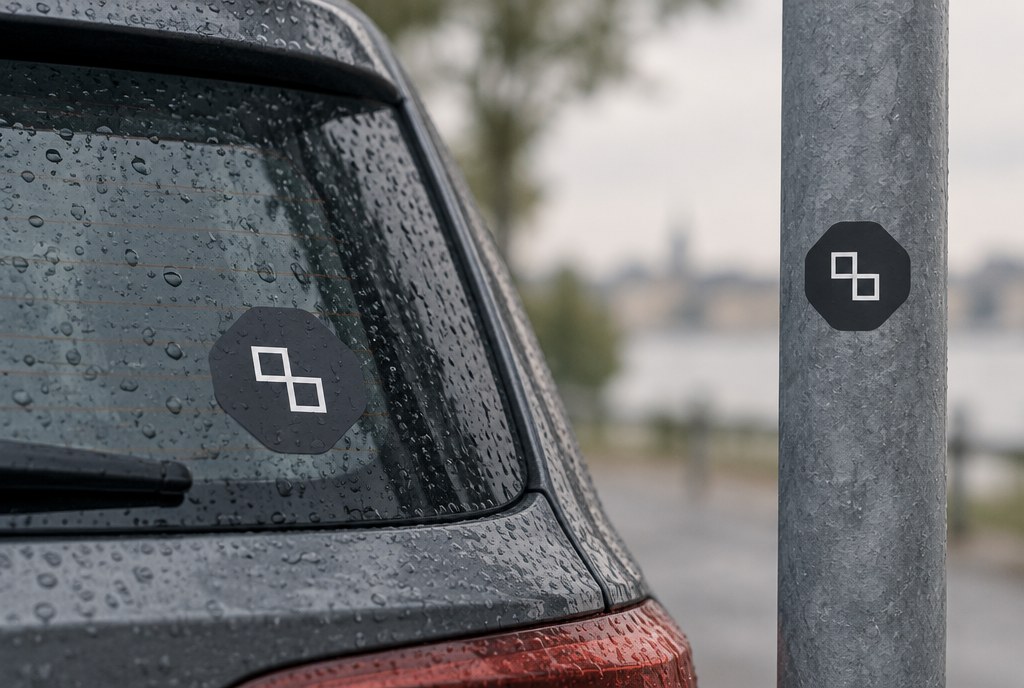
Sticker durability outdoors in Latvia's climate is typically 1–3 years for cheaper monomeric vinyl, 3–5 years for polymeric film, and 5–7 years for cast film with UV laminate. The main ageing factor isn't rain or frost but UV radiation, which fades print colours over the year and makes the film brittle. With a protective laminate, a sticker's actual lifespan increases by 30–50% on average, making it the cheapest investment in sticker longevity.
What actually damages a sticker outdoors
A sticker is a three-layer system: adhesive, film and print ink. Each layer ages at its own rate, and in practice damage starts wherever the weakest link is.
- UV radiation. Fades pigments. Reds, oranges and purples suffer first; black and blue hold up longest. Without lamination, an intense red logo in a south-facing shop window can be noticeably paler after just 8–12 months.
- Moisture and rain. The film itself is waterproof, but water gets in under the edges if the sticker wasn't applied to a degreased surface or was cut too close to the print. This is where peeling starts.
- Temperature swings. In Latvia, the annual range runs roughly from −25°C to +30°C, and on a dark metal surface in the sun it can reach +70°C. The film expands and contracts, and monomeric film eventually cracks.
- Salt and mechanical stress. On cars and street fixtures, winter salt and grit abrade the surface. In this case, laminate also serves as scratch protection.
- Application quality. About half of early peeling cases aren't a material fault but adhesion to a dirty or too-cold surface.
Approximate film lifespan
The figures below are indicative for Latvian conditions — a vertical surface not facing directly south. For a horizontal surface (e.g. a sticker on a bench or box lid), expect 30–40% less, since sun and water hit it most intensely there.
| Material | Without laminate | With UV laminate | Suitable for |
|---|---|---|---|
| Monomeric vinyl | 1–2 years | 2–3 years | Short-term promotions, seasonal signage |
| Polymeric vinyl | 2–3 years | 3–5 years | Shop windows, door logos, equipment |
| Cast film | 3–5 years | 5–7 years | Vehicles, curved surfaces, long-term marking |
| Clear window film | 1–2 years | 2–3 years | Opening hours, glass decoration |
| PVC banner fabric | 2–3 years | – | Fences, façades, events |
Matte and gloss films have similar durability; the difference is visual. Matte better hides surface irregularities and reflects less in the sun, while gloss gives more saturated colours. You'll find all these options, including shape-cut contours, in our stickers section.
Lamination: when it's essential
Laminate is a thin transparent film placed over the print. It absorbs the UV impact, resists scratches and lets you clean the sticker with a damp cloth without risking rubbing off the ink.
Lamination is recommended whenever the sticker:
- will be outdoors for longer than one season;
- is touched by hand (door handles, counters, equipment);
- is on a vehicle or gets washed with a pressure washer;
- contains intense reds, oranges or greens, which fade faster.
In terms of cost, laminate typically increases sticker price by around 15–30%, depending on quantity. For comparison: an unlaminated sticker that needs replacing after a year ends up costing more overall than a laminated one that lasts three.
How to apply stickers so they last the full term
Surface and temperature
The adhesive fully bonds within 24–72 hours. The optimal application temperature is +15…+25°C. Below +10°C, the adhesive doesn't spread properly across the surface and the sticker peels off at the first thaw — so in winter we either postpone outdoor application or work with surface pre-heating.
The surface should be degreased with isopropyl alcohol, not window cleaner, which leaves a silicone film. Freshly painted surfaces need 2–3 weeks to dry.
Edges and size
Leave at least 2–3 mm of film around the print area to prevent colour delamination at the edge. For large stickers (over 50 cm), we use the wet application method or application tape to avoid air bubbles — a bubble expands in the sun and becomes a crack.
When a sticker isn't the best solution
If outdoor graphics need changing more often than once a year, or the surface is rough (wooden fence, concrete, mesh wall), it's more durable and cheaper to work with a different medium:
- PVC banner with eyelets — for fences and façades, lasts 2–3 seasons;
- Composite or PVC panel with applied film — for signage and display stands;
- Roll-up and photo banners — for indoor events, where outdoor factors don't apply.
See banner and roll-up solutions in our banners section, or browse the full range of printing services in our shop.
Frequently asked questions
How long does a sticker last on a car?
On the sides and rear with cast film and laminate, expect 4–6 years; with polymeric film, 3–4 years. On the roof or bonnet, where the sun hits vertically, the lifespan is roughly half as long. Regular washing with a pressure washer closer than 30 cm shortens its life.
Does a sticker withstand Latvian winters?
Yes. Quality vinyl film works from −30°C to +80°C, so frost alone doesn't damage a sticker. Problems only arise if the sticker was applied in cold weather or to a poorly degreased surface.
How much do weather-resistant stickers cost?
Price depends on size, shape and quantity. As a guide: A6-format laminated stickers with contour cutting start at around €0.60 per piece for a batch of 100, excl. VAT; unit prices drop significantly for larger quantities. We prepare an exact quote based on size and quantity.
Can a faded sticker be restored?
No, faded pigment can't be brought back. The old sticker is removed with a heat gun and adhesive remover, the surface is degreased, and a new one is applied. If the film has been in place for more than 5 years, removal takes longer because the adhesive has hardened.
How long does an order take?
Standard stickers with contour cutting are usually ready in 2–5 business days, depending on quantity and finishing. Urgent jobs are handled by separate arrangement.
What files are needed?
Vector graphics in .ai, .eps or .pdf format, in CMYK colour space, with a 2–3 mm bleed and a separately marked cutting contour. If you don't have a vector file, we can help prepare one.
If you need help choosing the right film for a specific location and timeframe, send us the size, installation surface and intended lifespan at info@attaprint.lv or call/WhatsApp +371 25776699 — we'll prepare a quote within one business day.
FAQ
How long does a sticker last on a car?
On the sides and rear with cast film and laminate, expect 4–6 years; with polymeric film, 3–4 years. On the roof or bonnet, the lifespan is roughly half as long. Washing with a pressure washer closer than 30 cm shortens its life.
Does a sticker withstand Latvian winters?
Yes. Quality vinyl film works from −30°C to +80°C, so frost alone doesn't damage a sticker. Problems only arise if the sticker was applied in cold weather or to a poorly degreased surface.
How much do weather-resistant stickers cost?
As a guide, A6-format laminated stickers with contour cutting start at around €0.60 per piece for a batch of 100, excl. VAT. Unit prices drop significantly for larger quantities; we prepare an exact quote based on size and quantity.
Can a faded sticker be restored?
No, faded pigment can't be brought back. The old sticker is removed with a heat gun and adhesive remover, the surface is degreased, and a new one is applied. After 5 years, removal takes longer because the adhesive has hardened.
How long does an order take?
Printing standard stickers with contour cutting usually takes 3–10 business days, depending on quantity and finishing. Urgent jobs are handled by separate arrangement.
What files are needed?
Vector graphics in .ai, .eps or .pdf format, in CMYK colour space, with a 2–3 mm bleed and a separately marked cutting contour. If you don't have a vector file, we can help prepare one.