Vector logo: what it is and why print shops ask for it
An explanation of what a vector logo file is, how it differs from JPG and PNG, which formats to send for printing, and what to do if you don't have a vector version.
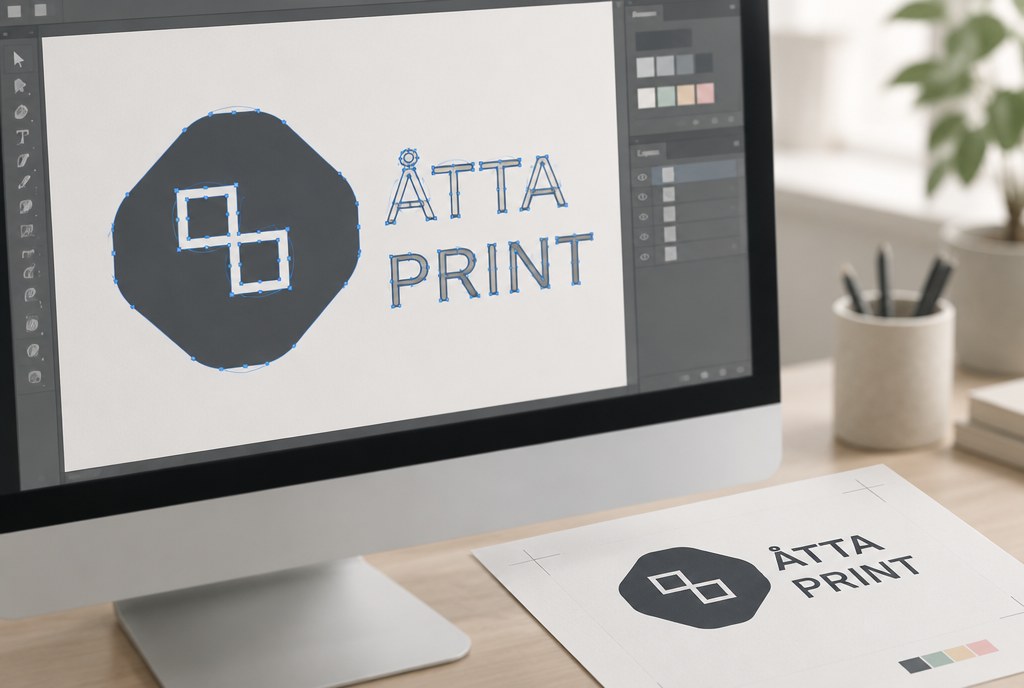
A vector logo is an image built from mathematically described lines, curves and shapes rather than pixels — which is why it can be scaled from a 15 mm cap embroidery up to a 3-metre banner without any loss of quality. Print shops ask for it because screen printing, contour cutting, embroidery and large-format printing physically work with outlines and separate colours, not with a pixel grid. Suitable formats are .ai, .eps and .pdf with the curves preserved, in CMYK or Pantone colours.
How vector differs from a pixel image
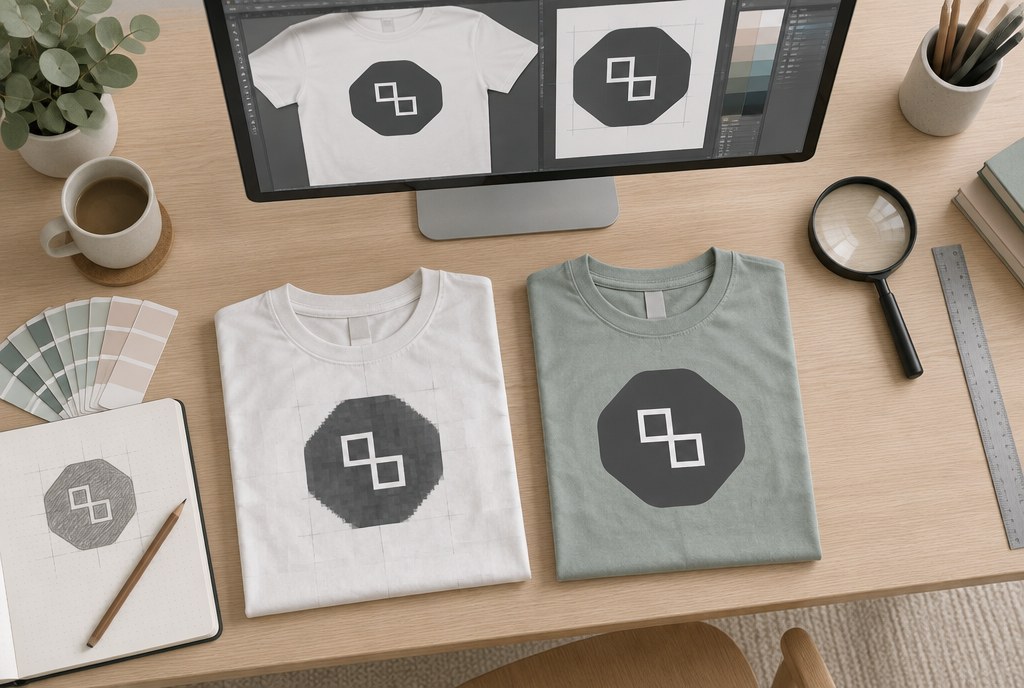
JPG, PNG and TIFF are raster, or pixel, images: they consist of a fixed number of tiny squares. If you stretch a 500-pixel-wide logo onto an A1 poster, each pixel turns into a visible square and the edges become blurred. In a vector file the same shape is described as "a circle with radius X and outline Y", so size is just a number that can be changed without any loss.
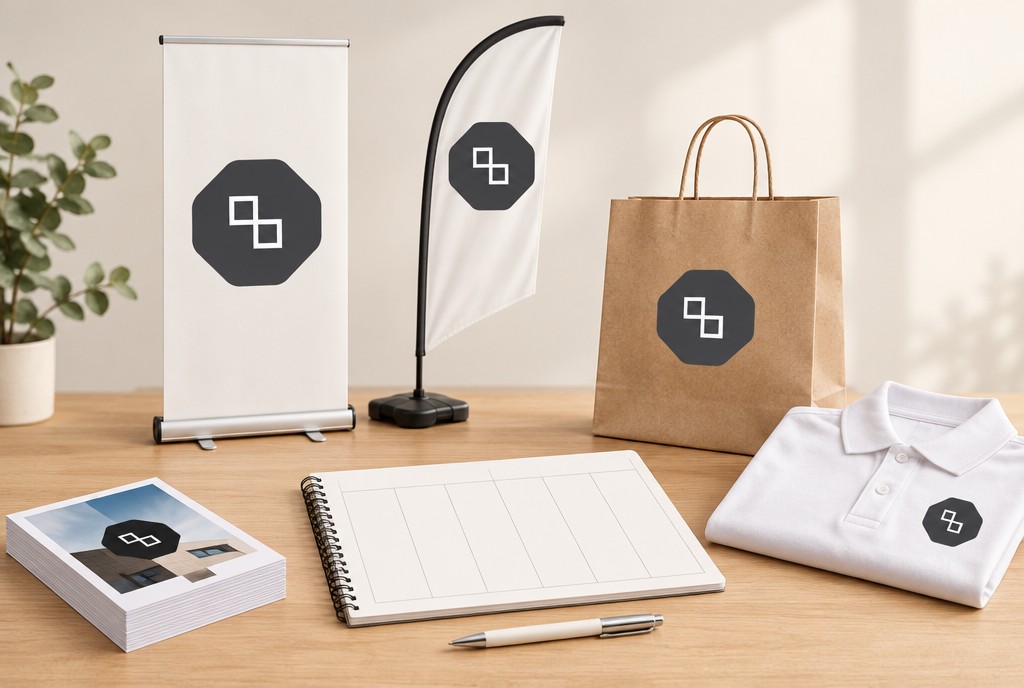
In practice this means one good vector logo will work for every job: business cards, stickers, T-shirts, cap embroidery and a 4-metre banner. A pixel logo would need to be redrawn for each format.
| Feature | Vector (.ai, .eps, .pdf) | Raster (.jpg, .png) |
|---|---|---|
| Scaling | Unlimited | Degrades when enlarged |
| Colour control | CMYK, Pantone, separate layers | RGB or compressed CMYK |
| Contour cutting for stickers | Possible | Not possible without redrawing |
| Screen printing separations | Each colour can be separated | Needs redrawing |
| Embroidery digitising | Prepared quickly | Requires extra work |
| File size | Usually small | Large if high resolution |
In which jobs is vector mandatory
- Stickers with contour cutting. A cutting plotter needs a cutting line — an actual vector path. Without it, cutting isn't possible. Contour cutting — from around €8.00/m² (excl. VAT); the printing itself on matte or gloss vinyl — from around €24.00/m², from 5 m² €22.00, from 20 m² €19.00. See examples on the stickers page.
- Screen printing. A separate screen is prepared for each colour. If the logo isn't vector, colours can't be separated correctly. 1 colour, 1 position — from around €3.50/pc, from 50 pcs €2.50, from 100 pcs €1.90, from 250 pcs €1.50; screen setup around €35.00 one-off.
- Embroidery. The stitch program is built from the outlines. Embroidery up to 10,000 stitches — from around €5.50/pc, from 50 pcs €4.20; digitising around €25.00.
- Large-format printing. For banners, roll-ups and posters A3–A0, the logo is scaled up many times. A2 poster — from around €6.00/pc, A1 — from €9.00/pc.
- Engraving and pad printing on promotional products. For pens, thermal mugs and bottles the print area is often just 20–40 mm, so the outline needs to be clean.
DTF transfer (from around €6.00/pc up to A4, from 50 pcs €4.20) is an exception — it also accepts a good-quality raster image with a transparent background, at least 300 dpi at actual size. All prices are excl. VAT.
How to check whether you actually have a vector file
We often receive a PDF with a JPG embedded inside it — the format is right, but the content isn't. Three quick checks:
- Open the PDF and zoom in on the logo to 800%. If the edges stay sharp, it's vector; if little squares appear, it's raster.
- Check the file size. A simple vector logo is usually 50 KB–2 MB. An "8 MB logo" is almost always an image.
- Ask your designer whether the text has been converted to curves/outlines. If not, send the fonts along with it.
What to include in the file
- The main version of the logo plus a single-colour version (black, white) — needed for screen printing and engraving.
- Colours in CMYK or Pantone codes, not RGB. RGB blues and bright greens print noticeably darker.
- Text converted to curves, or fonts attached.
- If needed, a cutting contour on a separate layer for stickers.
- 3 mm bleed and a 3–5 mm safety margin from the edge for printed items such as business cards and flyers.
What to do if you don't have a vector version
This is very common: a company received its logo ten years ago as a JPG from someone who's no longer around. Solutions:
- Vector redrawing. For a simple logo — around €20–40; for a complex one with many elements — €40–80. This is indicative and excl. VAT; we confirm the exact price once we've seen the file. We also hand over the result to you so you can use it for other jobs in future.
- Automatic tracing. Fast, but the edges come out jagged, which shows at small sizes. We only use this for simple shapes.
- Using raster where it's allowed. For digital printing and DTF, a 300 dpi file at actual size is enough.
Timelines and workflow
File checks are free, and we usually reply the same business day. Once the artwork is approved, standard turnaround is 2–5 business days for stickers, banners, posters and business cards, and 5–10 business days for printed promotional products (screen printing, embroidery, engraving). Rush jobs can be arranged separately.
If your logo isn't in vector format, redrawing usually takes 1–2 business days and runs in parallel with preparing the quote, so the overall timeline rarely gets longer. You can see the full range of services and pricing tiers on the printing services page.
Frequently asked questions
Is a PNG with a transparent background a vector file?
No. PNG is always a pixel image — the transparent background just makes it easier to place. PNG works for DTF transfers and digital printing if the resolution is at least 300 dpi at the final size, but it doesn't work for contour cutting, screen printing or embroidery.
What formats should I send to Atta Print?
.ai, .eps or .pdf with the curves preserved, colours in CMYK or Pantone, text converted to curves. Send them to info@attaprint.lv or via WhatsApp to +371 25776699. If the file is larger than 20 MB, use a file-sharing service and send us the link.
How much does it cost to redraw a logo in vector?
Around €20–80 excl. VAT depending on complexity. A simple text logo with one graphic element is at the cheaper end; a multi-colour illustration with fine detail is at the more expensive end.
Does a small order also need a vector file?
Yes, if the technology requires it — even for a single cut-contour sticker set or one embroidered T-shirt. We do work with orders of 1 piece, but the file requirements don't change.
How can I be sure the printed colour will match what I see on screen?
Specify Pantone codes or CMYK values. Monitors display in RGB while printing works in CMYK, so some bright tones can't be reproduced exactly. On request, we prepare a print sample before running the full batch.
Send your logo file to info@attaprint.lv, call +371 25776699, or message us on WhatsApp — project manager Madara will check the file and let you know if it's print-ready. We prepare quotes within one business day.
FAQ
Is a PNG with a transparent background a vector file?
No. PNG is always a pixel image — the transparent background just makes it easier to place. PNG works for DTF transfers and digital printing if the resolution is at least 300 dpi at the final size, but it doesn't work for contour cutting, screen printing or embroidery.
What formats should I send to Atta Print?
.ai, .eps or .pdf with the curves preserved, colours in CMYK or Pantone, text converted to curves. Send them to info@attaprint.lv or via WhatsApp to +371 25776699. If the file is larger than 20 MB, use a file-sharing service and send us the link.
How much does it cost to redraw a logo in vector?
Around €20–80 excl. VAT depending on complexity. A simple text logo with one graphic element is at the cheaper end; a multi-colour illustration with fine detail is at the more expensive end.
Does a small order also need a vector file?
Yes, if the technology requires it — even for a single cut-contour sticker set or one embroidered T-shirt. We do work with orders of 1 piece, but the file requirements don't change.
How can I be sure the printed colour will match what I see on screen?
Specify Pantone codes or CMYK values. Monitors display in RGB while printing works in CMYK, so some bright tones can't be reproduced exactly. On request, we prepare a print sample before running the full batch.