Vinyl Stickers vs Paper Stickers: Durability, Price, Uses
Comparing vinyl and paper stickers: lifespan, moisture resistance, price per piece and typical uses in local conditions.
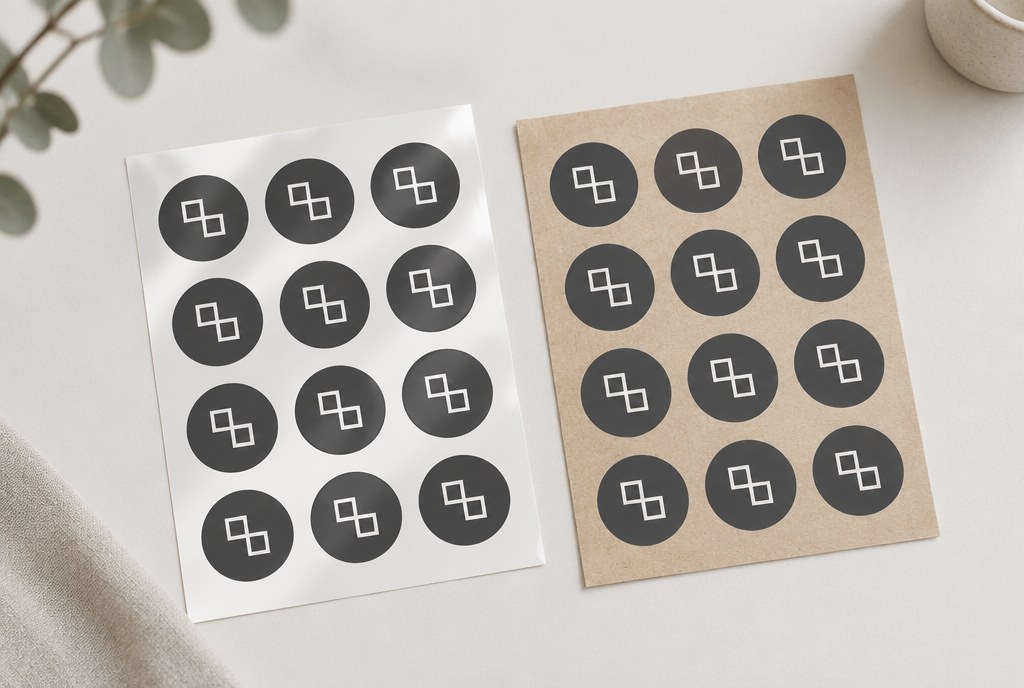
Vinyl stickers are made from a polymer adhesive film, withstand water, UV light and temperature changes, and last roughly 2–5 years outdoors, while paper stickers are designed for dry indoor environments and typically last from a few weeks up to a year. In terms of price, paper stickers in larger runs cost around 25–40% less — roughly from EUR 0.05/pc versus about EUR 0.07/pc for vinyl (1,000 pcs, small format, excl. VAT). In practice, the choice is simple: if the sticker will come into contact with moisture, sunlight or friction, go with vinyl; if it's for internal labelling or packaging design, paper is enough.
Key differences between the materials
A paper sticker is self-adhesive paper with acrylic glue. It takes colour well and comes in matte or semi-gloss finishes, but swells, deforms and washes off when it comes into contact with water. Paper can be torn by hand — a plus if the sticker is meant for single use, and a drawback if the product needs to look presentable for several months.
Vinyl film is flexible, elastic and waterproof. It conforms to slightly curved surfaces (bottles, containers, equipment housings), peels off in one piece without tearing, and after lamination also withstands cleaning agents. Standard monomeric vinyl lasts 2–3 years outdoors, while polymeric vinyl lasts 4–5 years.
Matte or gloss
Gloss film produces more saturated colours and works well for product labels. Matte film reflects less light, is easier to read for information and signage, and shows fewer fingerprints. We produce both options in rectangular formats as well as die-cut to the shape of your logo — find out more in our sticker printing section.
Comparison table
| Criterion | Paper sticker | Vinyl sticker |
|---|---|---|
| Indoor lifespan | 6–12 months | 3–5 years |
| Outdoor lifespan | not suitable | 2–5 years |
| Water resistance | none | complete |
| UV resistance | low, colours fade | good, high with lamination |
| Curved surfaces | difficult, wrinkles | fits well |
| Removal | tears in pieces | usually comes off in one piece |
| Approx. price for 1,000 pcs (50×50 mm) | from EUR 0.05/pc | from EUR 0.07/pc |
| Approx. price for 100 pcs (50×50 mm) | from EUR 0.12/pc | from EUR 0.18/pc |
Prices are excl. VAT and indicative — the final amount depends on the format, die-cutting, lamination and quantity.
When paper stickers are enough
- Packaging labels and ingredient labels for products sold within a few weeks.
- Logistics and warehouse labels, barcodes, box numbering.
- One-day event stickers: attendee badges, gift wrapping.
- In-store promotional price tags that change monthly.
- Bakery and confectionery packaging where the product is dry and consumed quickly.
If a sticker will be applied to a cardboard box and stay in a dry environment only, paper is the logical choice — at 2,000–5,000 pcs, the savings become noticeable.
When to go with vinyl
- Cosmetics, soap, shampoo and beverage bottles that come into contact with water.
- Outdoor signage, window stickers, opening-hours information on doors.
- Vehicle and trailer markings, sports equipment numbering.
- Factory and equipment labelling where surfaces are wiped regularly.
- Souvenir and brand stickers that customers stick on laptops and bottles.
- Fridge and freezer labels — vinyl adhesive also works in the cold.
For cafés and restaurants, we usually recommend vinyl with a matte laminate: a sticker on a jar or bottle will withstand washing, and the logo won't rub off within the first week.
Price and quantity impact
Material makes up a relatively small share of sticker costs — preparation, the cutting path and quantity have the biggest impact. That's why the difference between paper and vinyl is barely noticeable at 50 pieces, but at 5,000 pieces it can already add up to several dozen euros.
| Quantity (70×70 mm, die-cut) | Paper, EUR/pc | Vinyl, EUR/pc |
|---|---|---|
| 50 | from 0.35 | from 0.42 |
| 250 | from 0.16 | from 0.22 |
| 1000 | from 0.11 | from 0.15 |
| 5000 | from 0.09 | from 0.12 |
We also work with single pieces, for example if you need a sample for approval before a large run. Additional services — posters, banners, print — can be found in the services section.
Files and turnaround
Artwork should be sent as vector graphics (.ai, .eps or .pdf) in CMYK colour space, with a 2–3 mm bleed area and text converted to outlines. If you only have a photo or raster file, the minimum is 300 dpi at actual size. For die-cutting, add a separate cutting line.
Standard turnaround for stickers is 2–5 business days from artwork approval; for more complex jobs with lamination or especially large quantities, we confirm the timeline when preparing the quote. Urgent jobs are completed by agreement if the file is print-ready.
Frequently asked questions
Can a vinyl sticker be applied to a car?
Yes, standard monomeric vinyl lasts 2–3 years on flat car surfaces. For curved parts and longer use, we recommend polymeric film with lamination. The surface must be clean and dry, and the application temperature should be at least +10°C.
How long does a paper sticker last on a product in the fridge?
In cold, damp conditions, paper swells within a few days — condensation damages the edges. For fridge products, we always recommend vinyl, as its adhesive remains stable even at low temperatures.
What is the minimum order quantity?
There's no minimum — we also produce a single sticker or a small sample set. However, the price per piece drops sharply from 250–500 pcs onwards, so it's often more cost-effective to order a larger run straight away.
Can a sticker be cut to the shape of a logo?
Yes, die-cutting is available for both vinyl and paper. The cutting path must be on a separate layer in the artwork; very fine details under 2 mm wide get rounded off, and we'll let you know about this before printing.
Is lamination mandatory?
It's not mandatory, but we recommend it for outdoor and damp-environment stickers. Lamination increases the cost by roughly 10–20%, but protects the print from friction, cleaning agents and UV.
If you're unsure which material suits your product, send us your artwork and describe the environment it will be used in at info@attaprint.lv, call +371 25776699, or message us on WhatsApp — contacts here. We prepare quotes within one business day.
FAQ
Can a vinyl sticker be applied to a car?
Yes, standard monomeric vinyl lasts 2–3 years on flat car surfaces. For curved parts and longer use, we recommend polymeric film with lamination. The surface must be clean and dry, and the application temperature should be at least +10°C.
How long does a paper sticker last on a product in the fridge?
In cold, damp conditions, paper swells within a few days — condensation damages the edges. For fridge products, we always recommend vinyl, as its adhesive remains stable even at low temperatures.
What is the minimum order quantity?
There's no minimum — we also print a single sticker or a small sample set. The price per piece drops sharply from 250–500 pcs onwards, so it's often more cost-effective to order a larger run straight away.
Can a sticker be cut to the shape of a logo?
Yes, die-cutting is available for both vinyl and paper. The cutting path must be on a separate layer in the artwork; very fine details under 2 mm wide get rounded off, and we'll let you know about this before printing.
Is lamination mandatory?
It's not mandatory, but we recommend it for outdoor and damp-environment stickers. Lamination increases the cost by roughly 10–20%, but protects the print from friction, cleaning agents and UV.