Cosmetics Labels: PAO, Batch Number and Small Print Requirements
What must appear on a cosmetics label by law, how to fit the PAO symbol and batch number into a tiny area, which materials to choose, and how much printing costs.
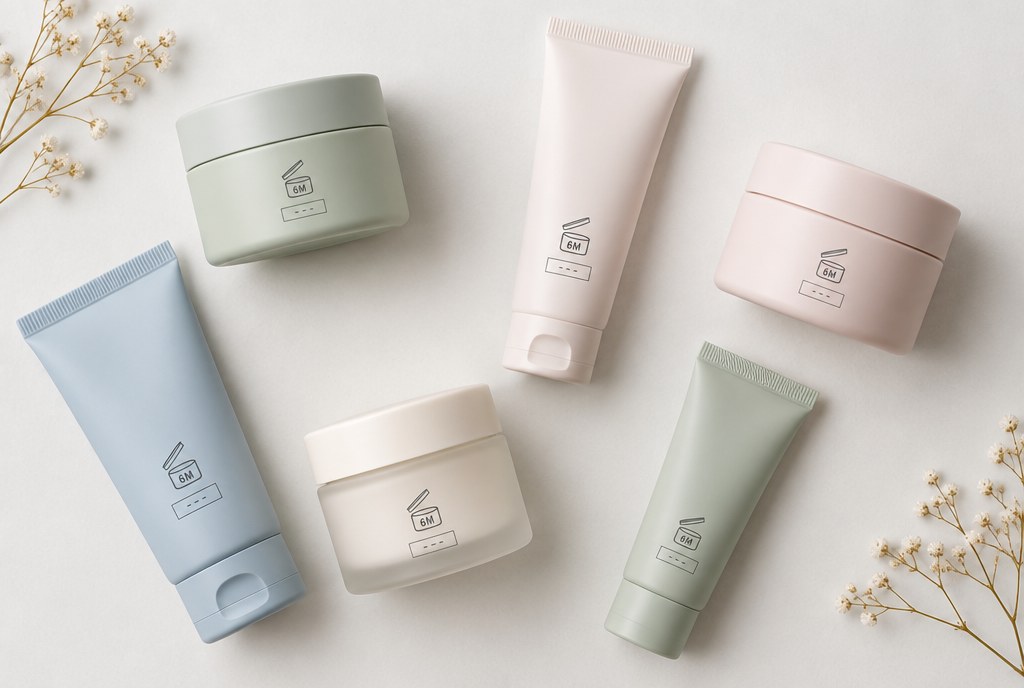
Cosmetics labels in the European Union are governed by Regulation (EC) No 1223/2009, and Article 19 lists nine mandatory elements: the name and address of the responsible person, country of origin (if manufactured outside the EU), nominal content, minimum durability date or PAO symbol, precautions for use, batch number, product function and the list of ingredients in INCI nomenclature. In practice, all of this has to fit on a 50×80 mm surface, or even smaller — which is why font size, contrast and material choice are critical. We print these labels on sheets and rolls with contour cutting; prices start from EUR 17.60/m² (excl. VAT), with a turnaround of 1–3 business days.
What must be on the packaging
The primary and secondary packaging (bottle and box) must include:
- Name and address of the responsible person within the EU — the address can be abbreviated, but it must remain identifiable.
- Country of origin for products imported from outside the EU ("Made in …").
- Nominal content at the time of packaging — weight or volume (g, ml). Not required below 5 g / 5 ml, for free samples and single-use doses.
- Minimum durability date (hourglass symbol or the words "Best used before end of") — if the product has a shelf life of up to 30 months. For longer shelf life, use the PAO symbol.
- Precautions for use and warnings.
- Batch number (LOT, batch, lot number).
- Product function, if not obvious from the name.
- List of ingredients headed "Ingredients", in INCI names, in descending order by weight; ingredients below 1% may appear in any order; fragrance allergens must be listed separately.
In Latvia, information on function, use, warnings and nominal content must also be provided in Latvian. The INCI list stays in its international nomenclature and is not translated.
The PAO symbol: what 6M and 12M mean
PAO (Period After Opening) is the open-jar symbol with a number — 3M, 6M, 12M, 24M — indicating how many months the product can be used after opening. It's used when the product's shelf life exceeds 30 months. PAO isn't required for products that can't physically be "opened" in the usual sense — aerosols, single-use doses, airless pump packaging.
For printing, always prepare the PAO symbol in vector format (.ai, .eps, .pdf, .svg), not as an image pulled from the internet. The recommended minimum symbol height is 5 mm — below that, the jar outline blurs together. The number must be at least as legible as the rest of the small print.
Batch number: printed, stamped, or left blank
The batch number is the only variable element on the label, and it's the one that causes the most headaches. Three practical solutions:
| Solution | When it works | What to consider |
|---|---|---|
| Batch number printed into each print run | Fixed batches, 200–2,000 pcs | Each batch = a new file, but no manual work |
| Blank field + stamp or thermal printer | Frequent production, changing batches | The field needs to be unlaminated or have a matte laminate so the ink holds |
| Number engraved/embossed on the bottle | Very small surfaces | Independent of the label, but requires equipment |
If you plan to stamp or print the batch yourself, let us know at the order stage — glossy lamination repels most stamp inks, so we'll prepare the field without a coating or with a matte finish.
Small print: how small can the font be
The regulation doesn't set a specific point size — the requirement is that text be "indelible, easily legible and visible". In practice, regulators' guidance and our own printing experience give these benchmarks:
- INCI list: no smaller than 5 pt, ideally 6 pt with 110% line spacing.
- Warnings and function: 6–7 pt.
- Nominal content: 7 pt and larger, so it's clearly visible from the front of the packaging.
- Line weight: no thinner than 0.25 pt; hairlines print as broken lines.
Technical rules for small print: text in 100% black (K) only, not a four-colour "rich black" — otherwise the slightest colour misregistration blurs the letters. Avoid light text on a dark background below 6 pt, and avoid thin (Light, Thin) typefaces. Convert text to outlines, keep a 2–3 mm safety margin from the cut edge, and a 2 mm bleed.
If there's genuinely not enough room
For small bottles (10–30 ml), use multi-layer solutions: a fold-out label with an extra leaflet, an attached card insert, or an outer box carrying the full information. In that case, the bottle itself carries the name, function, content, batch, PAO and the "hand on a book" symbol indicating additional information is provided elsewhere. A QR code is not a substitute for mandatory information — it can only be a supplement.
Materials and indicative prices
Cosmetics almost always need a moisture-resistant material: bathroom conditions, oily hands and solvents quickly damage unlaminated paper. Our standard options and prices (excl. VAT):
| Material / finish | Price | Suitable for |
|---|---|---|
| Paper sticker, standard print | EUR 17.60/m² | Outer boxes, dry cosmetics |
| Print + contour cutting + transfer film | EUR 24.00/m² | Shaped labels on jars |
| Laminated sticker (print + lamination) | EUR 24.00/m² | Shampoos, oils, creams — moisture resistance |
| Transparent film | EUR 48.00/m² | "No label look" on glass and gel |
| Brushed silver | EUR 64.00/m² | Premium ranges, decorative cosmetics |
| Mirror film | EUR 48.00/m² | Limited editions, accent labels |
Rough estimate: a 50×80 mm label is 0.004 m². 250 laminated labels, accounting for sheet usage, come to roughly 1.2 m² — indicatively from EUR 29 for the whole run. There's no setup fee; the exact price depends on size, shape, material and quantity. More on materials and formats in our stickers section; examples of completed work are in our portfolio.
Files and turnaround
Send a vector file (.ai, .eps, .pdf, .svg) in CMYK colour space; for raster images, use 300 dpi. Include a ready-made cutting contour, or specify the desired shape and corner radius. Before printing, we send the artwork for approval by email; for larger runs, we recommend printing one test sheet and applying it to the actual packaging — that's when you'll see whether a 5 pt INCI list is actually legible.
The standard turnaround for stickers is 1–3 business days after artwork approval. If you also need outer packaging inserts, instructions or product cards at the same time, we print them in the same batch so the colours match.
Frequently asked questions
Is the PAO symbol mandatory for all products?
No. PAO applies to products with a shelf life exceeding 30 months. If the product has a shorter shelf life, the label must show the minimum durability date instead. Aerosols, single-use doses and airless pump packaging don't require PAO.
How small can the font be for the INCI list?
The regulation doesn't specify a point size, but in practice 5 pt is the lower limit where text remains reliably legible. Below that, letter counters fill in with ink, especially on film. Always use 100% black text and a typeface with normal, not thin, weight.
What's the best way to handle batch numbers for small runs?
If you only have a few batches a year, it's simplest to print a separate file for each — there's no setup fee. If batches change frequently, we leave a blank, unlaminated field on the label, and you apply the number with a stamp or thermal printer.
Will labels hold up on a shampoo bottle in the shower?
A laminated PP film sticker (EUR 24.00/m²) withstands moisture and friction. Unlaminated paper isn't suitable for shower conditions. For products containing oils and alcohol, we recommend testing a sample on the actual packaging before the full run.
What's the minimum quantity?
We also work with small batches — pricing is based on area, so even 50 labels are possible. Larger runs use the sheet more efficiently, which lowers the price per piece.
How long does it take?
For stickers, 1–3 business days after artwork approval. Urgent jobs can be arranged by agreement.
Send us the label size, material and quantity to info@attaprint.lv, or call or message us on WhatsApp at +371 25776699 — we'll prepare a quote with price and turnaround within one business day. More contact options are available on our Contacts page.
FAQ
Is the PAO symbol mandatory for all products?
No. PAO applies to products with a shelf life exceeding 30 months. If the product has a shorter shelf life, the label must show the minimum durability date instead. Aerosols, single-use doses and airless pump packaging don't require PAO.
How small can the font be for the INCI list?
The regulation doesn't specify a point size, but in practice 5 pt is the lower limit where text remains reliably legible. Below that, letter counters fill in with ink, especially on film. Always use 100% black text and a typeface with normal, not thin, weight.
What's the best way to handle batch numbers for small runs?
If you only have a few batches a year, it's simplest to print a separate file for each — there's no setup fee. If batches change frequently, we leave a blank, unlaminated field on the label, and you apply the number with a stamp or thermal printer.
Will labels hold up on a shampoo bottle in the shower?
A laminated PP film sticker (EUR 24.00/m² excl. VAT) withstands moisture and friction. Unlaminated paper isn't suitable for shower conditions. For products containing oils and alcohol, we recommend testing a sample on the actual packaging before the full run.
What's the minimum quantity of labels?
We also work with small batches — pricing is based on area, so even 50 labels are possible. Larger runs use the sheet more efficiently, which lowers the price per piece.
How long does label printing take?
For stickers, 1–3 business days after artwork approval by email. Urgent jobs can be arranged by agreement.