Food Label Requirements: Ingredients, Allergens, Shelf Life
A practical guide for small food producers: what must be on a label by law, how to highlight allergens, font sizes, moisture-resistant materials, and prices from €17.60/m².
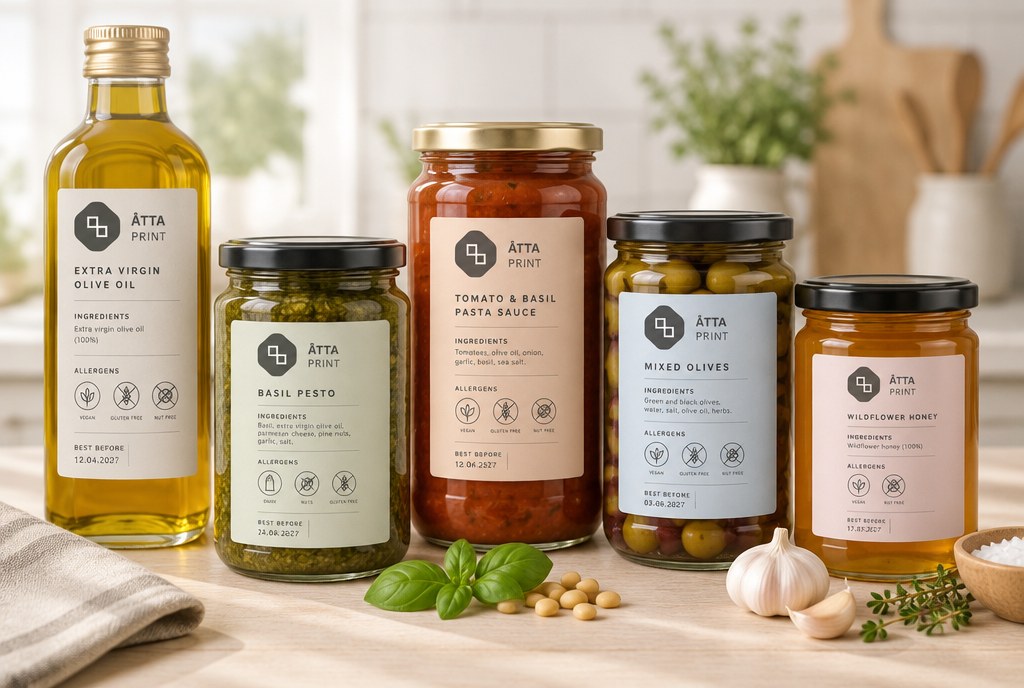
Food label requirements in Latvia are set by Regulation (EU) No 1169/2011: packaging must show, in Latvian, the product name, a list of ingredients with allergens highlighted, the net quantity, shelf life ("best before" or "use by"), storage conditions, the manufacturer's name and address, the batch number, and a nutrition declaration. The minimum x-height for text is 1.2 mm, or 0.9 mm for packaging whose largest surface is smaller than 80 cm². In practice this means the label needs to be reasonably large: experience shows that a full text with a nutrition table needs at least a 50×70 mm area.
What must be on the label
For a small producer — a farm making jams, honey, cheese, smoked goods or frozen vegetables — the mandatory information is the same; only the details change depending on the product:
- Name — one that describes the product, not just a brand name (e.g. "Strawberry jam", not just "Grandma's Delight").
- List of ingredients in descending order by weight, with percentages for ingredients mentioned in the name or shown in an image.
- Allergens — highlighted within the list of ingredients.
- Net quantity in grams, kilograms, millilitres or litres; for products packed in liquid, also the drained weight.
- Shelf life and storage/usage conditions ("Store at 0…+6 °C", "After opening, keep refrigerated and use within 5 days").
- Name and address of the manufacturer or packer within the European Union.
- Batch number (can also be stamped separately, e.g. a date stamp).
- Nutrition declaration per 100 g or 100 ml — energy value, fat, of which saturates, carbohydrate, of which sugars, protein, salt. Some products (unprocessed foods, herbs, teas, small quantities sold directly to consumers) are exempt.
- Country of origin, if required by sector-specific rules or if its absence could mislead the buyer.
Certain product groups have additional requirements: alcoholic beverages above 1.2% ABV must state the alcohol content, frozen products may need a freezing date if required by sector regulation. The manufacturer is responsible for the accuracy of the content; as a print shop, we print what is in the approved artwork file and only check technical quality — font size, colours and cutting margins.
Allergens: 14 groups and how to highlight them
The regulation defines 14 allergen groups that must be declared: cereals containing gluten, crustaceans, eggs, fish, peanuts, soybeans, milk, nuts, celery, mustard, sesame seeds, sulphites (above 10 mg/kg), lupin and molluscs.
Allergens must be highlighted within the ingredients list using a typeface that clearly distinguishes them from the rest of the text — most often bold, less often capitals or a background colour. A separate line such as "Contains: milk, mustard" without highlighting in the ingredients list does not meet the requirement.
Two common mistakes we see in artwork files in practice: the bold is "lost" because the font is too small (the highlight is no longer noticeable), and an allergen is highlighted in one place but forgotten in another ingredient — for example, "wheat" is highlighted, but "semolina" is not.
Shelf life and batch number
For highly perishable products (fresh meat, fish, short-life cheese products), use "Use by" with the day and month; for others — "Best before". Format: up to 3 months — day and month; up to 18 months — month and year; over 18 months — year alone is enough.
If the date is printed on the label itself, this means small batches and more frequent print runs. It's more convenient to leave a blank or unprinted area in the artwork where the date and batch number are stamped on with a date stamp or marker — then one print run of labels can be used for a whole season. On laminated or glossy PP film, ink from an ordinary stamp smears, so we leave this area unlaminated or choose a matte material.
Material: what withstands moisture, cold and fat
Material choice is where small producers lose the most money — a paper label on a jar that sits in the fridge or gets wiped down is soaked through within a week.
| Environment | Suitable material | Comment |
|---|---|---|
| Dry storage (honey, tea, biscuits) | Self-adhesive paper | Cheapest option, takes a stamp well |
| Fridge, condensation (cheese, meat, salads) | White PP film | Doesn't get soggy, adhesive holds on a cool package |
| Freezer −18 °C | PP film with cold-resistant adhesive | Apply before freezing, on a dry surface |
| Greasy, wipeable packaging | PP film + laminate | Laminate protects the print from scratches and oil |
| Glass jars with a "glass" look | Transparent film | Product stays visible; white text is printed with a white base layer |
For small jars and irregular shapes, a die-cut sticker works well — round, oval or with rounded corners. In practice, rounded corners last longer: a sharp corner is the first to start peeling.
Prices and quantities
Stickers are priced by the area of material used (excl. VAT). Indicative examples, assuming a ~3 mm gap between labels:
| Service | Price per m² |
|---|---|
| Stickers, standard printing without cutting (sheets) | €17.60 |
| Stickers with printing, contour cutting and transfer film | €24.00 |
| Laminated stickers (printing + laminate) | €24.00 |
| Transparent stickers | €48.00 |
| Setup fee | €0.00 |
Specific calculations:
| Label | Quantity | Approx. area | Approx. price |
|---|---|---|---|
| 40×30 mm | 500 pcs | ~0.7 m² | from €13 |
| 60×40 mm | 1000 pcs | ~2.6 m² | from €46 (laminated ~€63) |
| 80×50 mm | 1000 pcs | ~4.3 m² | from €76 (laminated ~€104) |
| 100×70 mm | 500 pcs | ~3.8 m² | from €67 (laminated ~€91) |
Prices are indicative and depend on the material, shape, cutting and how efficiently the labels fit on the sheet. It's often more cost-effective to print labels for two products in one order — the material is used more efficiently. Delivery with a partner courier in Riga costs €16.00 per trip.
Artwork file and turnaround times
We need the artwork in vector format (.ai, .eps, .pdf, .svg), CMYK, with a 2 mm bleed and text no closer than 2 mm from the cut line. Small text — ingredients and nutrition information — should be printed in 100% black (K), not four colours, otherwise it looks blurred. Before printing, we send the artwork with dimensions and cutting outline by email for approval.
Making the stickers takes 1–3 business days after artwork approval; urgent jobs are handled by arrangement. If the label is being designed from scratch, we recommend first printing a single test sheet and applying it to the actual packaging — on a flat sheet of paper, the area looks different than on a 200 ml jar. Examples of previous work can be viewed in the our work section.
Frequently asked questions
Does the label have to be in Latvian?
Yes, mandatory information for food sold in Latvia must be stated in Latvian. Other languages can be added as well, as long as the Latvian text is at least as legible — for export, we often print bilingual or trilingual labels, or a separate additional label with a translation.
How big does the text need to be?
For mandatory information, the x-height (the height of the lowercase letter "x") must be at least 1.2 mm. If the largest surface of the packaging is smaller than 80 cm², 0.9 mm is allowed. In practice, this corresponds to roughly a 6–7 pt font, depending on the typeface.
How should allergens be highlighted correctly?
The allergen must be highlighted within the ingredients list itself — in bold, capitals or a background colour, applied consistently in every instance. A separate line such as "Contains…" without highlighting in the list does not satisfy the requirement.
What material is suitable for frozen products?
PP film with cold-resistant adhesive. The label must be applied to dry packaging before freezing — adhesive won't stick to a frosted or damp package regardless of the material.
How much do 1000 labels at 60×40 mm cost?
Indicatively from €46 excl. VAT for paper or PP labels in sheets, and roughly €63 for laminated ones, depending on the material and cutting method. We calculate the exact price based on the specific size and shape.
Can you print the shelf life on each label?
We can, but then each batch needs a separate print run. More often, we leave a blank area in the artwork where the date and batch number are stamped on — we choose a material without lamination for this area.
Send us your ingredient list text, packaging size and planned quantity to info@attaprint.lv, call +371 25776699, or write to the same number on WhatsApp — we'll prepare a quote with a material recommendation and timeline within one business day. Contact details and opening hours: attaprint.lv/kontakti.
FAQ
Does the label have to be in Latvian?
Yes, mandatory information for food sold in Latvia must be stated in Latvian. Other languages can be added as well, as long as the Latvian text is at least as legible — for export, we often print bilingual or trilingual labels, or a separate additional label with a translation.
How big does the text need to be?
For mandatory information, the x-height (the height of the lowercase letter "x") must be at least 1.2 mm. If the largest surface of the packaging is smaller than 80 cm², 0.9 mm is allowed. In practice, this corresponds to roughly a 6–7 pt font, depending on the typeface.
How should allergens be highlighted correctly?
The allergen must be highlighted within the ingredients list itself — in bold, capitals or a background colour, applied consistently in every instance. A separate line such as "Contains…" without highlighting in the list does not satisfy the requirement.
What material is suitable for frozen products?
PP film with cold-resistant adhesive. The label must be applied to dry packaging before freezing — adhesive won't stick to a frosted or damp package regardless of the material.
How much do 1000 labels at 60×40 mm cost?
Indicatively from €46 excl. VAT for paper or PP labels in sheets, and roughly €63 for laminated ones, depending on the material and cutting method. We calculate the exact price based on the specific size and shape.
Can you print the shelf life on each label?
We can, but then each batch needs a separate print run. More often, we leave a blank area in the artwork where the date and batch number are stamped on — we choose a material without lamination for this area.