Ingredient labels for products: what to include and how to lay them out
A manufacturer's guide: what information must appear on an ingredient label, which font size and material to choose, prices from EUR 17.60/m² and a 1–3 business day turnaround.
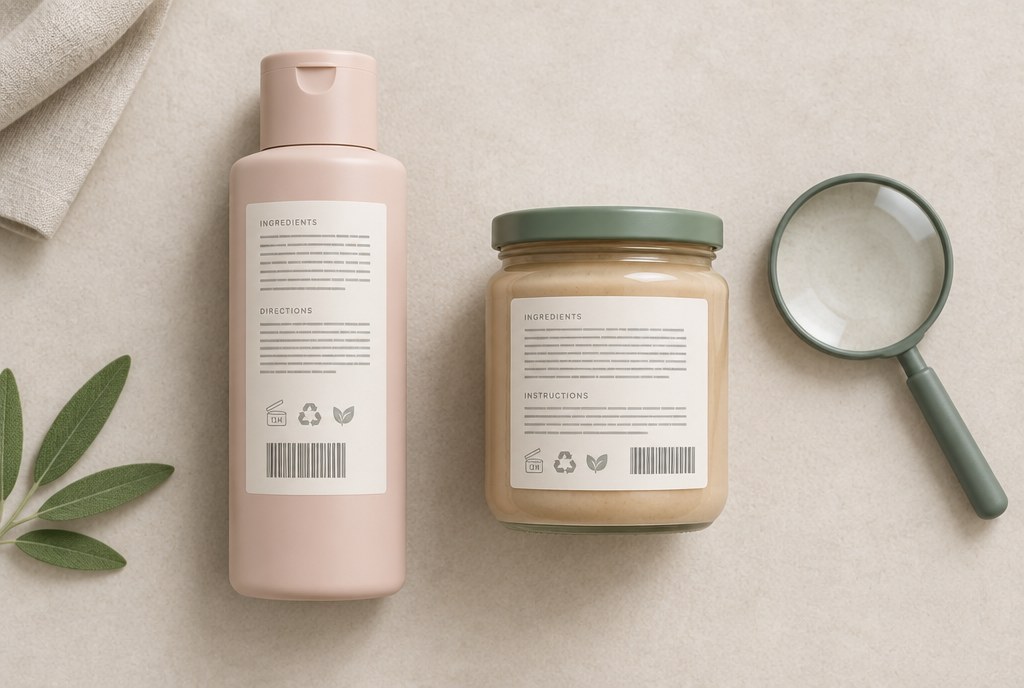
Ingredient labels on a product must include the product name, ingredients (in descending order by weight), net quantity, the manufacturer's or distributor's name and EU address, batch number and instructions for use — and on the Latvian market, all of this must be in Latvian. For food products, the x-height of the text may not be smaller than 1.2 mm (0.9 mm if the largest surface area is less than 80 cm²). We print these labels in sheets or rolls from EUR 17.60/m² (laminated EUR 24.00/m²), with a turnaround of 1–3 business days.
What information must be on the label
The required content differs by product type, but the basic block is mostly the same: what it is, what it's made of, how much there is, who made it, when to use it by, how to use it. In practice, the batch number and the manufacturer's address with country are most often forgotten, and too little space is left for translation — Latvian text is usually 10–20% longer than English.
| Product type | What must be stated |
|---|---|
| Food | Name, ingredient list with allergens highlighted, net weight, best-before/expiry date, storage conditions, manufacturer/distributor, country of origin, nutritional value per 100 g/ml, batch |
| Cosmetics | Function, INCI ingredients, nominal content, PAO symbol or minimum shelf life, warnings, batch code, responsible person in the EU |
| Textiles | Fibre composition in percentages, care symbols, size, manufacturer, country of origin |
| Chemicals, cleaning products | CLP pictograms, signal word, hazard and precautionary statements, ingredient groups, volume, manufacturer, batch |
| Technical products | Model, technical parameters, instructions for use and safety, CE mark (if applicable), manufacturer, serial number |
| Supplementary label for imported goods | Latvian translation, local distributor's details, barcode if the original doesn't have one |
How to lay out the information on the label
A simple principle applies: one label — three zones. Name and brand at the top, ingredients and instructions in a smaller size in the middle, technical data at the bottom (batch, expiry date, barcode, manufacturer, symbols).
- Safety margin. Leave at least 3 mm from the edge to the text, 4 mm for rounded corners. Contour cutting allows a tolerance of ±0.5 mm.
- Font size. Don't use less than 6 pt for ingredients (x-height 1.2 mm). Condensed fonts with thin strokes blur together on small labels — a regular sans-serif with 110–120% line spacing is better.
- Contrast. Black text on a white background, or at least a 70% contrast difference. Grey 40% text on a coloured background at 6 pt is no longer legible.
- Barcode. Minimum width 25 mm, with a 2 mm white margin around it; don't print on metallised or transparent film without a white underlay.
- Symbols. Place recycling, PAO, CE and CLP pictograms in one row at the bottom; CLP pictogram edges must be at least 10 mm for packaging up to 3 L.
When you need two labels
If the original design is already printed on the packaging, it's often more cost-effective to print a separate translation label with the ingredients and distributor details and apply it next to or over the foreign-language text. This is the most affordable approach for importers: one small white label measuring 60×40 mm costs just a few cents per piece, and the design can be changed for each batch.
Material: which one to choose
The material should be chosen based on where the product will be kept and how it's handled. A paper label on a jar stored in the fridge starts peeling off after two days.
| Material | Suitable for | Price (excl. VAT) |
|---|---|---|
| Paper, standard print | Dry environment, cardboard boxes, translation labels | EUR 17.60/m² |
| PP film with laminate | Food, cosmetics, moisture, friction | EUR 24.00/m² |
| Printing + contour cutting | Non-standard shape, round and oval labels | EUR 24.00/m² |
| Easy removable | Labels that need to come off without residue (displays, packaging) | EUR 28.80/m² |
| Transparent film | "No label look" on glass and transparent bottles | EUR 48.00/m² |
| Silver brushed / mirror film | Technical data, serial numbers, nameplates | EUR 48.00–64.00/m² |
There's no setup fee for labels. The price is based on the printed area, so small labels cost little per piece: one square metre of laminated film fits around 350–400 labels of 60×40 mm, which works out to roughly EUR 0.06–0.07 per piece. The exact price depends on size, shape, material and quantity — the price per piece drops for larger volumes. See more options in our stickers section.
Sheets or rolls
Sheets (A4, A3) are convenient for small batches and manual application — they can be contour-cut and left on the carrier film. Rolls are needed if the labels are applied with an applicator or semi-automatic machine: in that case you need to know the roll core diameter, the order of the labels on the roll, and the gap between them. Specify these parameters in your request right away to avoid having to reprint.
Files and turnaround
- Format: vector graphics .ai, .eps, .pdf or .svg; raster images at least 300 dpi.
- Colours: CMYK. If a specific brand colour matters on the film, specify a Pantone reference.
- Bleed: 2–3 mm along the edges, text 3 mm from the cut line.
- Text converted to outlines, contour-cutting line on a separate layer.
- Turnaround: 1–3 business days after artwork approval. Rush jobs by agreement.
If you don't have artwork, we can put together the layout of the ingredients and instructions ourselves based on your text in a Word or Excel file — please also include the product dimensions and a photo of the packaging. You can view previous work in our portfolio section.
Frequently asked questions
Must the ingredients be in Latvian?
Yes. For products sold on the Latvian market, the mandatory information must be in the national language. Other languages can appear alongside it, as long as the Latvian text isn't smaller or less legible. That's exactly why importers often order separate translation labels.
How small can a label be while keeping the text legible?
In practice, a full ingredient list with allergens and a nutritional table realistically fits on a label starting at around 50×70 mm. For smaller sizes, you either need to reduce the amount of text or use a two-layer (fold-out) label. Printing below 6 pt doesn't make sense.
Can white be printed on transparent film?
Yes, we print with a white base layer so the text and barcode are visible against glass or transparent packaging. Transparent labels start from EUR 48.00/m² excl. VAT.
How long does it take to prepare a small batch of ingredient labels?
Usually 1–3 business days from artwork approval. Delivery via a partner courier in Riga costs EUR 16.00 per trip, or you can collect the labels at Kandavas iela 29A.
Can you cut labels into a non-standard shape?
Yes, contour cutting is included in the EUR 24.00/m² price (printing + cutting + carrier film). We need a cutting line in the artwork, or at least a precise shape sketch.
Will the label withstand a fridge and moisture?
PP film with laminate withstands condensation, refrigeration and light friction. For deep freezing or dishwashers, a special adhesive is needed — let us know the usage conditions and we'll find the right material.
Send us the product dimensions, text and preferred material at info@attaprint.lv, call +371 25776699, or message us on WhatsApp at the same number — we'll prepare a quote with the price and turnaround within one business day. Contact details are also available on our Contacts page.
FAQ
Must the ingredients be in Latvian?
Yes. For products sold on the Latvian market, the mandatory information must be in the national language. Other languages can appear alongside it, as long as the Latvian text isn't smaller or less legible. That's why importers often order separate translation labels.
How small can a label be while keeping the text legible?
A full ingredient list with allergens and a nutritional table realistically fits on a label starting at around 50×70 mm. For smaller sizes, you need to reduce the amount of text or use a fold-out label. Printing below 6 pt (x-height 1.2 mm) doesn't make sense.
Can white be printed on transparent film?
Yes, we print with a white base layer so the text and barcode are visible against glass or transparent packaging. Transparent labels start from EUR 48.00/m² excl. VAT.
How long does it take to prepare a small batch of ingredient labels?
Usually 1–3 business days from artwork approval. Delivery via a partner courier in Riga costs EUR 16.00 per trip, or you can collect the labels at Kandavas iela 29A.
Can you cut labels into a non-standard shape?
Yes, contour cutting is included in the EUR 24.00/m² price (printing + cutting + carrier film). We need a cutting line in the artwork, or a precise shape sketch.
Will the label withstand a fridge and moisture?
PP film with laminate withstands condensation, refrigeration and light friction. For deep freezing or dishwashers, a special adhesive is needed — let us know the usage conditions and we'll find the right material.