Translation Labels for Imported Products: Labelling in Latvian
How to relabel imported products with Latvian-language information: requirements, material choice, sizes and prices from EUR 17.60/m² excl. VAT.
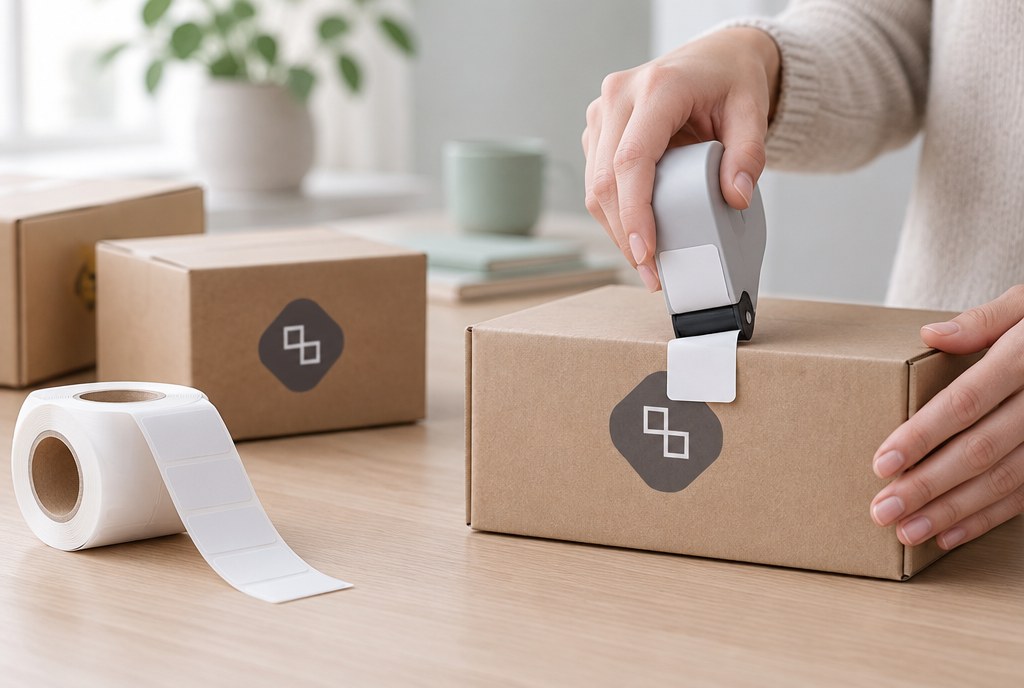
Translation labels are the most practical way to add mandatory Latvian-language information to an imported product without changing the original packaging: we print them from EUR 17.60/m² (excl. VAT), in sheets or rolls, with production in 1–3 business days. For food products, the x-height of letters must not be less than 1.2 mm (if the largest surface of the packaging is smaller than 80 cm², 0.9 mm is acceptable), so label sizes typically range from 40×25 mm up to A5. There are no set-up fees — you only pay for the printed area.
What information must be given in Latvian
Products intended for consumers in Latvia must provide product information in the state language. In practice, this means the translation label must repeat everything that appears only in a foreign language on the original packaging:
- product name and type;
- ingredients and allergens (for food — highlighted, e.g. in bold);
- net quantity, nutritional value, best-before date and storage conditions;
- instructions for use and warnings;
- name and address of the manufacturer and importer/distributor;
- for chemicals — the signal word, hazard (H) and precautionary (P) statements in Latvian, if the original is in another language.
Important condition: the translation label must not cover mandatory original markings — batch number, best-before date, CE mark, barcode and manufacturer details. That's why it's advisable to photograph the packaging from all sides and measure the free area before preparing the artwork.
How to choose the label material
The material should be chosen based on the packaging surface and the environment the product is stored in:
- Paper — the cheapest solution for cardboard boxes, dry warehouse and shop environments.
- White PP film — for plastic bottles, jars, cosmetics; resistant to moisture and friction.
- Laminated label — for freezers, cold storage, oil and cleaning product packaging; the laminate protects the print from scratches.
- Transparent film — when you want to keep the original design and only overlay the text.
- Easy removable — when the label needs to be removable without leaving adhesive residue, for example on products with gift packaging.
If labels need to be applied by hand in large volumes, order them in rolls with perforation — this speeds up the work roughly twice compared to peeling from a sheet. You can view all options in the sticker printing section.
Prices: materials and area
The price is based on the printed area per square metre of film or paper, not per piece, so for small labels the per-piece cost is a matter of a few cents. Prices are excl. VAT and indicative — the exact amount depends on total area, material and cutting method.
| Option | Price EUR/m² | Best for |
|---|---|---|
| Standard print (no contour cutting) | 17.60 | rectangular ingredient and instruction labels |
| Laminated (print + laminate) | 24.00 | humid environments, freezers, chemicals |
| Print + contour cutting + transfer film | 24.00 | non-standard shapes, round labels |
| Easy removable | 28.80 | removable without adhesive residue |
| Transparent labels | 48.00 | to keep the original design visible |
To help with budget planning — how many labels you get from one square metre and the approximate per-piece price:
| Label size | Approx. pcs/m² | Standard print | Laminated |
|---|---|---|---|
| 40×25 mm | ~900 | ~EUR 0.02/pc | ~EUR 0.03/pc |
| 60×40 mm | ~380 | ~EUR 0.05/pc | ~EUR 0.06/pc |
| 100×70 mm | ~130 | ~EUR 0.14/pc | ~EUR 0.18/pc |
| 105×148 mm (A6) | ~60 | ~EUR 0.30/pc | ~EUR 0.40/pc |
For a small order, expect a minimum volume of around 1 m² — meaning 500 labels at 60×40 mm cost around EUR 25, while 200 labels of the same size will realistically cost similarly, since the same sheet is printed and cut. If you need several different texts (several product items), it's more cost-effective to combine them in one print file.
How to prepare the file and text
A translation label is a text-focused job, so readability matters more than design:
- vector file (.ai, .eps, .pdf, .svg), CMYK; 300 dpi for raster elements;
- minimum letter x-height of 1.2 mm for food (0.9 mm for small packaging), though we recommend 1.5–2 mm in practice;
- 2 mm safety margin from the label edge so text isn't cut off;
- black text on a white background — 100% K, not four-colour black, so letters stay sharp;
- if there's a lot of text, it's better to enlarge the label than shrink the font; a 60 mm width fits approximately 250–350 characters at 1.5 mm height.
If you don't have artwork ready, send us a Word or Excel file with the translated text and a photo of the packaging — we'll prepare the layout and send it as a PDF for approval. You can see examples of our work in our portfolio.
Timelines and process
Production after artwork approval takes 1–3 business days. We send a quote with price, material and deadline within one business day of receiving your request.
Typical sequence: request with text and packaging dimensions → quote → PDF artwork → approval by email → printing and cutting → pickup at Kandavas iela 29A or delivery. Courier delivery in Riga via our partner costs EUR 16.00 per trip. If you regularly import new batches, it's more cost-effective to combine all items into one file and print once a month — this reduces the overall area cost and waste.
Frequently asked questions
Can a translation label cover the original markings?
It must not cover mandatory information already on the packaging — batch number, best-before date, net quantity, barcode, CE mark and manufacturer details. You may only overlay the part whose information the label fully repeats in Latvian, or apply it to a free area.
How much do 1000 labels with ingredients at 60×40 mm cost?
That's approximately 2.6 m² with spacing, so around EUR 46 excl. VAT for standard print or around EUR 63 for the laminated version. We confirm the exact price based on size and material.
Will the label stay on frozen product packaging?
For cold and condensation, we use PP film with laminate — EUR 24.00/m². The label must be applied to a dry surface at room temperature, as adhesive doesn't bond well to frosted packaging.
Can you apply the labels for us?
We apply larger volumes ourselves by arrangement; this work is calculated separately depending on label size and packaging shape. For smaller volumes, it's usually more cost-effective to apply them at your own warehouse.
Do you produce labels with variable data — batch numbers and barcodes?
Yes, digital printing allows printing different data within one file, including barcodes and QR codes. Data must be submitted in an Excel table; the recommended minimum barcode width is 25 mm to ensure reliable scanning.
Can I order labels in rolls?
Yes. Perforated rolls are more convenient for large-volume application; when ordering, specify the number of labels per roll and the preferred winding direction.
Send the translated text and packaging photo to info@attaprint.lv, call us, or message us on WhatsApp at +371 25776699 — we'll prepare a quote with material, size and timeline within one business day. See other contacts and business hours on the Contacts page.
FAQ
Can a translation label cover the original markings?
It must not cover mandatory information already on the packaging — batch number, best-before date, net quantity, barcode, CE mark and manufacturer details. You may only overlay the part whose information the label fully repeats in Latvian, or apply it to a free area.
How much do 1000 labels with ingredients at 60×40 mm cost?
That's approximately 2.6 m² with spacing, so around EUR 46 excl. VAT for standard print or around EUR 63 for the laminated version. We confirm the exact price based on size and material.
Will the label stay on frozen product packaging?
For cold and condensation, we use PP film with laminate — EUR 24.00/m². The label must be applied to a dry surface at room temperature, as adhesive doesn't bond well to frosted packaging.
Can you apply the labels for us?
We apply larger volumes ourselves by arrangement; this work is calculated separately depending on label size and packaging shape. For smaller volumes, it's usually more cost-effective to apply them at your own warehouse.
Do you produce labels with variable data — batch numbers and barcodes?
Yes, digital printing allows printing different data within one file, including barcodes and QR codes. Data must be submitted in an Excel table; the recommended minimum barcode width is 25 mm to ensure reliable scanning.
Can I order labels in rolls?
Yes. Perforated rolls are more convenient for large-volume application; when ordering, specify the number of labels per roll and the preferred winding direction.